Download
1 / 13
150 likes | 253 Vues
World War I, a catastrophic conflict from 1914 to 1918, was influenced by four key causes encapsulated in the acronym M.A.I.N.: Militarism, Alliances, Imperialism, and Nationalism. Militarism fostered a race for military superiority, while a tangled web of alliances drew multiple powers into the fray. Imperial ambitions further ignited tensions, as industrialized nations sought dominance over weaker countries. Lastly, burgeoning nationalism stirred pride and conflict among nations. The assassination of Archduke Franz Ferdinand acted as the spark that ignited this complex interplay of causes, plunging Europe into war.

E N D
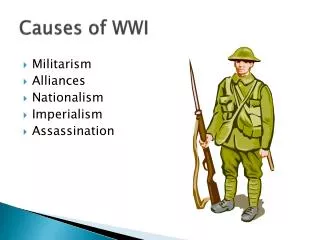
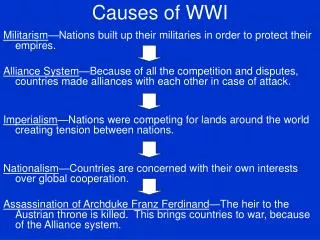
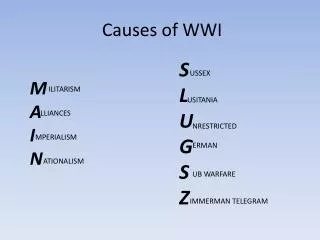
M.A.I.N. • Militarism • Alliances • Imperialism • Nationalism
Militarism • Definition: Armed Strength = Glory! • Leaders believed that a country got what it wanted through military strength. • Large standing armies of drafted men • Arms Race • If one country mobilized (got its troops ready for combat), other countries would do the same for their own protection
Alliances • Definition: Agreements by countries that pledge to support each other. • During the 1800s, the unifications of Germany and Italy (from other empires and city-states) gave them more power than the rest of Europe’s countries.
Alliance System in Europe • The Creation of Germany • TripleAlliance - Austria-Hungary, Germany, and the Ottoman Empire
Alliance System in Europe Militarism: The Naval Race • 1898-Germans begin to build navy and challenge Great Britain’s dominance • Tensions begin to build – Britain, France, and Russia enter “entente cordiale” aka Triple Entente WWI battleship
Imperialism • Definition: The domination of a stronger country over a weaker country in every aspect: socially, economically and politically. • Industrialization forced countries to need other markets to supply raw materials and to buy their goods.
Nationalism • Definition: A sense of pride and loyalty to one’s “nation” (sometimes the same as one’s country but not always). • Can be a problem when one government rules over many nationalities. • Germany wanted their “place in the sun” • Pan-Slavism: the movement to unite different Slavic people under one government
“The Spark” • Serbian nationalist group, “The Black Hand” was trained and stocked by Serbian gov’t • Assassinate Archduke Franz Ferdinand (heir to Austria Hungary throne) and his wife while on a trip to Bosnia • Serbian gov’t denies involvement • Austria Hungary issues a list of demands that Serbia refuses to agree to and declares war
Falling Dominos: • On July 28th, Austria declared war on Serbia. • Russia moves troops to protect Serbia along the Austria Hungary and German border • Germany declares war on Russia and France • Germany enters Belgium to attack France – Britain is Belgium’s ally and therefore declares war on Germany
Allied and Central Powers Triple Alliance Triple Entente Allies -France, Russia, and Great Britain -Italy joins in 1915 Central Powers -Germany, Austria- Hungary, Ottoman Empire, Bulgaria