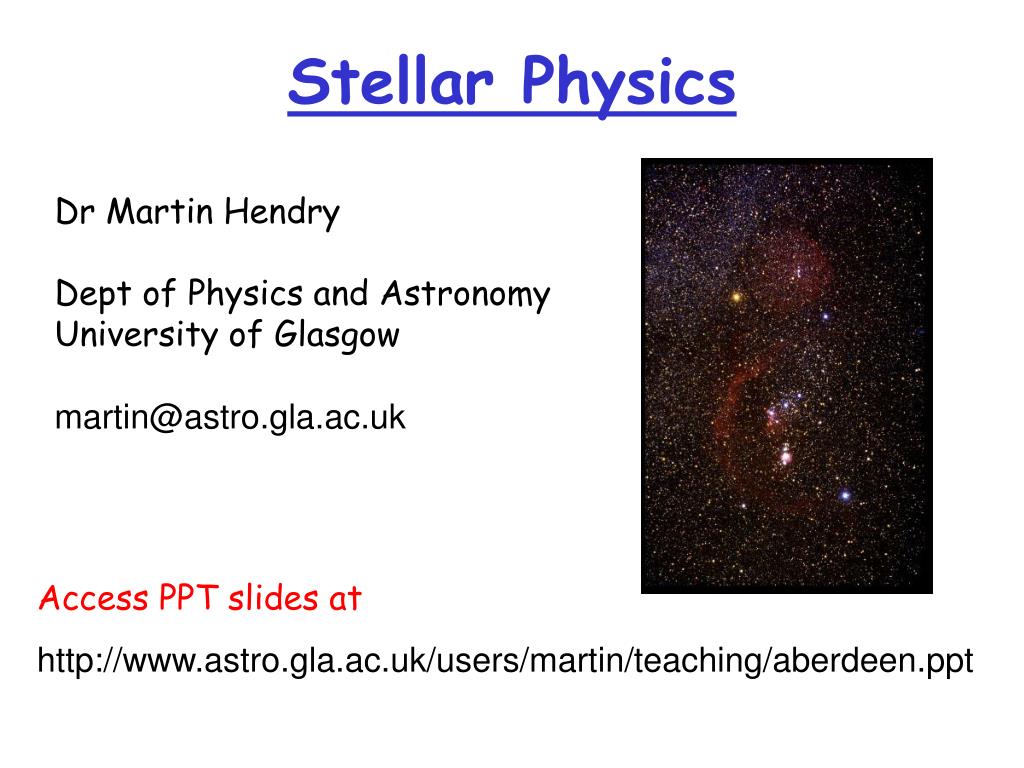
Stellar Physics. Dr Martin Hendry Dept of Physics and Astronomy University of Glasgow martin@astro.gla.ac.uk. 10 lectures, exploring the development of cosmology, and some of the key ideas of Big Bang theory. Access PPT slides at http://www.astro.gla.ac.uk/users/martin/teaching/aberdeen.ppt.
Une image / un lien ci-dessous est fourni (tel quel) pour télécharger la présentation
Politique de téléchargement : le contenu du site vous est fourni TEL QUEL pour votre information et votre usage personnel ; il ne peut être vendu, concédé sous licence ni partagé sur d’autres sites sans l’accord de son auteur.Le contenu vous est fourni TEL QUEL, pour votre information et votre usage personnel uniquement.Téléchargez la présentation en cliquant sur ce lien.Lors du téléchargement, si vous ne parvenez pas à télécharger une présentation, l’éditeur a peut-être supprimé le fichier de son serveur.Pendant le téléchargement, si vous ne parvenez pas à obtenir une présentation, le fichier a peut-être été supprimé par l’éditeur.
F I N
Plus de contenu associé
Transcription de la présentation
Stellar Physics Dr Martin Hendry Dept of Physics and Astronomy University of Glasgow martin@astro.gla.ac.uk 10 lectures, exploring the development of cosmology, and some of the key ideas of Big Bang theory Access PPT slides at http://www.astro.gla.ac.uk/users/martin/teaching/aberdeen.ppt
Surface temperature (K) 25000 10000 8000 6000 5000 4000 3000 106 -10 100 RS 1000 RS We can plot the temperature and luminosity of stars on a diagram Stars don’t appear everywhere: they group together, and most are found on the Main Sequence 10 RS Supergiants 104 -5 1 RS 102 Giants 0 0.1 RS Luminosity (Sun=1) Absolute Magnitude Main Sequence 1 +5 0.01 RS 10-2 +10 0.001 RS White dwarfs 10-4 +15 O5 B0 A0 F0 G0 K0 M0 M8 Spectral Type
Surface temperature (K) 25000 10000 8000 6000 5000 4000 3000 . . . 106 . -10 . Deneb . . . . Stars on the Main Sequenceturn hydrogen into helium. Blue stars are much hotter than the Sun, and use up their hydrogen in a few million years Rigel . . . . Betelgeuse . . . . . Antares 104 . -5 . . . . . . . . . . . . . Arcturus . . . Aldebaran . . . . . . . . . . . . Regulus . . . . . . . 102 Vega . . . . . 0 . . . Mira Sirius A . . . . . . Pollux . Procyon A . . . . Luminosity (Sun=1) . . Altair Sun Absolute Magnitude 1 . . . +5 . . . . . . . . . . . . . . . 10-2 . +10 . . . . . . . . . . . . . . . . Barnard’s Star . . . . Sirius B . . . . 10-4 . +15 . . Procyon B . . . . O5 B0 A0 F0 G0 K0 M0 M8 Spectral Type
Type Ia Supernova White dwarf star with a massive binary companion. Accretion pushes white dwarf over the Chandrasekhar limit, causing thermonuclear disruption Good standard candle because:- Narrow range of luminosities at peak brightness; Observable to very large distances
Will the Universe continue to expand forever? To find out we need to compare the expansion rate now with the expansion rate in the distant past… Is the Universe speeding up or slowing down?
For how long might we expect such an X-ray binary source to shine?... Suppose we could completely annihilate a source of, say, So if we want a source lifetime of, say, we would need to extract around 10% of the source’s rest mass energy (same efficiency would give longer lifetime for a less luminous source) Is this realistic? Energy source believed to be gravitational infall (accretion) of matter onto a neutron star from a binary companion. Energy yield / unit mass
Matter falls in via an accretion disk. Some orbital angular momentum is lost by viscous friction. XRB luminosity comes from disk as well as the central source.
Accretion Luminosity and the Eddington Limit If matter accretes at rate then we expect, at radius But if is large, the accretion process becomes self-limiting, because the emitted luminosity exerts a significant radiation pressure force on the infalling material. Consider a proton of mass at radius Radiation force Thomson cross-section
Pulsars Observe: High spin rate High B field Electron acceleration
Binary neutron stars Very strong gravity provides a test of GR. Advance of periastron, Production of GWs Source of GRB’s?
Gravity in Einstein’s Universe Gravity and acceleration are completely equivalent: both cause spacetime to become curved or ‘warped’ Gravity is not a force propagating through space and time, but the result of mass (and energy) warping spacetime itself
Gravity in Einstein’s Universe v Differences between Newtonian and Einsteinian gravity are tiny, but can be detected in the Solar System – and Einstein always wins!
Gravity in Einstein’s Universe v 1. Precession of orbits – observed for Mercury, matching GR prediction 2. Bending of light close to the Sun – visible during total eclipse, measured in 1919
Gravity in Einstein’s Universe ‘Ultimate’ case of light deflection = ‘Black Hole’: warps spacetime so much that light can’t escape
Lines of central Pressure, constant mass Rel. Proton degeneracy pressure Pressure, P N.R. Proton degeneracy pressure Rel. Electron degeneracy pressure E D N.R. Electron degeneracy pressure C B A Density,