Download
1 / 17
170 likes | 292 Vues
Join us for an in-depth exploration of Sergei Eisenstein's groundbreaking techniques in Soviet cinema. This week's agenda includes a quiz, a discussion of "Man with a Movie Camera," a lecture on montage editing, and an analysis of the Odessa Steps sequence from "Battleship Potemkin." We will delve into the film’s messages about life in the 1920s Soviet Union, examine genre and narrative techniques, and consider how editing shapes audience emotions and conveys ideologies. Prepare for rich discussions on cinematic storytelling and the art of filmmaking.

E N D
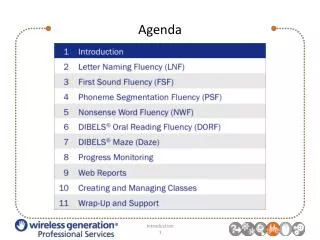
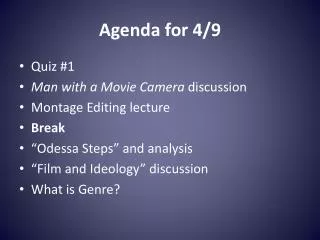
Agenda for 4/9 • Quiz #1 • Man with a Movie Camera discussion • Montage Editing lecture • Break • “Odessa Steps” and analysis • “Film and Ideology” discussion • What is Genre?
Man with a Movie Camera • What did you draw in your picture? • Is there a story in this film? • What does the film tell you about life in the Soviet Union in the 1920s? • Why doesVertov show us his filmmaking process at various points in the film? • Why watch experimental film? What are the strategies for drawing meaning from it?
Formal Approaches to Movie Meaning-Making • How do you use film to: • Tell a story (in a way that a novel or a play can’t)? • Convey the complex inner thoughts and intentions of the people on screen? • Make viewers in the audience feel strong emotions, or think new ideas, or see the world in a different way?
Continuity Editing • Associated with D.W. Griffith • The convention of classical Hollywood filmmaking. • Meant to be essentially invisible to the viewer. • Cause and Effect Editing: • A→B→C • Parallel Editing or Cross-Cutting: • A + B = C
Aspects of Continuity Editing • Shot-to-Shot Matches • Eyeline match • Match-on-action • Graphic match • Spatial Consistency • “Master scenes” • Establishing shot • 180-degree rule • Temporal Consistency • Linear progression of time and event
Montage (or disjunctive) Editing • Associated with Sergei Eisenstein and Soviet Cinema of the 20s. • Meant to call attention to the editing itself: • Andre Bazin: “The creation of a sense of meaning not proper to the images themselves but derived exclusively from their juxtaposition” (LaM 349) • A + B = Z (where “Z” is something offscreen that we, the viewer, have to imagine or think or feel)
Some Aspects of Montage Editing • Tempo: Use of different shot lengths (very fast cuts, for example) to create a feeling (like tension) • Vectors: Using contrasting angles and movements to convey a feeling (like confusion) • Repetition: Using the same or very similar shots multiple times in a sequence • Fragmentation: Breaking a simple action into several different shots • Dramatic Juxtaposition: Mixing related by not directly connected images (as in a “reaction shot”) • Visual Metaphor: Adding unrelated images to a sequence to create a metaphoric association
Montage Editing In Man with a Movie Camera • Graphic Matches to Draw Unusual Connections • i.e., woman washing face / someone washing the city street • Man mining coal / industrial stack producing smoke • Fast Tempo: • Average shot length of movies made in 1929: 11.2 seconds. • Average shot length of Man with a Movie Camera:2.3 seconds • Use of Still Images • Crowd Movements • http://www.theasc.com/blog/2014/01/13/the-spinning-top-and-the-parvo-man-with-a-movie-camera/
“Odessa Steps” Sequence • From Sergei Eisenstein’s Battleship Potemkin (1925) • Watch for: • Sharp juxtapositions between shots • Mix of “crowd” and “individual” shots • Tempo of shots • Directionality and angles of movement
Film and Ideology • What’s ideology? • How do films transmit ideology? How do you determine a film’s ideology? • “The same commercial instinct that inspires filmmakers to use seamless continuity also compels them to favor stories that reinforce viewers’ shared belief systems . . . Because so much of this occurs on an unconscious, emotional level, the casual viewer may be blind to [a film’s] implied political, cultural, and ideological messages” (LaM 10) • What is Sherlock Jr.’s ideology?What is Man with a Movie Camera’s?
Next Week: Singin’ in the Rain (1952) • Read chapter 4 (on narratives) and pages 450-455 • First blog post due at the end of next week (Friday 4/18). • I’ll talk about the shot list/essay assignment due at the end of Week 4 (Friday, 4/25)