Introduction to Ruby: Key Features and Design Decisions
This course material provides an introduction to Ruby, highlighting its pure object-oriented nature, scripting capabilities, and design decisions. It compares Ruby with other languages like Java and Smalltalk, emphasizing its dynamic typing, mixins, and rich library ecosystem. Key concepts include everything being an object, dynamic evaluation, and unique naming conventions. The course also covers getting started with Ruby installations on various platforms, along with key programming constructs and syntactic features that distinguish Ruby from other languages.

Introduction to Ruby: Key Features and Design Decisions
E N D
Presentation Transcript
CSE 413 Autumn 2008 Introduction to Ruby Credit: Dan Grossman, CSE341
Why Ruby? • Because: • Pure object-oriented language • Interesting, not entirely obvious implications • Interesting design decisions (compare Java) • Particularly type system, mixins, etc. • Interesting, but not our focus • Scripting language • RAILS and other frameworks
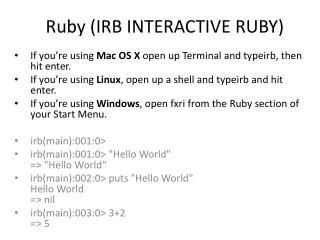
Getting Ruby • Link to www.ruby-lang.org/en on course web. Documentation & downloads • Implementations: • Windows: get the “one-click installer” • OS X: Ruby 1.8 is part of developer tools • Linux: Should be available from your distro. Be sure to include the irb interactive interpreter too.
Ruby • Pure object-oriented: all values are objects • Contrast w/Java primitive vs reference types • Class-based • Dynamically Typed • vs static typing in Java • Convenient reflection
Languages Compared One way to get an overview of what these mean and how other languages relate
Ruby vs Smalltalk (1) • Smalltalk is the classic example of a pure OO, class-based, dynamically-typed language • Basically unchanged since the 80’s • Tiny language, regular, can learn whole thing • Integrated into a powerful, malleable, GUI environment • Uses blocks (closures) for control structures
Ruby vs Smalltalk (2) • Ruby • Large language, “why not” attitude • “make programmers happy” • Scripting language, minimal syntax • Huge library (strings, regexps, RAILS) • Mixins (somewhere between Java interfaces and C++ multiple inheritance – very neat) • Blocks and libraries for control structures and functional-programming idioms
Ruby Key Ideas (1) Everything is an object (with constructor, fields, methods) Every object has a class, which determines how it responds to messages Dynamic typing (everything is an object) Dynamic dispatch (like Java; later) Sends to self (same as this in Java)
Ruby Key Ideas (2) • Everything is “dynamic” • Evaluation can add/remove classes, add/remove methods, add/remove fields, etc. • Blocks are almost first-class anonymous functions (later) • Can convert to/from real lambdas • And a few C/Java-like features (loops, return,etc.)
No Variable Declarations • If you assign to a variable, it’s mutation • If the variable is not in scope, it is created(!) (Don’t mispell things!!) • Scope is the current method • Same with fields: if you assign to a field, that object has that field • So different objects of the same class can have different fields(!)
Naming Conventions • Used to distinguish kinds of variables • Constants and ClassNames start with caps • local_vars and parameters start w/lower case • @instance_variables • @thing = thing sets and instance variable from a local name – and creates @thing if it doesn’t exist! • @@class_variables • $global $VARS $CONSTANTS
Visibility. Protection? • Fields are inaccessible outside instance • Define accessor/mutator methods as needed • Methods are public, protected, private • protected: only callable from class or subclass object • private: only callable from self • Both of these differ from Java
Unusual syntax(add to this list as you discover things) • Newlines often matter – example: don’t need semi-colon when a statement ends a line • Message sends (function calls) often don’t need parentheses • Infix operations are just message sends • Can define operators including =, [ ] • Classes don’t need to be defined in one place • Loops, conditionals, classes, methods are self-bracketing (end with “end”) • Actually not unusual except to programmers who have too much prior exposure to C/Java, etc.
A bit about Expressions • Everything is an expression and produces a value • nil means “nothing”, but it is an object (an instance of class NilClass) • nil and false are false in a boolean context; everything else is true (including 0) • ‘strings’ are taken literally (almost) • “strings” allow more substitutions • including #{expressions}