Understanding U.S. Resource Conservation Ethics and Public Land Classifications
This overview delves into resource conservation ethics in the U.S., contrasting Gifford Pinchot’s utilitarian view of maximizing resource use for the greatest good with John Muir's philosophy of preserving nature for its intrinsic value. It presents key statistics on public land use, revealing that 42% of land is public. The various classifications of public land, including national parks, wildlife refuges, and wilderness areas, are discussed, alongside an explanation of relevant laws like NEPA and the Endangered Species Act.

Understanding U.S. Resource Conservation Ethics and Public Land Classifications
E N D
Presentation Transcript
National Parks 9/26/11
What is the resource conservation ethic? • Gifford Penshall’s philosophy: People should maximize resource use based on the greatest good for everyone. • John Muir’s Philosophy: Forests are sacred for their intrinsic value, and should be preserved from the contamination of man.
What are the classifications of public land in the US? • Rangelands • National forests • National parks • National wildlife refuges • Wilderness areas
What are Rangelands? • Grasslands in tropical or temperate climates that are unfenced. • Overgrazing by cattle reduces grass cover, exposes soil to erosion by water and wind, compacts the soil
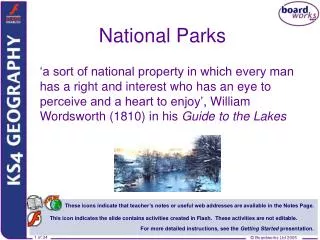
What are National Parks? • Public lands established to preserve scenic views and unusual landforms. • For the use of people’s enjoyment of ecosystems • Has distinct boundaries • Managed by National park services • 58 national parks in the US
What are National Wildlife Refuges? • The only federal public land managed for the primary purpose of protecting wildlife. • Managed by Fish and Wildlife service • 450 wildlife refuges and 28 waterfowl protection areas in the US (85 million acres)
What are National Wilderness areas? • Areas set aside to preserve large tracts of ecosystems. • Boundaries less defined than a National Park’s • Created from other public lands (usually national forests or rangelands) • Designated as “roadless”, limit human use • 95 million acres in US
What is the Wilderness Act of 1964? • Any area of undeveloped Federal land retaining its primeval character and influence, without permanent improvements of human habitation, which is protected and managed so as to preserve its natural conditions. • Allowed for Us Forest Service’s Roadless Area Review and evaluation to evaluate land for designation as “wilderness”
What is the National Park Service? • Manages the national resource lands. • Manages 391 national parks, historical parks, and national monuments
What is the National Wildlife Foundation? • Provide Fish and Wildlife services • Manage wildlife refuges
What is U.S. forest service? • Manages National Grasslands and Forests.
What is the Bureau of Land management? • Manages national battlefields, monuments, historic sites and other areas.
Federal Regulation of Land Use 9/27/11
What is NEPA? • NEPA = National Environmental Protection Policy Act • Mandates an environmental assessment of all projects involving federal money or federal permits.
What is EIS? • EIS=Environmental impact statement • Developer’s project proposal outlines the scope and purpose of the project, describes environmental context, suggests and analyzes alternatives.
What is an environmental mitigation plan? • A plan stating how it will address the project’s environmental impact.
What is the endangered species act? • 1973 law designed to protect species from extinction.
What are International Categories for Public Lands? • National Parks • Managed Resource Protection Area • Habitat/Species Management Areas • Strict Nature Reserves and Wilderness Areas • Protected Landscapes and Sea Scapes • National Monuments