Generating a Thesis Statement for Character Analysis
This guide outlines the essential components of a thesis statement necessary for character analysis essays. A strong thesis should appear in your introduction, typically at the end of the first paragraph. It must include the essay's subject (topic), purpose (informative or persuasive), a specific focus (your viewpoint), and a brief overview of the related subdivisions. It also provides a step-by-step method to create a thesis statement, using examples like Salinger's "The Catcher in the Rye" to illustrate how to focus and develop your topic effectively.

Generating a Thesis Statement for Character Analysis
E N D
Presentation Transcript
Generating a Thesis Statement for Character Analysis M. Smolinsky
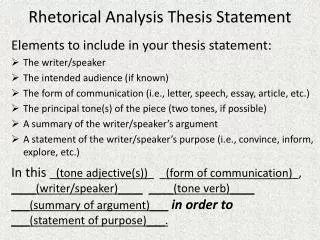
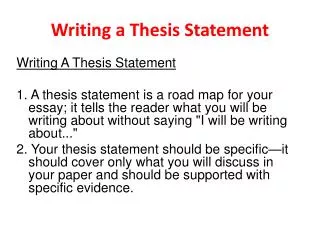
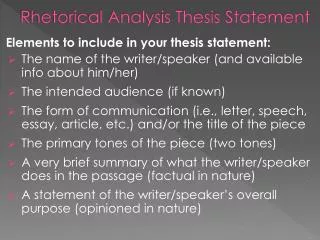
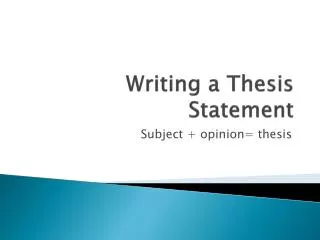
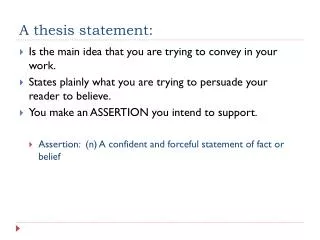
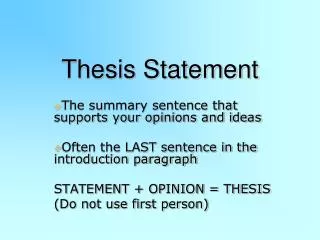
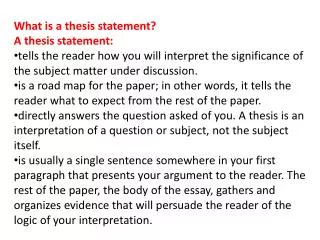
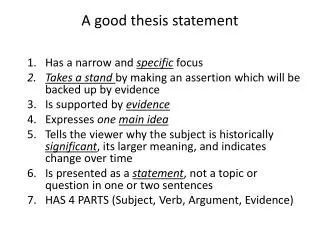
REVIEW – WHAT IS A THESIS STATEMENT • The thesis statement should appear in your introduction and is usually at the end of this first paragraph • Simon and Schuster’s Handbook for Writers requirements for a thesis statement: • the essay’s subject—the topic that you will discuss • the essay’s purpose—either informative or persuasive • your focus—the assertion that presents your point of view • specific language—not vague words • brief overview of topics subdivisions
CREATING A THESIS – STEP #1 • Choose a topic from the reading (a theme, issue, technique, or concept) • Example: Loss of Innocence in The Catcher in the Rye
CREATING A THESIS – STEP #2 • Focus the topic (what does the author communicate about this topic?) • Example: Salinger uses symbols to represent Holden’s loss of innocence
CREATING A THESIS – STEP #3 • Develop the topic by posing a question (how does the author communicate the topic) • Example: How does Salinger use symbolism to portray Holden’s loss of innocence?
CREATING A THESIS – STEP #4 • Generate a thesis statement by answering the question • Example: Salinger uses several symbols like the museum, the record, and the carousel to represent Holden’s loss of innocence.
1-TO-3 FORMULA FOR CHARACTER ANALYSIS • It may help to choose one literary technique and discuss how it is used to represent different themes or issues • Ex. Salinger uses (technique) to explain the concept of (idea #1, #2, #3) • Or you may choose one theme or symbol and discuss how the author uses different techniques or examples to develop that idea • Ex. Salinger develops the idea of (theme) through his use/description of (technique/example #1, #2, #3)