Motion and Forces
140 likes | 248 Vues
This guide explores the concepts of force, velocity, and inertia. It explains how these elements are interconnected, particularly in the context of Newton's First Law of Motion, which states that an object will stay at rest or continue moving at a constant velocity unless acted upon by a net force. The impact of balanced versus unbalanced forces on motion is discussed, along with examples to illustrate these principles. Additionally, the relationship between mass and inertia is made clear, highlighting the challenges in changing the motion of objects with different masses, like a bowling ball versus a tennis ball.


Motion and Forces
E N D
Presentation Transcript
Question 1: • Answer: A
Agenda • Explain how force and velocity are related. • Describe what inertia is and how it is related to Newton’s first law of motion. • Identify the force and motion that are present during a crash.
What is force? • Force – is a push or pull that one body exerts on another. • Examples • Atmosphere • Weight
Changing motion • What happens to an object when a force is exerted on it? • The object at rest moves in the direction of the force.
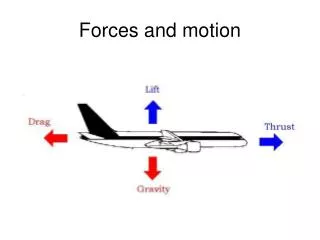
Balanced force • Balanced force – forces on an object that are equal in size and opposite in direction. • Net force – when two or more forces act on an object at the same time. • Net force = zero
Unbalanced forces - Unequal forces in opposite directions, a net force occurs in the direction of the greater force.
Inertia and Mass • Inertia – is the tendency of an object to resist any change in motion. • The velocity of an object remains constant unless an unbalanced force acts on it.
Could an astronaut move the space station by himself? No, though it is "weightless" it still has mass!
Why would it be very difficult to catch a bowling ball like you would a tennis ball? • A greater force would be needed to change the motion of the bowling ball because it has greater inertia. • Inertia is related to the mass of an object • Greater the mass, greater the inertia.
Newton’s first law of Motion • Sir Isaac Newton – stated the rules that describe the effects of force on the motion of objects. • First law of Motion or Law of Inertia– an object moving at a constant velocity keeps moving at that velocity unless a net force acts on it. • Object at rest, stays at rest unless a net force acts on it.