Download
1 / 12
120 likes | 249 Vues
The subprime mortgage crisis of the late 2000s was influenced by a series of government policies and financial regulations. The Tax Reform Act of 1986 made only home interest deductible, while the Federal Reserve's drastic interest rate cuts post-9/11 and subsequent increases contributed to market instability. The Community Reinvestment Act aimed to curb redlining yet had mixed effects, and the deregulation of mortgage standards by Fannie Mae and Freddie Mac spurred risky lending. In response to the crisis, government initiatives included TARP, aimed at stabilizing banks, and the American Recovery and Reinvestment Act of 2009, which infused billions into the economy.

E N D
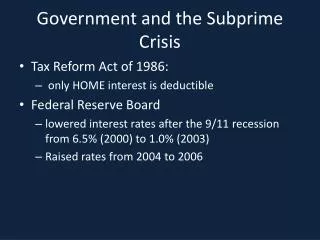
Government and the Subprime Crisis • Tax Reform Act of 1986: • only HOME interest is deductible • Federal Reserve Board • lowered interest rates after the 9/11 recession from 6.5% (2000) to 1.0% (2003) • Raised rates from 2004 to 2006
TOO MUCH Regulation? • Community Reinvestment Act (1977) • -forbid “redlining” and encouraged investment in low income neighborhoods. • Mostly applied during bank mergers in the late 1990s • Applied on to federally insured banks (partly) • Did not apply to lenders issuing 50-75% of subprime loans
Regulation • Fannie Mae and Freddie Mac • 1999 relaxed requirements for mortgages it “securitized” • Began purchasing subprime loans in 2004, especially in 2005(arrived late to subprime loans)
Deregulation • Alternative Mortgage Transactions Parity Act (AMTPA) 1982 • Allowed non-federally chartered housing creditors to write adjustable-rate mortgages • 2004: SEC allows unregulated investment companies to issue more debt (Bears and Stearns, Lehman Brothers, Merrill Lynch, Goldman Sachs) • They invest in more mortgages
Government response to the crisis: Federal Reserve • Lowers “discount” interest rate to near 0 • $30 Billion for Bears Stearns buyout • $200 Billion to nationalize Fannie and Freddie • Buys most of AIG for $182 Billion (or $85B)-- “covers” investors who bought credit default swaps at full value. • (2008-9) Buys $300 Billion of US Debt(“monetizes” the debt) • Buys $1.25 Trillion in Mortgage-backed securities
TARP: Troubled Asset Relief Program • $750 Billion • Fall, 2008 (big issue in presidential campaign) • Initial purpose: to buy “toxic” mortgage securities • Instead: to “buy” the Banks themselves:AIG: $40B CITI $45B Bank of Am. $45BGM: $13.4B Chrysler: 4B
American Recovery and Reinvestment Act of 2009“Stimulus Bill” • Feb, 2009: $787 Billion • Tax cuts: $288B • Health Care: $144B (Medicaid and COBRA) • Education: $90B • Income assistance: $83B (unemployment, Food Stamps, Social Security bonus) • Infrastructure\vehicles\energy $81B • Homebuyers tax credit $8000 (until 4/30/10)
NEXT • Pending FHA default • 2% of all mortgages in 2006 • 33% in 2009 • 1 in 6 borrowers in default