Download
1 / 1
10 likes | 133 Vues
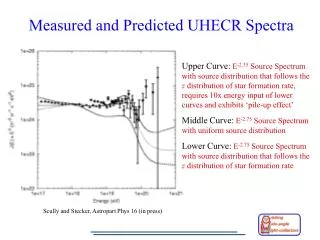
This study investigates Ultra High Energy Cosmic Rays (UHECR) through three spectral models characterized by their source distributions. The upper curve, following a source spectrum of E-2.35 with a z-distribution aligned to the star formation rate, indicates a need for ten times the energy input compared to lower curves, also noting a 'pile-up effect.' The middle and lower curves both correspond to an E-2.75 spectrum, with the latter reflecting a uniform source distribution. Findings provide insights into cosmic ray production and implications for astrophysical processes.

E N D
Measured and Predicted UHECR Spectra Upper Curve:E-2.35 Source Spectrum with source distribution that follows the z distribution of star formation rate, requires 10x energy input of lower curves and exhibits ‘pile-up effect’ Middle Curve:E-2.75 Source Spectrum with uniform source distribution Lower Curve:E-2.75 Source Spectrum with source distribution that follows the z distribution of star formation rate Scully and Stecker, Astropart Phys 16 (in press)