Understanding Spectra: Energy Levels, Emission, and Absorption in Light
Explore the fascinating world of light spectra, including continuous, emission, and absorption spectra. A continuous spectrum displays all energy levels and contains all colors of light, while emission and absorption spectra provide insights into energy levels of various elements. Emission spectra arise from hot gases, while absorption spectra are created when white light passes through cold gases. Learn how these spectra reveal the composition of stars and planets and understand the relationship between energy levels and spectral lines, focusing on the hydrogen line spectrum.

Understanding Spectra: Energy Levels, Emission, and Absorption in Light
E N D
Presentation Transcript
Most energy? • Red • Blue
Biggest wavelength? • Orange • Green
Highest frequency? • Violet • Yellow
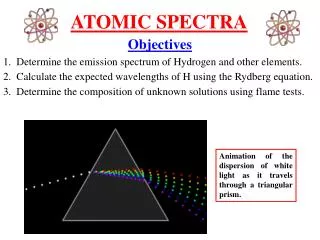
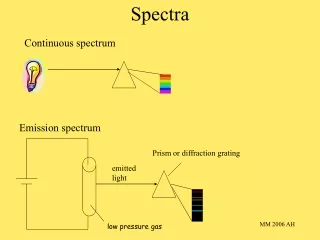
Continuous spectrum • Produced by white light going through a prism • Contains all colors of light, so indicates all possible energies of electrons
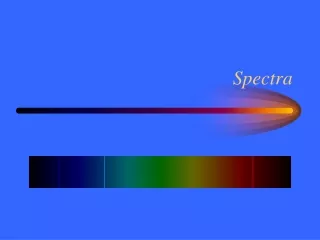
Differences • Continuous shows all energy levels • In line spectrums (emission and absorption), lines represent different frequencies of energies of various energy levels
Emission Spectrum • Emission spectrum produced by hot gas going through a prism http://www.iun.edu/~cpanhd/C101webnotes/modern-atomic-theory/emission-spectrum.html
Absorption Spectrum • Produced by white light passing through a cold gas and then a prism http://www.museevirtuel-virtualmuseum.ca/edu/ViewLoitDa.do;jsessionid=55F3241793B573106876E2154526ED6D?method=preview&lang=EN&id=19930
http://nothingnerdy.wikispaces.com/ATOMIC+SPECTRA+AND+ATOMIC+ENERGY+STATEShttp://nothingnerdy.wikispaces.com/ATOMIC+SPECTRA+AND+ATOMIC+ENERGY+STATES
How we know what stars/planets are made of? • element spectrums • Why we see these lines
Relation of spectra to energy levels • simple view • simple explanation