Analyzing Circular Components of Time Series: Clockwise and Counter-Clockwise Rotations
This document explores the separation of time series data, such as current or wind data, into clockwise and counter-clockwise rotating circular components. Instead of traditional Cartesian components, we analyze circular components defined by their amplitudes and phases. Using Fourier Series in complex form, we demonstrate how to derive these components, their magnitudes, and their interactions based on their rotational direction. Examples, including data from La Paz Lagoon in the Gulf of California, are provided, illustrating the application of this method in understanding oscillatory phenomena.

Analyzing Circular Components of Time Series: Clockwise and Counter-Clockwise Rotations
E N D
Presentation Transcript
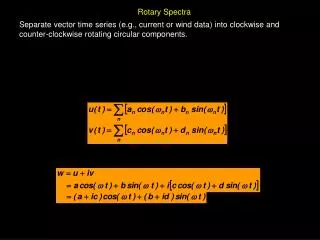
Rotary Spectra Separate vector time series (e.g., current or wind data) into clockwise and counter-clockwise rotating circular components. Instead of having two Cartesian components (u, v) we have two circular components (A-, - ; A+, + ) Suppose we have de-meanedu and v components of velocity, represented by Fourier Series (one coefficient for each frequency): These can be written in complex form (dropping subindices and summation) as:
Now write was a sum of clockwise and counter-clockwise rotating components: Remember: e i t= cos(t) + i sin( t) rotates counter-clockwise in the complex plane, and e -i t= cos( t) – i sin( t) rotates clockwise. Equating the coefficients of the cosine and sine parts, we find: A- A+
Magnitudes of the rotary components : The -and +components rotate at the same frequency but in opposite directions. → Sometimes they will reinforce each other (pointing in the same direction) and sometimes they will oppose each other (pointing in opposite direction) tending to cancel each other. Major axis = (A++ A-) minor axis = (A+- A-)
Major axis = (A++ A-) minor axis = (A+- A-) where: and the components of the rotary spectrum:
La Paz Lagoon, Gulf of California Small minor axis Oriented ~40 from East Slope ~ 0.84
a b c d
S+ S-
S+ S-
S+ S-
Major axis = (A++ A-) minor axis = (A+- A-)
Examples: Miles Sundermeyer notes (U MASS)
Examples: Miles Sundermeyer notes (U MASS)
Examples: Miles Sundermeyer notes (U MASS)
Examples: Miles Sundermeyer notes (U MASS)