The Life Cycle of Stars: From Nebula to Supernova
Explore the fascinating life cycle of stars, illustrating the transformative processes that govern their formation and evolution. Beginning as a nebula, a star undergoes stages such as main sequence, giant, and finally supernova. Key processes like nuclear fusion create new elements and release vast amounts of energy, highlighting the connection between stardust and all matter in the universe. Learn how different types of stars, like white dwarfs and neutron stars, emerge from these intense cosmic events, revealing the incredible forces driving our universe.

The Life Cycle of Stars: From Nebula to Supernova
E N D
Presentation Transcript
Stellar Evolution ‘The life-cycle of stars’
Star Energy • Nuclear Fusion – a nuclear reaction in which to atoms are fused together… • New elements are created and energy is released. • This process is responsible for creating ALL elements found in the universe… in other words, we are all made from star dust.
Star Energy (con’t) • Hydrogen fusion H + H He + • Helium fusion He + He Be + • As the mass of elements increases, energy production increases Energy More Energy
1. Nebula • A cloud of gas and dust • Gravity causes the cloud to collapse and condense • Temperatures begin to increase = Glows • Fusion begins at VERY high temps. (Some of the extra gas and dust may form planets)
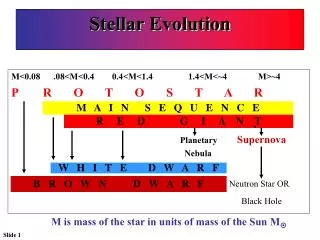
Main Sequence Stars • Core reaches a temp of ~15 million K. • Hydrogen begins to fuse into Helium in the core. • ~90% of stars lifetime is spent in the main sequence stage. • Classified based on temperature and luminosity
Giant Stars • Core decreases in size as • All (or most) H is consumed • He fusion is occurring – producing more energy • Diameter increases x10 • Surface temp decreases as star expands
Super Giants • Form from massive stars • A chain of reactions take place in the core producing He, C, O, Ne, Mg, Si, S, Ar, Ca, Ti, Cr, Fe • Highest temperature = Blue Super Giants • Usually explode in a tremendous event called a supernova
Nova/Super Nova • The core of a giant star produces too much energy in it’s core and causes the outside of the star to expand. • The outer layer of gasses are blown out to space (nova, or supernova), leaving behind a small, hot core…
White Dwarf • Stars decrease in size ~ same diameter as earth, mass stays the same • Mass of sun, size of Earth • DENSITY INCREASES TREMENDOUSLY D = 1,000,000 g/cm3 1 sugar cube > 1 car • Solid, but still hot, so it is glowing • Luminosity decreases
Neutron stars • Form from the remains of extremely massive stars after a supernova. • Very small ~ 30 km across • D = 2 x 10¹⁴ • 1 sugar cube = mass of humanity