Enhancing Education for Students with Disabilities: The Role of Web 2.0 Tools
This article explores the implications of integrating Web 2.0 technologies into rehabilitation, counseling, and education programs for students with disabilities. It highlights the positive impact on logical reasoning, self-esteem, social learning, and writing quality, as discussed by Brunvand (2010). The article also suggests practical solutions, including various tools like ShareTabs and Awesome Highlighter, that can enhance accessibility and learning outcomes. A range of helpful links to online learning platforms and resources is provided to support educators and students.

Enhancing Education for Students with Disabilities: The Role of Web 2.0 Tools
E N D
Presentation Transcript
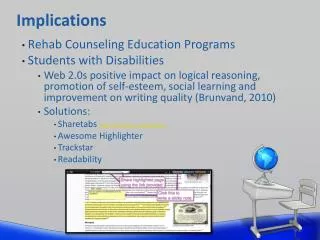
Implications • Rehab Counseling Education Programs • Students with Disabilities • Web 2.0s positive impact on logical reasoning, promotion of self-esteem, social learning and improvement on writing quality (Brunvand, 2010) • Solutions: • Sharetabshttp://sharetabs.com/?abelincoln • Awesome Highlighter • Trackstar • Readability
Professional Implications • http://adca-online.org/site_map.htm
Helpful Links http://www.good.is/post/mit-launching-free-interactive-online-learning-platform/ http://education-portal.com/articles/Best_Online_Learning_Platform_Peoples_Choice_Awards.html http://edudemic.com/2010/07/the-100-best-and-free-online-learning-tools/ http://www.youtube.com/watch?v=WvCIv5KCbeE
References Brunvand, S. & Abadeh, H. (2010). Making Online Learning Accessible: Using Technology to Declutter the Web. Intervention in School and Clinic. 45,p304-311. Grabinger, S., Aplin, C. (2008). Supporting Learners with Cognitive Impairments in Online Environments. Tech Trends. 52(1)63-68. Abdein,B. (2011). Web 2.0 and Online Learningand Teaching: A Preliminary Benchmarking Study. Canadian Center of Science and Education. 7(11)5-11. Daggar, D., O’Connor, A., Lawless, S. (2007). Service Oriented E-Learning Platforms. IEEE Internet Computing. 5, p.28-35. Usluel, Y., & Mazman, S. (2009). Adoption of Web 2.0 tools in distance education. International Journal of Human Services. 6(2)90-97. Prensky, M. (2010). Teaching Digital Natives, Partnering for Real Learning. 1 p17-21.