Efficient Object Tracking Strategies at the University of Alaska Museum of the North
The primary function of museums is effective object tracking to prevent the loss of specimens. At the University of Alaska Museum of the North, we implement accountability measures using barcodes to optimize storage costs. We analyze expenses related to archival space, considering factors such as the cost of maintaining underutilized freezer space. By organizing specimens based on spatial requirements and utilizing a recursive, hierarchical data structure, we can enhance data accuracy and reduce labor. This approach ensures efficient specimen management and flexibility in inventory practices.

Efficient Object Tracking Strategies at the University of Alaska Museum of the North
E N D
Presentation Transcript
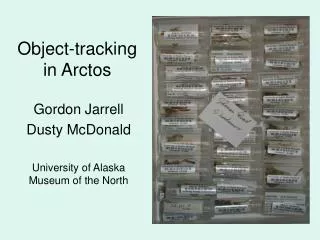
Object-tracking in Arctos Gordon Jarrell Dusty McDonald University of Alaska Museum of the North
Primary function of museums is object-tracking • Stuff is in museums so it won’t get lost. • When we can’t find something in a museum, we have failed our societal function. • Barcodes = Accountability
Costs of Storage • Space for a cryotube in a 27-cubic-foot ultra-cold freezer with racks and boxes costs 24 cents. • If a “filled” freezer is actually 10% empty, you have paid $1,498 for empty space. Electricity to cool empty space is about $100/year. • LN2 startup (not including LN2 & electricity) is about three times this.
Archival space is expensive. • Put stuff where it fits. • Organize by space requirements, not by alphabetical order, taxonomic order, catalog sequence, etc. Keep track of where it is in a database!
Recursive, hierarchical data structure(containers within containers) Every container is within a parent container, except for The Big One. Recorded dimensions and logic prevent placement of a large container into a smaller parent.
2-piece cryotube label One piece wraps cryotube. Other piece affixed to data sheet. Less transcription work. Less (no?) transcription errors. Tubes (containers) can be installed immediately. Specimen’s parent container is scanned in at data-entry.
Scanning Nuncs Laptop on wireless Uninstalled tubes USB barcode scanner Installed tubes
Freezer boxes in rack positions Positions are containers that cannot be moved from their parent container. The dimensions of a position are greater than the dimensions of a box. Logic prevents operators from scanning the position “into” the box.
Freezer racks in freezer positions. Racks have barcode on top. 48 positions have barcodes on lip of freezer. Miscellaneous containers can be scanned into a freezer in no specific position.
Benefits • Less labor. No sorting, just barcode scanning. • Accountability – A log of scans log amounts to an ongoing inventory. • Completely fill containers in high-cost storage. • Un-barcoded (legacy) containers can be moved into barcoded parent containers. • Flexible hierarchy. Not all intermediate levels are required.