Download
1 / 16
160 likes | 288 Vues
The 22nd International Conference on the Reduction of Drug-Related Harm shed light on the complex HIV epidemic among injecting drug users (IDUs) in the Middle East and North Africa (MENA) region. With nearly one million IDUs, the conference highlighted the need for enhanced HIV surveillance, testing, and treatment services. Insights from various countries revealed concentrated and emerging HIV epidemics and emphasized the importance of establishing comprehensive harm reduction programs. The findings recommend advocacy for civil society’s engagement and enhanced access to prevention services in a challenging socio-economic landscape.

E N D
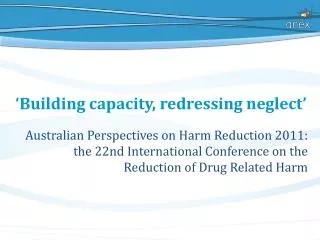
‘Building capacity, redressing neglect’ Australian Perspectives on Harm Reduction 2011: the 22nd International Conference on the Reduction of Drug Related Harm
Backdrop of Prison Riots Footage of riot
The MENA assessment Project • Limited knowledge of the HIV epidemic in Middle East and North Africa (MENA) region • High levels of heroin production in MENA • Major drug trafficking routes pass through the region
About the MENA Project • To gather, review, analyze, and synthesize for the first time all evidence on the epidemiology of HIV among IDUs in MENA.
Methodology • Study design: • Systematic review, synthesis and analysis • Triangulation approach • Sources of data: • Scientific literature search of Medline • Country-level reports & databases • International organizations reports & databases
Results: more data than expected • Status of the evidence: • Hundreds of data sources identified • Variable quality • Recent integrated bio-behavioral surveillance surveys • Some state of the art sampling methodologies
Fraction of the population who inject drugs • There are nearly one million IDUs in MENA • Population fraction: 0.2% (0.05-0.4%) • Intermediate range compared to other regions • Note Iran, Iraq and Pakistan
Injecting risk behavior • Sharing of needles & syringes: ~ 50%
IDU mode of HIV transmission: • Fraction of the total HIV cases due to IDU • Important mode of transmission in: Afghanistan, Bahrain, Iran, Libya, Pakistan, and Tunisia • Note Iraq: Situation Unknown
Discussion • Concentrated HIV epidemics at a national level: Iran and Pakistan • Emerging HIV epidemics: Afghanistan and Egypt • At least “outbreak-type” HIV epidemics: Algeria, Bahrain, Libya, Morocco, Oman, and possibly Tunisia • Apparently low/zero HIV prevalence: Lebanon, Jordan, Kuwait, Saudi Arabia, and Syria
Recommendations: quite obvious • Expand HIV surveillance • Expand access to HIV testing, prevention, and treatment services • Establish national harm reduction programs
‘Arab Spring’: implications • High Unemployment: drug use risk environment • Implications for civil society overall • Implications for civil society engaging with injecting drug users.
Iran a leader • One of worlds highest rates of opium/heroin usage. • Religious conflicts resolved • Large numbers of civil society organisations • Multi-faceted programs: • Needle exchange • Methadone • Prison-based interventions
Sub-Saharan Africa • Nigeria: trafficking, usage and lack of Government response. • Seychelles: tiny nation, Catholic Church opposition • Tanzania: very early stages of mapping and planning. Methadone beginning soon. • Challenge: advocacy in generalised epidemic populations.
Other Snippets Indonesia to begin prison-NSP Moroccon King endorses harm reduction • including prison-NSP. Excellent session on smoking harm reduction. • More than plain packaging Afghanistan has begun methadone.
Drug Lords celebrate prohibition To raise awareness of 50 years of prohibition, Hungarian Civil Liberties Union filmed the real beneficiaries: Including Igor the Russian Heroin Trader http://drogriporter.hu/en/dli_short