
Complementarity of Resources in Quantum Systems: Reference Frames, Superselection Rules, and Work Extraction

This talk examines the interplay of resources in quantum systems, focusing on superselection rules (SSRs) and the extraction of mechanical work. It discusses how conservation of local particle number and general symmetry groups influence accessibility to entanglement and work extraction, with a particular emphasis on bipartite systems under SSR. By investigating reference frames and the asymmetry of systems, we explore the hierarchy of restrictions and resources, and demonstrate how these concepts facilitate understanding of quantum information processing and entanglement distillation.
Complementarity of Resources in Quantum Systems: Reference Frames, Superselection Rules, and Work Extraction
E N D
Presentation Transcript
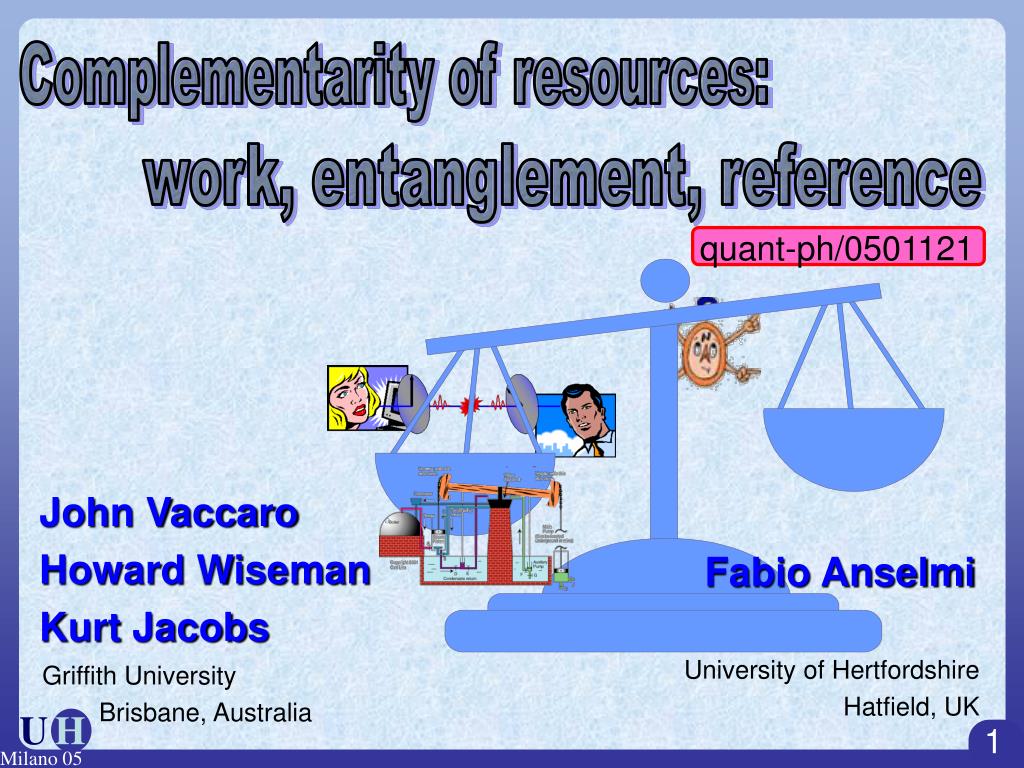
Complementarity of resources: work, entanglement, reference quant-ph/0501121 John Vaccaro Howard Wiseman Kurt Jacobs Fabio Anselmi University of Hertfordshire Hatfield, UK Griffith University Brisbane, Australia
S This talk • Superselection Rules (SSRs) • conservation of local particle number • general symmetry groups • Reference frames • asymmetry: ability to act as a reference • Extracting mechanical work • Bipartite systems under SSR • Accessible entanglement • Extracting local work • Hierarchy of restrictions/resources • Complementarity
Superselection Rules Conservation of particle number all physical operations conserve particle number cannot observe coherence between subspaces of different particle number effectively a superselection rule.
S S Expressed as symmetry group U(1) Operationally accessible states “crisp“ projective measurement of General symmetry group Symmetry group: unitary representation: Operationally accessible states system under SO(2) reduced coherence
S Reference systems (frames) Reference frames break the symmetry preserve coherence of system Any system with asymmetry can act as a reference system (frame) for G A symmetric system cannot act as a reference. R Measure of asymmetry asymmetric system von Neumann entropy induced by G reference system
Properties of asymmetry i) ii) iff is symmetric: iii) does not increase for G-SSR operations Q iv) Synergy of is given by
Example of Abelian case (particle number) system: asymmetry reference: Pegg & Barnett (1989). asymmetry combined: -invariant to -coherence is preserved reduction in asymmetry (synergy):
1 under SSR Extracting mechanical work
Synergy advantage of acting as a composite system acting as single system acting separately Upper bound asymmetry is a resource
Bipartite systems under SSR Local action of the group: local G-SSR
can act as local & shared reference Local asymmetry i) iff is locally symmetric: ii) iii) does not increase for locally G-SSR operations Q iv) Synergy of is given by
Accessible entanglement under SSR Wiseman and Vaccaro, PRL 91, 097902 (2003). 17 fixed total number of N particles f n N B A 11 6 + + N-n n
Examples cross terms represent 1 particle at each site – no particle entropy Super-additivity: • releases “latent” entanglement • a kind of distillation
Extracting local work Oppenheim et al PRL 89, 180402 (2002)
equivalent method classically-correlated state with min entropy LOCC classical channel local extraction of work
equivalent method for pure states pure state classically-correlated state with min entropy LOCC dephase in Schmidt basis classical channel local extraction of work
For pure, globally-symmetric states classically-correlated state with min entropy dephase in Schmidt basis LOCC classical channel local extraction of work
local asymmetry local symmetry work can act as a local reference
local asymmetry local symmetry mechanical logical can act as a local reference
Recall examples for U(1) R S R ability to act as shared reference super-additivity of accessible entanglement =
Recall examples for U(1) R LOCC LOCC+LocalG S R ability to act as shared reference super-additivity of accessible entanglement =
Details of general group case Symmetry group: Unitary representation: Globally-symmetric states Locally accessible states
multiplicity “flavour” Elemental globally symmetric state “colour” “charge” where and are conjugate w.r.t. : i.e.: 1 dim irrep General globally symmetric state
entropy associated with charge fluctuations entropy associated with mixing of i & j indices entanglement due to multiplicity indices reduced by entropy associated with
Complementarity of resources ability to act as a reference frame asym sym W RF ability to perform work M L asymmetry symmetry
Hierarchy of restrictions-resources - G LOCC for globally-symmetric states GG GG LOCC,
reference frames accessible entanglement and work complementarity of resources: reference ability versus mechanical work versus logical work Summary triality