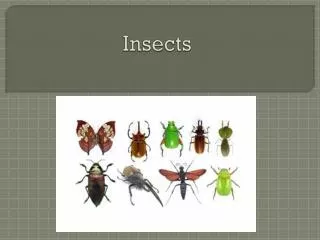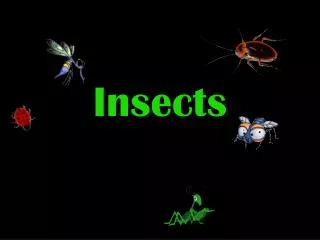
Ch. 37 Insects
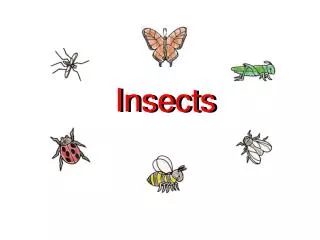
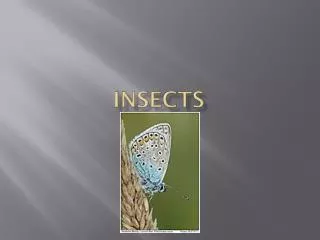
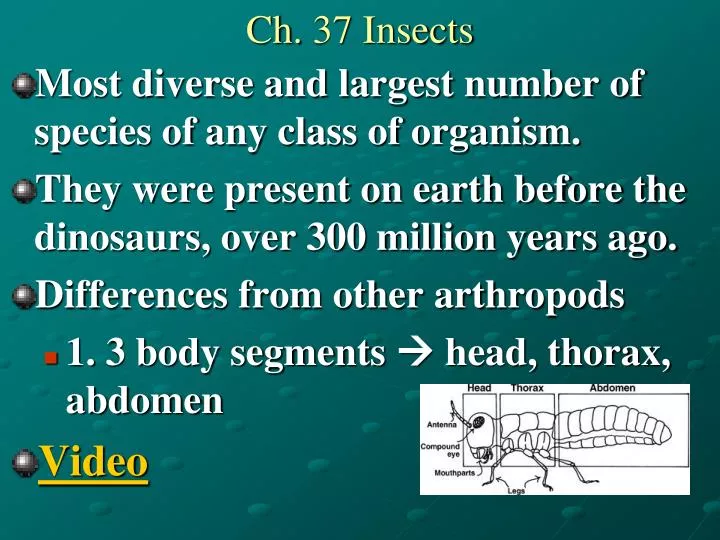
Ch. 37 Insects. Most diverse and largest number of species of any class of organism. They were present on earth before the dinosaurs, over 300 million years ago. Differences from other arthropods 1. 3 body segments head, thorax, abdomen Video. 2. Head has 1 pair of antennae

Ch. 37 Insects
E N D
Presentation Transcript
Ch. 37 Insects • Most diverse and largest number of species of any class of organism. • They were present on earth before the dinosaurs, over 300 million years ago. • Differences from other arthropods • 1. 3 body segments head, thorax, abdomen • Video
2. Head has 1 pair of antennae • 3. Thorax has 3 pairs of legs & 1 or 2 pair of wings. • 4. No wings or legs attached to the abdomen. • Video
Kingdom: Animalia • Phylum: Arthropoda • Class: Insecta (700,000 + species named) • What makes insect so successful? • Lots of them – adapt very well • Great diversity – several types • Reproduce rapidly • Small size & ability to fly (most)
Benefit of insects? • 1. Pollination – plants can’t reproduce without insects. We need plants to survive. • 2. Food – for other animals. Several animals rely on insects as a source of food. • 3. Industrial uses – silk & honey • Video • What is the study of insects called? (E.C) • Entomology
Grasshopper External Structures • 3 Body Parts: • 1. Head • Labium – grasps the food ( bottom lip) • Mandible – chews the food (jaws) • Labrum – holds the food (upper lip) • Maxilla – extra jaws • 2. Thorax • 3 pairs of legs (6 total) • 2 pair of wings usually
3 parts to the thorax • 1. Prothorax – pair of walking legs • 2. Mesothorax. – pair of walking legs • 3. Metathorax – pair of jumping legs • Forewings are attached to the mesothorax • Hindwings are attached to the metathorax
3. Abdomen • Spiracle – for respiration • Tympanum – for hearing (eardrum) • Ovipositors – holds it eggs
GrasshopperInternal Structures • Digestive System • What do grasshoppers eat? • What are the mouth parts? • Food passage: esophaguscrop (storage) gizzard (grind) midgut (digested) hindgut (rectum & colon) out the anus
Circulatory System • Open Circulatory System • An aorta is a large vessel that carries the blood on the dorsal side. • 2 Hearts along the aorta
Respiratory System • No lungs or gills • Use spiracles – openings along the abdomen • The spiracles lead to the trachea • Nervous System • Brain connected to a ventral nerve cord • Has simple and complex eyes
Have antennae • Tympanum for sensing sound • Reproductive System • The male deposits sperm into the seminal receptacle, which stores the sperm. • The female uses its ovipositors to deposit her eggs in the ground.
Types of Metamorphosis • Incomplete Metamorphosis • 1. Egg • 2. Nymph – immature form of an adult • 3. Adult – able to reproduce (wings)
Complete Metamorphosis • 1. Egg • 2. Larvae – caterpillar stage • 3. Pupa – cocoon protects the pupa • 4. Adult – emerges from the pupa (butterfly)
Defenses of Insects • What ways do insects use defenses? • 1. Stinger or bite – bee, wasp, ants • 2. Camouflage – blend into their surroundings. • Ex. Grasshopper, praying mantis • 3. Warning coloration – alert other animals that the insect might be poisonous. • Video
Insect Behavior • Division of Labor among Bees • 1. Worker bee – female bees, most abundant. (8,000) - sterile • 2. Drone – male bees (100) • 3. Queen bee – the only fertile female • CHARACTERISTICS OF EACH BEE
The worker bee produces royal jelly to feed the queen bee • The worker also secretes wax to make the hive. • The produces a pheromone called queen factor, which makes the other females sterile. • Round Dance – tells the other bees food is within 50 meters • Waggle Dance – tells the other bees food is greater than 50 meters. • Video