Image Blending Techniques for Computer Vision Applications
Learn how to generate weight maps, compute Laplacian and Gaussian pyramids, and blend images for seamless panoramas using feathering and weight selection methods in computer vision.
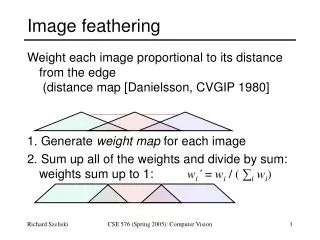

Image Blending Techniques for Computer Vision Applications
E N D
Presentation Transcript
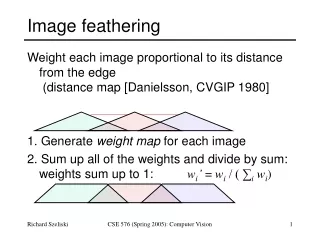
Image feathering • Weight each image proportional to its distance from the edge (distance map [Danielsson, CVGIP 1980] • 1. Generate weight map for each image • 2. Sum up all of the weights and divide by sum:weights sum up to 1: wi’ = wi / ( ∑iwi) CSE 576 (Spring 2005): Computer Vision
Pyramid Blending CSE 576 (Spring 2005): Computer Vision
Laplacian level 4 Laplacian level 2 Laplacian level 0 CSE 576 (Spring 2005): Computer Vision left pyramid right pyramid blended pyramid
Laplacian image blend • Compute Laplacian pyramid • Compute Gaussian pyramid on weight image (can put this in A channel) • Blend Laplacians using Gaussian blurred weights • Reconstruct the final image • Q: How do we compute the original weights? • A: For horizontal panorama, use mid-lines • Q: How about for a general “3D” panorama? CSE 576 (Spring 2005): Computer Vision
Weight selection (3D panorama) • Idea: use original feather weights to selectstrongest contributing image • Can be implemented using L-∞ norm: (p = 10) • wi’ = [wip / ( ∑iwip)]1/p CSE 576 (Spring 2005): Computer Vision