Analyzing Spring-Mass and Circuit Systems: Motion, Damping, and Charge Over Time
This document explores the dynamics of spring-mass systems and series circuits, focusing on motion analysis and charge behavior. It includes various scenarios: a spring with a mass of 4 kg stretched and compressed, the effect of damping, and the response of series circuits involving resistors, inductors, and capacitors. Each scenario provides a unique challenge, such as determining position over time for springs or calculating current and charge in circuits. The document combines principles of physics with mathematical methods to derive meaningful insights.

Analyzing Spring-Mass and Circuit Systems: Motion, Damping, and Charge Over Time
E N D
Presentation Transcript
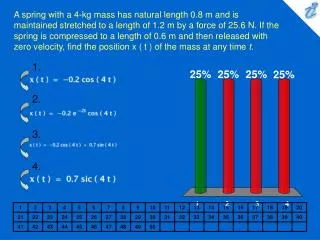
1. 2. 3. 4. A spring with a 4-kg mass has natural length 0.8 m and is maintained stretched to a length of 1.2 m by a force of 25.6 N. If the spring is compressed to a length of 0.6 m and then released with zero velocity, find the position x ( t ) of the mass at any time t. • {image} • {image} • {image} • {image}
1. 2. 3. 4. A spring with a mass of 4 kg has damping constant 32 and spring constant 128. Graph the position function of the mass at time t if it starts at the equilibrium position with a velocity of 4 m / s. • {applet} • {applet} • {applet} • {applet}
1. 2. 3. 4. Suppose a spring has mass M and spring constant k and let {image} . Suppose that the damping constant is so small that the damping force is negligible. If an external force {image} is applied (the applied frequency equals the natural frequency), use the method of undetermined coefficients to find the equation that describes the motion of the mass. • {image} • {image} • {image} • {image}
1. 2. 3. 4. A series circuit consists of a resistor {image} , an inductor with L = 2 H, a capacitor with C = 0.025 F, and a 12-V battery. If the initial charge is 0.0011 C and the initial current is 0, find the current I ( t ) at time t. • {image} • {image} • {image} • {image}
1. 2. 3. 4. A series circuit consists of a resistor {image} , an inductor with L = 1 H, a capacitor with C = 0.0125 F, and a 12-V battery. If the initial charge and current are both 0, find the charge Q ( t ) at time t. • {image} • {image} • {image} • {image}
1. 2. 3. 4. A series circuit consists of a resistor {image} , an inductor with L = 1 H, a capacitor with C = 0.002 F, and a generator producing a voltage of E ( t ) = 12cos 10t. If the initial charge and current are both 0, find the charge Q ( t ) at time t. • {image} • {image} • {image} • {image}