Download
1 / 14
150 likes | 259 Vues
This chapter explores the essentials of sound perception, detailing how pitch is determined by frequency and how loudness is influenced by amplitude. Women's higher voices result from shorter vocal cords, while the ear's structure—including the outer, middle, and inner ear—plays a crucial role in sound transmission. Key concepts include the eardrum's function, auditory bones, and the cochlea's role in generating neural impulses. Additionally, the chapter discusses deafness types, such as conductive and sensorineural deafness, highlighting their causes and potential interventions, like cochlear implants.

E N D
Hearing Chapter 4, Section 3
Pitch • How high or low the sound • Depends on the frequency, or number of cycles per second. The more cycles per second the higher the pitch • Women’s voices are generally higher due to shorter vocal chords that vibrate at a greater frequency
Loudness • Determined by height, or amplitude, of sound waves. • The higher the amplitude of the wave, the louder the sound…measured in decibels dB
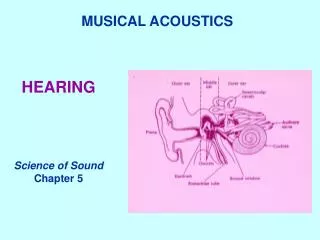
The Ear • Consists of the outer, middle, and inner ear. • Eardrum is the gateway from the outer to the middle ear. Thin membrane that vibrates when sound waves strike it. As it vibrates, it transmits sound to three bones, the hammer, anvil, and stirrup (smallest bone in the body) these bones vibrate and transmit sound to the inner ear.
Inner Ear – consists of the cochlea – a snail shaped, bony tube that contains fluids and neurons that move in response vibrations in the fluids. • The movement generates neural impulses that are transmitted to the brain via the auditory nerve
Deafness • About 2 million Americans are deaf. May be inherited, caused by disease, injury, or old age http://youtu.be/9oh7mH7soZU
Conductive deafness • Occurs due to damage in the middle ear • Since this part amplifies sound, damage to this area prevents people from hearing sounds that are not loud enough • Often helped by hearing aids, which amplify sounds.
Sensorineural Deafness • Caused by damage to the inner ear, most often the neurons are destroyed, or the auditory nerve is damaged due to disease or prolonged exposure to very loud sounds • High volume concert – ears ringing- neurons destroyed in your ears • Workers who operate loud equipment
Cochlear implants- “artificial ears”- stimulate the auditory nerve directly. If the auditory nerve is damaged a cochlear implant will not help
http://www.mtv.com/videos/true-life-im-deaf/1590956/playlist.jhtmlhttp://www.mtv.com/videos/true-life-im-deaf/1590956/playlist.jhtml