Glyphosate and AMPA Contamination in Small Water Supply Plants: A Study of Vulnerability and Sources
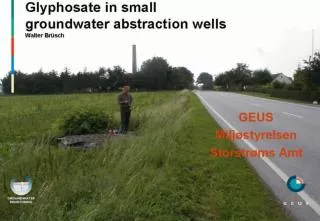
This study investigates the presence of glyphosate and AMPA in 28 small water supply plants, revealing that these substances were detected in 15 plants, as well as in 14 wells and one drilling site. It highlights that wells are more susceptible to contamination than deeper drillings. Proven sources of pollution include adjacent agricultural fields and local courtyards. Notably, concentrations of glyphosate and AMPA decrease with distance from these potential sources. The findings underscore the need for ongoing monitoring and assessments of water quality in relation to agricultural practices.

Glyphosate and AMPA Contamination in Small Water Supply Plants: A Study of Vulnerability and Sources
E N D
Presentation Transcript
Some conclusions: • Glyphosate and AMPA: re-found in 15 out of 28 small water supply plants, where glyphosate and AMPA were found in 2001/2002. • Glyphosate and AMPA were found in 14 wells and in 1 drilling located in the bottom of a well => wells are much more vulnerable compared to drillings extracting ground water from deeper reservoir’s. • Glyphosate and AMPA sources are presumably adjacent fields at 5 small water plants. At 4 plants the pollution originated from local courtyards. The remaining sources were of different characters => every plant - it’s history. • Glyphosat/AMPA concentrations in the well water decreases with increasing distance to possible sources. • The well water were characterized by ground water originating from fractured till.
Background: Glyphosate and AMPA were found frequently in upper ground water reservoir’s in StorstømSmall Water Plants with findings of glyphosate / AMPA.
Background: distribution of AMPA in 4 counties. (Map- thickness of sediments over chalk)
Background: BAM in small water plants(Map – pre quartenary, green = chalk)
New project implemented in 2005: 38 small water plants with previous findings of glyphosate/AMPA in Storstrøm analytical program - Glyphosate/ AMPA, BAM, coliform bacteria, selected main components (NO3, SO4, Fe++, etc.) interview Hand drillings, sampling of ground water Multivariable statistic work
Glyphosate and AMPA re-found in 15 plants out of 28 investigated. 4 plants closed + 8 inactive = 12 plants not running => app. 30%of the previous investigated plants are closed
Distribution of glyphosate/AMPA in different types of plants28 investigated plants
Glyphosate/AMPA, sample month and concentration. Results from 2001/2002 and from Storstrøm 2005 10 1 Konc i µg/l . 0,1 0,01 København Storstrøm Sønderjylland Viborg Storstrøm ny 0,001 juli juni maj april marts august januar februar oktober november december september
Glyphosate/AMPA concentrations and groundwater table in hand drillings and wells Samples analyzed for glyphosate and AMPA
water samples with findings of E.coli and coliform bacteria. 71 samples Hand drilling – findings of coliform bacteria and E.coli against depth of water table in hand drillings. Maximum counted bacteria -160
Concentration and distance to possible scource. Water samples with findings of glyphosate/AMPA from wells and plants. Detection limit 0,01µg/l
Geological description Isseg. – ice segmentation in till