Conjecturing Connections Between Collinear Points
Explore the concept of conjecturing by investigating the number of ways to connect pairs of collinear points. When given five or seven collinear points, identify a pattern in the number of connections possible. By analyzing smaller cases, you can formulate a conjecture regarding how many distinct connections can be formed. Test your conjectures using additional examples to validate your findings. This exercise helps develop reasoning skills and the ability to recognize patterns in mathematics.

Conjecturing Connections Between Collinear Points
E N D
Presentation Transcript
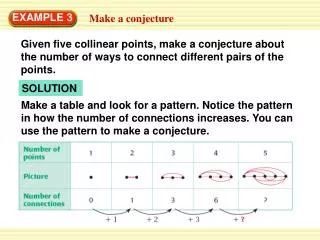
EXAMPLE 3 Make a conjecture Given five collinear points, make a conjecture about the number of ways to connect different pairs of the points. SOLUTION Make a table and look for a pattern. Notice the pattern in how the number of connections increases. You can use the pattern to make a conjecture.
ANSWER Conjecture: You can connect five collinear points 6 + 4, or 10 different ways. EXAMPLE 3 Make a conjecture
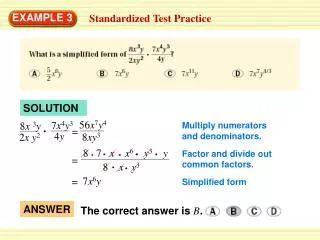
= 4 3 = 8 3 = 113 = 17 3 ANSWER Conjecture: The sum of any three consecutive integers is three times the second number. EXAMPLE 4 Make and test a conjecture Numbers such as 3, 4, and 5 are called consecutive integers. Make and test a conjecture about the sum of any three consecutive numbers. SOLUTION STEP 1 Find a pattern using a few groups of small numbers. 3 + 4 + 5 = 12 7 + 8 + 9 = 12 10 + 11+ 12 = 33 16 + 17 + 18 = 51
= 101 3 = 0 3 EXAMPLE 4 Make and test a conjecture STEP 1 Test your conjecture using other numbers. For example, test that it works with the groups –1, 0, 1 and 100, 101, 102. 100 + 101 + 102 = 303 –1 + 0 + 1 = 0
3. Suppose you are given seven collinear points. Make a conjecture about the number of ways to connect different pairs of the points. Number of points. 1 2 3 4 5 6 7 . . . . . . . . . . . . . . . . . . . . . . . . . . . . Picture Number of connections 0 1 3 6 10 15 ? +1 +2 +3 +4 +5 +? for Examples 3 and 4 GUIDED PRACTICE
ANSWER Conjecture: You can connect seven collinear points 15 + 6, or 21 different ways. for Examples 3 and 4 GUIDED PRACTICE
4. Make and test a conjecture about the sign of the product of any three negative integers. ANSWER Conjecture: The result of the product of three negative number is a negative number. Test: Test conjecture using the negative integer –2, –5 and –4 –2 –5 –4 = –40 for Examples 3 and 4 GUIDED PRACTICE