The Early Cold War: Foundations of the U.N. and Global Tensions (1945-1960)
The aftermath of World War II led to the establishment of the United Nations in 1945, inspired by the League of Nations and the Atlantic Charter. Major powers including the U.S., USSR, France, Britain, and China shaped global politics, leading to the Nuremberg Trials that prosecuted Nazi leaders. The Iron Curtain divided Europe, while conflicting ideologies fueled the Cold War. Key events included the Marshall Plan, Truman Doctrine, Berlin Airlift, Korean War, and rising tensions exemplified by the Suez Crisis and conflicts in Asia and Latin America, setting the stage for decades of geopolitical struggle.


The Early Cold War: Foundations of the U.N. and Global Tensions (1945-1960)
E N D
Presentation Transcript
Founding of the U.N. • Idea from League of Nations and Atlantic Charter • Begins in 1945 • General Assembly • Security Council – 15 nations • Permanent members with US, USSR, France, Britain, China
Europe – Post WWII • Nuremberg Trials 1945-6 • Top Nazi leaders tried for war crimes • Showed cooperation between allies • Satellite nations in Eastern Europe • Communist manipulated elections • “Soviet Bloc” of Poland, Romania, Bulgaria, Albania, Hungary, and Czechoslovakia • Occupation of Germany • Split 4 ways by US, France, Britain, and USSR • Soviet controlled area becomes East Germany • Other 3 sectors – West Germany • “Iron Curtain” – Communist Eastern Europe
Asia – Post WWII • Japan – Under control of US occupation until 1951 • US troops stayed (against communists?) • Philippines – 1946 became independent country • China • Civil War • Nationalists led by Chiang Kai-Shek (for Democracy, but corrupt) • Communists led by Mao Zedong • Two Chinas • Peoples Republic (Red China) • Formosa/Taiwan - Nationalists • Guess which one US supported? • What was the effect on Truman?
Marshall Plan • After war and harsh 1946-7 winter, Europe in bad shape • George Marshall outlined program of economic help • Economic aid to European countries • Soviets and Eastern Bloc turned down aid • Western Europe economic growing by 1950s • Was the Marshall Plan actually a plan against communism?
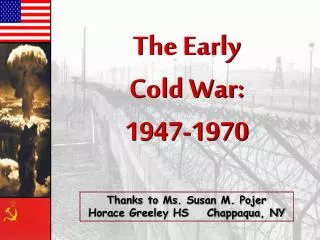
Cold War • Conflict between the USSR and US from mid-1940s to early 1990s • Early Roots • Red Scare after WWI • Potsdam Conference • How was the relationship of Truman different than FDR? • Truman’s policies • Some saw it as reasonable response to USSR effort to increase communism • Conservatives said he was soft on communism • Others say he overreacted to USSR’s historic need for border security
Truman Doctrine • After threat of communist takeover in Greece and Turkey ’46 • Truman asks Congress for economic aid to assist freedom • Idea was to Contain communism. • Containment idea - Dean Acheson and George Kennan (Mr. X) • NSC-68 (1950- after China) – secret at time • Increase defense spending • Alliances w/ non-communist countries • Work against “domino effect”
Restructure of the Military • Atomic Energy Commission established in 1946 • National Security Act – 1947 • Organized Military under Department of Defense – “Pentagon” • CIA – Central Intelligence Agency • National Security Council – coordinate foreign policy in Executive • Fell in line with Truman Doctrine and cold war strategy • Selective Service System and peacetime draft – 1948
Early “shots” of Cold War • Berlin Airlift 1948 • Soviets cut off land access to West Berlin • Massive Airlift • “candy bombers” • Soviets later open roads • Atomic Arms race • Soviets test atomic bomb in 1949 • Rosenbergs/Hiss • US – H-bomb in 1952
Good guys vs. Bad guys • NATO - 1949 • North Atlantic Treaty Organization • Military alliances with Western Europe, Canada, and US • What would Washington think of this? • Warsaw Pact– 1955 • Military alliance of Communist nations of Eastern Europe
Korean War • 1950 – North Korea (Communist) invade South Korea • UN authorized force to defend South Korea • Why did USSR not use their veto vote of Security Council? • Gen. MacArthur stops invasion and pushes back • But goes beyond orders including bombing China • Truman removes MacArthur despite public approval • Armistice would establish 38th Parallel in 1953 • More than 54,000 Americans killed
Brinkmanship • Eisenhower’s policy led by John Foster Dulles • Idea of Massive Retaliation • Dulles advocated more reliance on nuclear weapons
Suez Crisis • 1956 – Egypt got funds for Aswan Dam from Soviet Union. • Egypt then nationalized French/British-owned Suez Canal. • Britain, France, Israel attach Egypt and retake Canal. • Eisenhower was furious that allies had not contacted him. • U.S. joins U.N. and world in condemnation. • After crisis, U.S. dominate force in middle east, not Brit or Fra.
Eisenhower Doctrine • After Suez Crisis, Eisenhower pledged economic aid to Middle Eastern counties. • Also pledged to aid militarily against communism spread. • Builds upon Truman Doctrine with military and middle east focus.
Asia and Latin America Conflicts • France retook control of Indochina after WWII. • U.S. aided France in Vietnam against communist forces. • SEATO – Southeast Asia Treaty Organization – 1954 • Made to try to prevent Indochina from becoming Communist. • CIA involved in several overthrows in the 1950s. • Produced Anti-U.S. feeling • Cuba- 1959 • Dictator Batista overthrown by Fidel Castro-led communists. • American-owned businesses nationalized and alliance with USSR • Later Bay of Pigs and Cuban Missile Crisis with JFK
1950s Events • 1956 – Hungarian Revolt – New gov’t established, but Moscow sends in troops and restores communist gov’t. • US did not help as Ike feared WWIII • 1957 - Sputnik I and II – shock U.S. • US National Defense and Education Act 1958 • Explorer I – U.S. first satellite 1958 • NASA started in 1958 to direct U.S. space effort • 1961 – Alan Shepard in Space • 1962 – John Glenn first to orbit • 1969 – Neil Armstrong on moon
1960 and 1961 • U2 Crisis – U.S. spy plane w/ Frances Gary Powers shot down. • Scheduled peace summit with Khrushchev and Eisenhower cancelled • Eisenhower’s Farewell address • Warned about the “unwarranted influence…by the military-industrial complex.”