Exploring Thought and Judgment: Language and Human Cognition
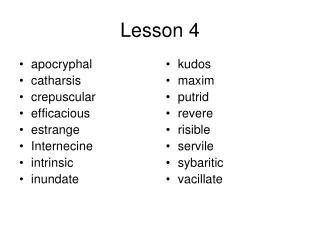
This lesson delves into the essential nature of thought and judgment in our lives, highlighting how our language mirrors these concepts through expressions like “second thoughts” and “reserving judgment.” Participants will engage with vocabulary related to the cognitive process, including terms like "abstruse," "acumen," and "cerebral." Understanding these words enhances our grasp of complex thoughts and judgments we navigate in daily life. Join us as we explore how language influences our cognition and decision-making.

Exploring Thought and Judgment: Language and Human Cognition
E N D
Presentation Transcript
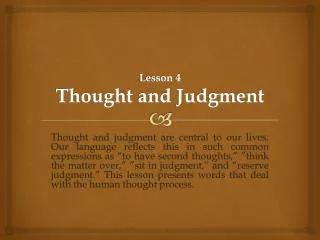
Lesson 4Thought and Judgment Thought and judgment are central to our lives. Our language reflects this in such common expressions as “to have second thoughts,” ”think the matter over,” ”sit in judgment,” and “reserve judgment.” This lesson presents words that deal with the human thought process.
Lesson 4Thought and Judgment • Turn to page 23. Solve all.
Lesson 4Thought and Judgment • Turn to page 26. Solve ‘Find the Example’.