Canaletto’s 18th Century View of St. Paul’s Cathedral Overlooking the Thames
50 likes | 162 Vues
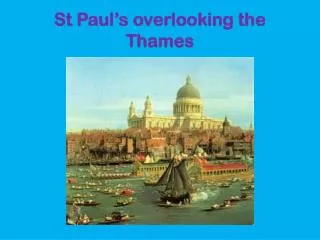
This painting, created by Giovanni Antonio Canal, known as Canaletto, during 1747-1748, brilliantly captures the Thames River in the 18th century. The foreground showcases several boats, including a distinctive sailing boat with an English flag and two rowers. Behind, charming houses border the harbor, while the majestic St. Paul’s Cathedral rises in the background. Canaletto, celebrated for his detailed landscapes, moved to London following a decline in Venetian tourism. His love for Venice is evident in his works, which remain influential to this day.


Canaletto’s 18th Century View of St. Paul’s Cathedral Overlooking the Thames
E N D
Presentation Transcript
Painting of theThamesin the 18th century ThispaintingrepresentstheThames in the 18th century.Itwaspaintedin 1747-1748. ThepainterisCanaletto. In theforegroundwe can seemanyboatsbutthere are onlythreebigones. Thefirstoneis a sailingboat in whichwe can seeanEnglishflag. Theotherbigones are rowers. Behindtheboatswe can seehouses and theharbor. In thebackground a cathedral.
Map London Venice
Giovanni Antonio Canal (28 October 1697 – 19 April 1768) • Giovanni Antonio Canal or Canaletto, was a very famous painter during the 18th century. He was known mostly for his beautiful landscapes of Venice, his hometown. • At the beginning of his career he was a theatricalscenepainter. • Though he did some traveling in his life, he much preferred Venice to any other city and most of his works reflect this love.
As helearned painting withhisfather, hestarted in hisoccupation: theatricalscenes. • Most of hisearlyworkwaspaintedfrom nature. • He soldloads of hiswork to English men. Following the war of Austria ( 1741-1748), hissuccessdecreaseddue to a sharpreduction of Europeantourists in Venice, sohehad to move to London in 1746 and hestayedthereuntil 1755. Thenhewentback to Venice and painted untilhisdeath.