Understanding Potential and Kinetic Energy in Everyday Examples
Explore the fundamental concepts of energy, specifically potential and kinetic energy. Energy is defined as the ability to make things move. Learn about seven types of energy, including chemical, light, heat, nuclear, mechanical, sound, and electrical, with practical examples for each. Understand how a roller coaster demonstrates kinetic energy when in motion and potential energy when elevated. Discover the transformations between potential and kinetic energy, and how stored energy in substances like wood and gasoline represents potential energy that can convert into kinetic energy.

Understanding Potential and Kinetic Energy in Everyday Examples
E N D
Presentation Transcript
Energy What are potential and kinetic energy?
First some review… • Write down the definition of energy. • Write down the four of the seven types of energy and an example of each.
Energy… • …is the ability to make things move
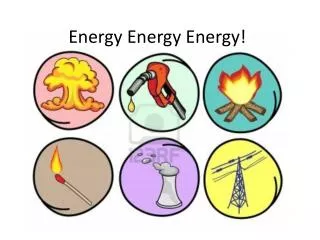
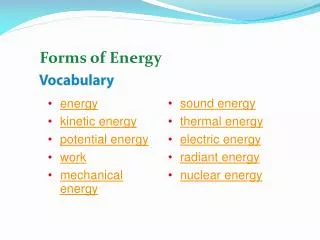
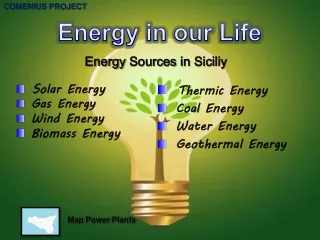
The seven types of energy… • Chemical - gasoline, • Light – flash light, • Heat – burner on a stove, • Nuclear - sun, • Mechanical - car, • Sound – music on the radio, • Electrical - lightning
Definitions • Kinetic Energy: the energy of motion • Potential Energy: stored energy
A Roller Coaster A roller coaster speeds along its track. It has kinetic energy because it is moving.
A Roller Coaster As it slows to a stop at the top of a hill, it has potential energy because of where it is. It has the potential to move because it is above the ground and has somewhere to go.
Right, mechanical.What if the cars crashed and burned? What type would it be?
Substances like wood, coal, oil, and gasoline have storedenergy because of their chemistry – they can burn • Stored energy is potential energy
Potential Energy can be changed into Kinetic Energy • Also Kinetic Energy can be changed into Potential Energy