Plan Comparisons
This article explores the differences between defined benefit (DB) and defined contribution (DC) pension plans, highlighting key concepts such as employer risk, employee choice, and how benefits are determined. It delves into the role of the Pension Benefit Guaranty Corporation (PBGC) in protecting retirement incomes, ensuring plans are backed for over 44 million American workers across thousands of pension plans. The article also discusses the implications for older and younger workers, as well as the portability of different plan types and the state-specific guarantees associated with pensions.

Plan Comparisons
E N D
Presentation Transcript
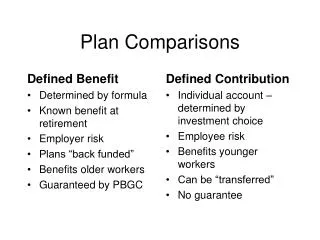
Defined Benefit Determined by formula Known benefit at retirement Employer risk Plans “back funded” Benefits older workers Guaranteed by PBGC Defined Contribution Individual account – determined by investment choice Employee risk Benefits younger workers Can be “transferred” No guarantee Plan Comparisons
Pension Benefit Guarantee Corporation • PBGC was created by the Employee Retirement Income Security Act of 1974 to encourage the continuation and maintenance of private-sector defined benefit pension plans • The Pension Benefit Guaranty Corporation (PBGC) protects the retirement incomes of 44.1 million American workers in 30,330 private-sector defined benefit pension plans • PBGC is responsible for the current and future pensions of about 1,296,000 people in 3,595 pension plans that ended • .
Pension Benefit Guarantee Corporation • Provides timely and uninterrupted payment of pension benefits, and keep pension insurance premiums at a minimum. • PBGC collects insurance premiums from employers that sponsor insured pension plans, earns money from investments and receives funds from pension plans it takes over
Pension Benefit Guarantee Corporation • The maximum pension benefit guaranteed by PBGC is set by law and adjusted yearly. For plans ended in 2005, workers who retire at age 65 can receive up to $3,801.14 a month ($45,613.68 a year) • The guarantee is lower for those who retire early or when there is a benefit for a survivor. • The guarantee is increased for those who retire after age 65.
Pension Benefit Guarantee Corporation • Most states continue payments to annuitants • Few states provide no guarantees • Colorado • Louisiana • New Jersey • District of Columbia • Some states limit amount of individual coverage • Example: California • guarantees no more than 80% of an annuity • limit total annuity coverage to $100K present value or
Pension Benefit Guarantee Corporation • Per ERISA, PBGC is to guarantee payment of retirees’ benefits in the event of a plan termination • PBGC covers defined benefit retirement plan – not retiree • 1990 – PBGC announced that it does not cover insurance annuities (periodic lifelong payments by insurance companies to retirees or their survivors) purchased by pension plans • If insurance company fails – pensioners holding annuities must rely on various state insurance guarantee laws • 3 – 4 million retirees in • Hurricane Andrew, Hugo, Charlie, Francis, Ivan, Katrina
Cash Balance Plans • Defined benefit plan that has characteristics of defined contribution plan • Each year a participant’s account is credited with a pay credit and an interest credit • The pay credit is dependent upon the participant’s compensation • The growth of the account depends on pay credits that the employer contributes, not on profit sharing • Offers more portability than traditional pension plans since you can take your vested account as a lump sum whenever you terminate employment • Will not be reduced because of your age
1.0% .9 .8 .7 .6 .5 .4 .3 .2 .1 0 Value of cash balance accrual Value of traditional accrual • 27 29 31 33 37 39 41 43 45 47 51 53 55 57 59 61 63 65 • Age