Understanding Air Masses: Characteristics and Formation
Air masses are large bodies of air with consistent temperature and humidity, influenced by their location over land or water. They form in areas of little wind, taking on characteristics of their underlying surfaces. There are different types of air masses: maritime tropical, continental tropical, maritime polar, continental polar, and continental arctic, each with unique temperature and humidity profiles. The movement of air masses is driven by convection, where warm, less dense air rises and cool, denser air sinks, creating circulation patterns. Understanding these concepts is crucial for weather prediction.

Understanding Air Masses: Characteristics and Formation
E N D
Presentation Transcript
The relative measure of the amount of water vapor in the air • Psychrometer • Water vapor affects the density of the air. • Cold air is heavier than warm air. Humidity
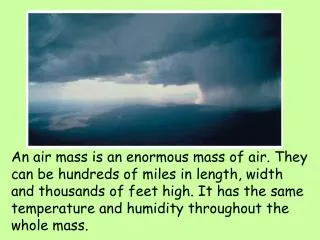
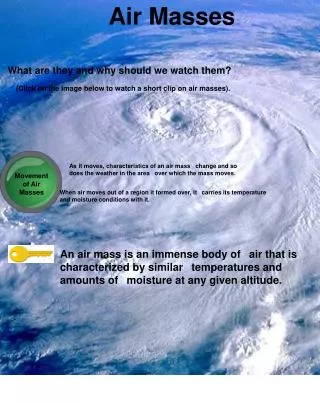
A body of air that has the same temperature and humidity throughout What is an air mass?
If a large body of air sits over an area of land or water for a long period of time, it will take on the characteristics of the land or water beneath it. • Temperature • Humidity How do air masses form?
Air masses over the equator will have higher temperatures. • Air masses over polar regions will have lower temperatures. • Air masses over water (maritime) will have high humidity (moisture content). • Air masses over land (continental) will have low humidity (moisture content). Location, Location, Location…
Air masses tend to form in areas with little wind. • Remember, they sit over an area for a long period of time without moving. Where do air masses form?
Air masses that form over water are called maritime. • Air masses that form over land are called continental. Labeling Air Masses
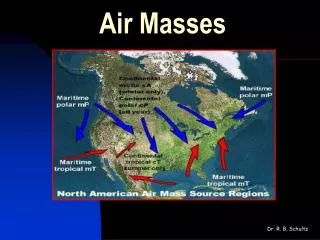
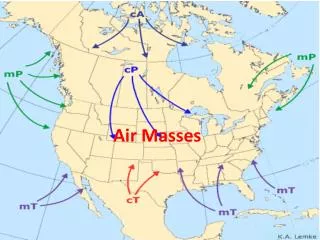
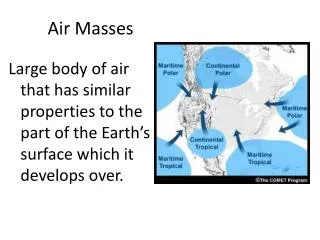
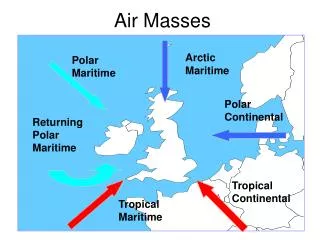
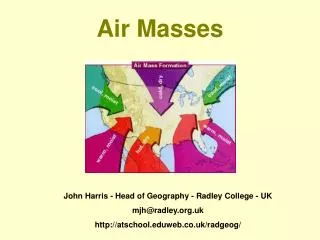
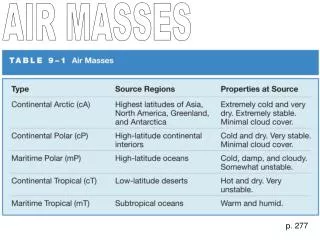
mT – maritime tropical • cT – continental tropical • mP – maritime polar • cP – continental polar • cA – continental arctic Classification of Air Masses
mT – warm, moist air • cT – warm, dry air • mP – cold, moist air • cP – cold, dry air • cA – super cold, dry air Characteristics of Air Masses
Convection! How do air masses move?
Warm air rises, and cold air moves in to replace it. • A circulation pattern is formed. • Convection causes air to move and ocean currents to form. Convection
Density! • Warm air is less dense and rises. • Cool air is denser and sinks. How does convection work?
Air Pressure! • Temperature differences cause air pressure differences. • Warm, less dense air has lower pressure and rises. • Cool, denser air has higher pressure and sinks. How does convection work?
How do different air masses form? Reflection Question