

SlideServe
Menu
Préférences
© SlideServe · v2026

Plan for Week 4

anisa avatar
17 diapositives · 336 Views · Jul 15, 2014

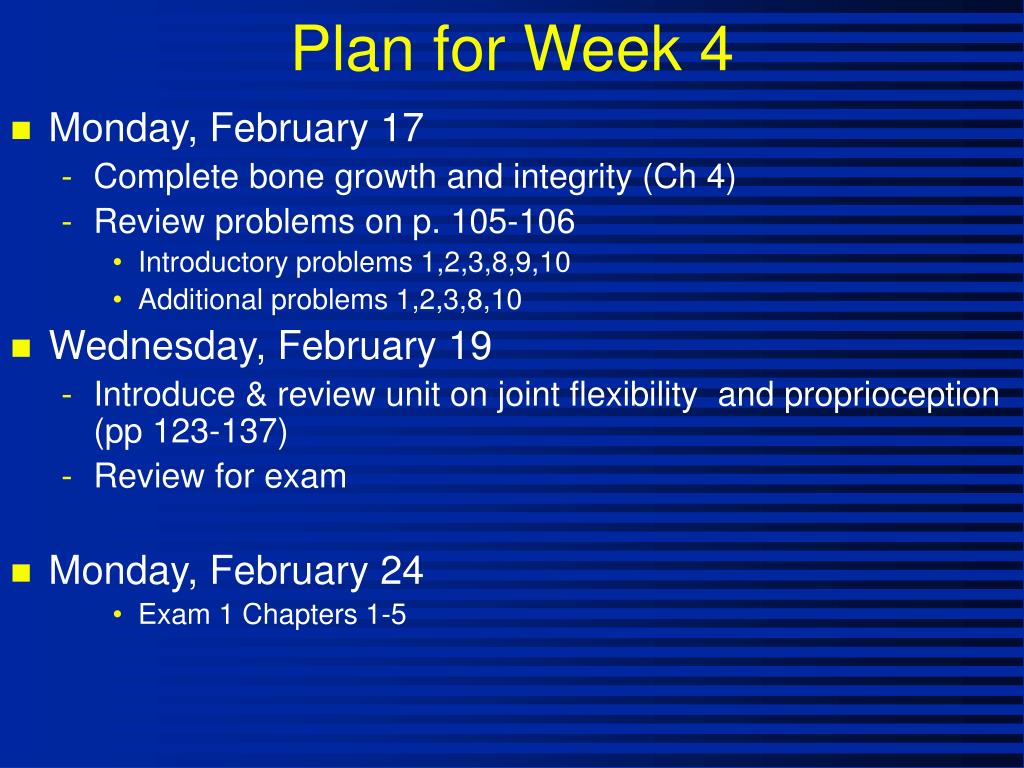
Plan for Week 4. Monday, February 17 Complete bone growth and integrity (Ch 4) Review problems on p. 105-106 Introductory problems 1,2,3,8,9,10 Additional problems 1,2,3,8,10 Wednesday, February 19 Introduce & review unit on joint flexibility and proprioception (pp 123-137)
Plan for Week 4 - slide 1
01 / 17Plan for Week 4
1 / 17

Télécharger la présentation

Plan for Week 4
Une image / un lien ci-dessous est fourni (tel quel) pour télécharger la présentation

Politique de téléchargement : le contenu du site vous est fourni TEL QUEL pour votre information et votre usage personnel ; il ne peut être vendu, concédé sous licence ni partagé sur d’autres sites sans l’accord de son auteur.Le contenu vous est fourni TEL QUEL, pour votre information et votre usage personnel uniquement. Téléchargez la présentation en cliquant sur ce lien. Lors du téléchargement, si vous ne parvenez pas à télécharger une présentation, l’éditeur a peut-être supprimé le fichier de son serveur.Pendant le téléchargement, si vous ne parvenez pas à obtenir une présentation, le fichier a peut-être été supprimé par l’éditeur.

F I N

Plus de contenu associé

Transcription de la présentation
  1. Plan for Week 4 • Monday, February 17 • Complete bone growth and integrity (Ch 4) • Review problems on p. 105-106 • Introductory problems 1,2,3,8,9,10 • Additional problems 1,2,3,8,10 • Wednesday, February 19 • Introduce & review unit on joint flexibility and proprioception (pp 123-137) • Review for exam • Monday, February 24 • Exam 1 Chapters 1-5

  2. Questions on Bone Growth & Dev • Why is bone density related to body weight? • What factors contribute to increase in bone density? • When and why is there a period of lower bone density in young people? • Name 3 factors essential for an increase in bone strength. • Why is osteoporosis mostly a problem with females and the aged? • How do we prevent it? • Is there a relationship between bone health in older people (50+ years) and bone density in youth?

  3. Position Statement of ACSM on Osteoporosis http://www.acsm.org/ • Weight-bearing physical activity is essential for developing and maintaining a healthy skeleton • Strength exercises may also be beneficial, particularly for non-weightbearing bones • An increase in physical activity for sedentary women can prevent further inactivity-related bone loss and can even improve bone mass • Exercise is not an adequate substitute for postmenopausal hormone replacement • Ex programs for older women should include activities for improving strength, flexibility, and coordination, to lessen the likelihood of falls

  4. Bone Growth &Structure Summary • Quality of mechanical properties depends on • age (bmc peaks in 20’s, declines 2 % per decade after 30) • nutritional status - what nutrients are important? • type of bone - trabecular or cortical • hormonal status -which hormones? • duration and magnitude of stress • Osteoporosis – nature & prevalence • Affects aged and mostly females. Why? • How do we prevent it? • Website on osteporosis: http://www.nof.org National Osteoporosis Foundation

  5. Objectives • Identify factors contributing to joint stability and flexibility. • Discuss role of proprioceptors in musculotendinous stretching exercises • Discuss characteristics of effective flexibility exercises, including PNF. • Discuss common joint injuries and pathologies

  6. Joint flexibility – Range of Motion (ROM) • Static vs dynamic • Active vs passive • Measuring joint range of motion • Direct measurement – • Goniometer (Fig 5.9, p 127) • Leighton flexometer (Fig 5.10, p 127) • Indirect & composite – e.g., sit and reach • Factors influencing joint flexibility • Shape of articulating bone surfaces (ex.: forearm extension) • Intervening muscle and fat (ex. : forearm flexion) • Length of ligaments and musculotendinous units crossing joint • Flexibility and injury – • Increased potential for injury when ROM is high, low, or imbalanced

  7. Measurement of Flexibility Direct Indirect, or composite

  8. Techniques for increasing joint flexibility • Focus is on increasing length of musculotendinous units crossing the joint • Neuromuscular response to stretch • The sensory unit • Consists of receptors, sensory neuron • Role is to provide feedback to provide body position and muscle-tendon condition sense & to enable motor control • Proprioceptors • cutaneous receptors (pressure-sensitive) • Joint receptors • pressure-sensitive Pacinian corpuscles • Position and velocity-sensitive Ruffini endings • Tendon receptors (stretch-sensitive golgi tendon organ, or GTO) • Muscle receptors (stretch-sensitive muscle spindle) • Role of proprioception in skilled movement & flexibility Goal of stretching is to minimize spindle effect and maximize GTO effect.

  9. Muscle spindle

  10. Increasing flexibility • Active and passive stretching • Ballistic and static stretching • Proprioceptive Neuromuscular Facilitation:

  11. Proprioceptive Neuromuscular Facilitation (PNF) • A group of stretching procedures involving alternating contraction and relaxation of the muscles being stretched. • Done to take advantage of GTO response. • Requires partner or clinician • Contract-relax-antagonist-contract technique • Agonist-contract-relax method • Can significantly increase joint ROM over single stretching session.

  12. Common jt injuries and pathologies • Sprains- stretching or tearing of ligaments, tendons, and connective tissues crossing a joint • Dislocations – displacement of the articulating bones at a joint • Bursitis – inflammation of bursae • Arthritis – inflammation with pain and swelling • Rheumatoid arthritis • autoimmune system disorder • Osteoarthritis • Joint-specific, due to wear and tear • Website on bone and joint injuries: • http://www.arthroscopy.com/ • Introductory problems, p 136: 3,4,5,7,8,9,10 • Additional problems, p 137: 2,6,7,10