Download
1 / 22
220 likes | 375 Vues
This comprehensive overview provides key concepts on U.S. government structure, including federalism, popular sovereignty, and separation of powers. It explores the differences between free enterprise and communism, examines the significance of essential historical documents like the Constitution and the Bill of Rights, and defines various map types. Additionally, it addresses cultural borrowing, drug issues in Colombia, and the impact of NAFTA. Understand the important distinctions between industrialized and developing nations.

E N D
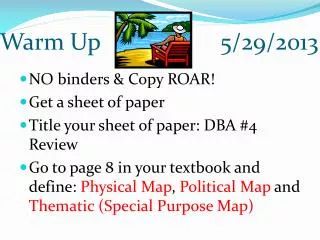
Warm Up 5/29/2013 • NO binders & Copy ROAR! • Get a sheet of paper • Title your sheet of paper: DBA #4 Review • Go to page 8 in your textbook and define: Physical Map, Political Map and Thematic (Special Purpose Map)
Federalism, Sovereignty & Separation of Powers • Federalism – power divided between state and national gov’t. • Popular Sovereignty– government that gains power from the people. • Separation of powers – checks and balances.
Cultural Borrowing & Diffusion • Borrowing – When a group of people adopt another’s traits. • EX. Americans wearing skinny jeans from France • EX. American eating Sushi from Japan • Diffusion – process of spreading new knowledge and skills to another group • EX. Christopher Columbus spreading Christianity to the native people.
Free Enterprise VS Communism • Free Enterprise – decisions are made by citizen business owners • EX. USA • Communism – decisions made by the government • EX. North Korea
Branches of Government • Legislative – make laws • Congress – senate and house of representatives • Judicial – interprets laws • Supreme Court • Executive – Enforces Laws • President, Vice-President and Cabinet
NAFTA • North American Free Trade Agreement • No trade barriers such as tariffs • Brings money into all 3 countries • Maquiladoras – factories built in border towns where labor is cheaper than the United States
Bolivia & Chile • Remember foldable? • Countries that are very close together but are very different because of the transportation barrier. • Andes Mountains
Columbia’s War on Drugs • Drug dealers pay farmers to grow coca. • Must grow coca or they lose their farms. • Drugs are sent to the United States and Europe.
Maps • Physical – map that shows only physical features • EX. Mountains, rivers, lakes … • Political – map that show man made features • EX. Cities, capitals, states, countries … • Thematic – map that only shows a specific topic • EX. Population density map
Preamble • introduction statement of the constitution • Tells what you will find in the constitution • We the people …
Bill of Rights • Guarantees your rights as a US citizen • 1 – RAPPS • 2 – Bear Arms • 3 – No Quartering • 4 – No illegal search and seizure • 5 – no incriminating yourself • 6 – speedy trial • 7 – trial by jury • 8 – no cruel or unusual punishment • 9 – rights not listed are given to YOU! • 10 – powers not given to the national government are given to the states (Federalism)
Types of Industry • Agriculture • Wholesale • Retail • Manufacturing • Service
Voting • Important right of US citizen
13th, 14th, 15th, & 19th • 13 – freed the slaves • 14 – made everyone equal citizens • 15 – equal voting rights (MEN!) • 19 – Women’s right to vote
Industrialized VS Developing • Industrialized (Developed) • High standard of living and developed industrial base • countries in Europe and North America • Developing • low living standard and underdeveloped industrial base • countries in Africa , Asia and Latin America
Important Documents • Constitution • 1787 • James Madison “Father of the U.S. Constitution” • Declaration of Independence • 1775 • Thomas Jefferson
Barriers and Corridors • Barrier – mountain, desert • Corridor – canal, river, strait