Understanding Newton's Laws: Inertia and Motion in Classical Physics
70 likes | 202 Vues
This lesson explores Newton's Laws of Motion, focusing on the concept of inertia. Through a warm-up activity involving LMU students on a moving float, we analyze how motion is affected by forces. We review key definitions and the foundational principles of classical physics, highlighting both the First Law, which states that objects in motion remain in motion unless acted upon, and the Second Law, represented by the formula F=ma. Students will engage in exercises, discussions, and homework to deepen their understanding of these concepts.


Understanding Newton's Laws: Inertia and Motion in Classical Physics
E N D
Presentation Transcript
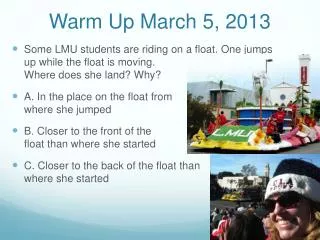
Warm Up March 5, 2013 • Some LMU students are riding on a float. One jumps up while the float is moving. Where does she land? Why? • A. In the place on the float from where she jumped • B. Closer to the front of the float than where she started • C. Closer to the back of the float than where she started
Agenda • Warm Up • Review HW • 10.3 Notes • First Law Investigation Lab • Cool Down
10.3 Newton’s 1st and 2nd Laws • Sir Isaac Newton came up with 3 laws used to describe motion. • These form the foundation of Classical Physics. • Newton’s Law work well for describing motion of human-sized objects (not atoms or galaxies) near earth. • Einstein expanded on Newton’s laws and formed the foundation of Modern Physics
The First Law • An object in motion will stay in straight-line motion and an object at rest will stay at rest unless acted on by an outside force. • Also called the Law of Inertia
Inertia • Inertia is the tendency of an object to resist changes in motion. • Inertia depends on mass. More massive objects have more inertia.
The Second Law • F= ma • The Second Law states that force depends on mass and acceleration
Cool Down • Title: Inertia Circle Map • P. 392 #1a-c, #2a-c • 10.3 Vocabulary Booklet (1 word on p. 389) Homework