Download
1 / 10
100 likes | 221 Vues
This resource delves into fundamental astronomical concepts discussed in the classroom, particularly focusing on apparent and absolute magnitude, the color spectrum of stars, and the lifecycle of stars. Students will explore the mechanics behind stellar classification, the fate of stars, including black holes, and the movement of stars in the night sky. The content also includes homework assignments aimed at reinforcing these concepts and preparing for summative assessments on the sun and stars.

E N D
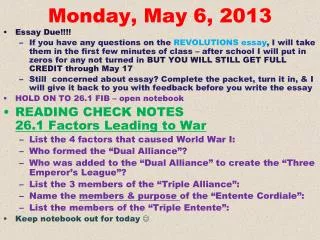
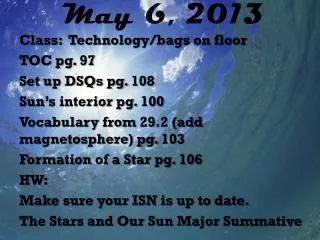
May 6, 2013 Class: Technology/bags on floor TOC pg. 97 Set up DSQs pg. 108 Sun’s interior pg. 100 Vocabulary from 29.2 (add magnetosphere) pg. 103 Formation of a Star pg. 106 HW: Make sure your ISN is up to date. The Stars and Our Sun Major Summative
DSQ #1 pg. 108 5/6/13 Q: What is the difference between apparent magnitude and absolute magnitude? A:
May 7, 2013 Class: Technology/bags on floor TOC pg. 97 DSQ #2 pg. 108 The Sun Lab pg. 110 HW: None
DSQ #2 pg. 108 5/7/13 Q: List the colors of the stars from hottest to coolest. A:
May 8, 2013 Class: Technology/bags on floor TOC pg. 97 DSQ #3 pg. 108 Comparing Apparent Magnitudes pg. 111 HW: Start working on your review (pg. 107) for Sun/Stars major summative.
DSQ #3 pg. 108 5/8/13 Q: Do all stars become black holes? Why or why not? A:
May 9, 2013 Class: Technology/bags on floor TOC pg. 97 DSQ #5 pg. H-R Diagram pg. 104-105 HW: Mini summative on H-R tomorrow
DSQ #4 pg. 108 5/9/13 Q: Why do stars appear to move in the night sky? A:
May 10, 2013 Class: Technology/bags on floor TOC pg. 97 DSQ #4 pg. 108 The Stars and Our Sun Review part 2 pg. HW: Study for tomorrow’s mini.
DSQ #5 pg. 108 5/10/13 Q: What will happen to the amount of hydrogen and helium in the sun over time? A: