The Interplay of Human and Physical Systems in Sub-Saharan Africa
150 likes | 359 Vues
This unit explores the dynamic interactions of physical and human systems that have influenced contemporary Sub-Saharan Africa. It examines the migration impacts of groups like the Bantu and Zulu on the region's economic, cultural, and political landscapes. Further, it analyzes strengths and weaknesses in development, including diversity in languages, tribes, religions, literacy levels, and the effects of colonial legacies. The study also highlights the major customs and traditions of various ethnic and religious groups, shedding light on the intricate tapestry of African culture.


The Interplay of Human and Physical Systems in Sub-Saharan Africa
E N D
Presentation Transcript
SSWG4The student will describe the interaction of physical and human systems that have shaped contemporary Sub-Saharan Africa.e. Analyze how the migration of people such as the Bantu and Zulu have impacted the economic cultural and political aspects of Sub-Saharan Africa.f. Analyze the strengths and weaknesses in the development of Sub-Saharan Africa including factors such as linguistic, tribal, and religious diversity, literacy levels, and the colonial legacy.g. Describe the ethnic and religious groups in Sub-Saharan Africa including major customs and traditions. Unit 7 African Culture
Ethnic Groups West & Central Africa: • Follow African, Islam, and European culture East Africa: • 100’s of different ethnic groups • Different languages, traditions, & religions • A reason for so much conflict in area
Ethnic Groups continued South Africa: • Mixture of Africans and Afrikaners • Africans include Zulu and Bantu ancestry • Afrikaners: white South Africans with European ancestry • Speak own language
Language West & Central Africa: • 100’s of different African languages spoken • English and French are spoken East Africa: • Many different African languages including Bantu
Language continued South Africa: • Many different African languages • Many people speak Bantu • White population speaks English and Afrikaans • Afrikaans: version of Dutch • Official language of South Africa
Religion West & Central Africa: • Christianity, Islam, and traditional African religions • African religion: believe in the power of their ancestor’s spirits—ancestor worship • Seek advice and help from sickness from spirits • African religion led by a shaman • Shaman: acts as link between the natural and supernatural worlds, uses magic to cure illness, foretells the future, and controls spiritual forces
Cannibalism • Cannibalism: eating of human flesh by humans • Found in West & Central Africa • Believed that eating the organs or pieces of the person would absorb their abilities and talents • Also related to sorcery and witchcraft
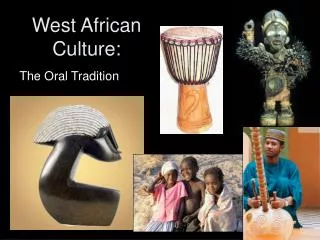
African Art • Originally meant to serve a religious purpose • Earliest forms of African art were rock paintings • Later forms of African art would be wooden sculptures/carvings • Carvings would represent gods, spirits, ancestors
Oral History • most African civilizations kept oral histories • stories of events & families that people memorized & passed from one generation to the next • much of the information was lost over time • Storytellers were usually called griots • Griots were able to keep many African traditions/stories alive
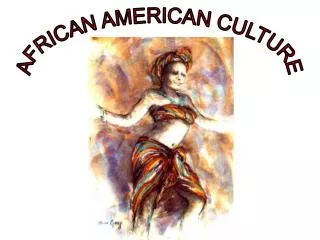
African Dance • Originally intended for religious purposes • Heavy rhythmic beats have strongly influenced Western music • Movements in African dance were meant to represent spirits expressing themselves through humans • Examples: • Dances of Love: usually performed at weddings • Rites of Passage Dances: usually performed by young men/women to show their entrance in adulthood
African Music • Served religious purpose/social purpose • Used to pass on to young people information about the history of different communities • Words in song served to transmit folk legends/religious traditions from generation to generation • Important feature was strong rhythmic patternsachieved through either drums, bells, harps, sticks beating together or hand clapping
African Music continued 3 Features of music: 1. Strong rhythmic patterns • Used drums, bells, harps, sticks beating together or hand clapping 2. Mixture of voice and music 3. Leader would sing a short piece and people would repeat it back to the drum beat
African Music continued • African music brought to North America through slavery • Slaves would use songs/music as a way to make their work seem less burdensome • Also used to lament the loss of their freedom and homeland • African music led to other forms of Western music such as rock, rap, blues, jazz, gospel