Finding Distance ND Using the Incenter and Angle Bisector Concurrency Theorem
In triangle ABC, the incenter N is the point where the angle bisectors meet and is equidistant from the sides. To find the length ND, we can derive it using the congruency of angle bisectors. By establishing the relationship between segments in triangle A and using the Pythagorean Theorem, we can substitute known values and solve for ND. In the guided practice example, if given BF = 12 and BN = 13, you can apply similar methods to determine ND.

Finding Distance ND Using the Incenter and Angle Bisector Concurrency Theorem
E N D
Presentation Transcript
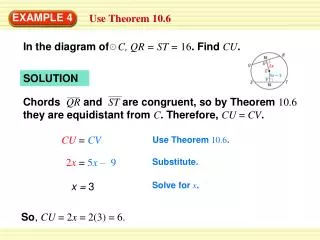
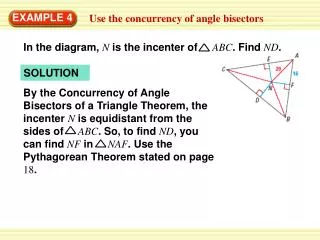
In the diagram, Nis the incenter of ABC. Find ND. By the Concurrency of Angle Bisectors of a Triangle Theorem, the incenter Nis equidistant from the sides of ABC. So, to find ND, you can find NFin NAF. Use the Pythagorean Theorem stated on page 18. EXAMPLE 4 Use the concurrency of angle bisectors SOLUTION
2 2 2 c = a + b 400 = 2 NF + 256 2 144 = NF 12 = NF 2 2 2 20 = NF + 16 EXAMPLE 4 Use the concurrency of angle bisectors Pythagorean Theorem Substitute known values. Multiply. Subtract 256 from each side. Take the positive square root of each side. Because NF = ND, ND = 12.
ANSWER 5 for Example 4 GUIDED PRACTICE WHAT IF? 5. In Example 4, suppose you are not given AF or AN, but you are given that BF = 12 and BN = 13. Find ND.