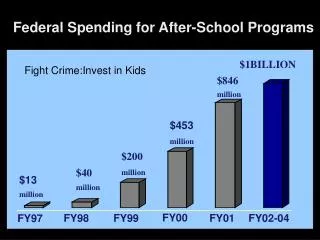
Federal Spending for After-School Programs
70 likes | 200 Vues
This report outlines the critical need for federal funding in after-school programs, highlighting a proposed investment of $1 billion to create a safer environment for children and reduce crime rates. It discusses the historical context of after-school initiatives, the struggle for sufficient funding, the importance of professionalization, and the economic impact on students who drop out. The document emphasizes the positive correlation between after-school engagement and student success, presenting a compelling case for prioritizing education and youth services to foster community safety and development.


Federal Spending for After-School Programs
E N D
Presentation Transcript
Federal Spending for After-School Programs $1BILLION Fight Crime:Invest in Kids $846 million $453 million $200 million $40 million $13 million FY00 FY97 FY98 FY99 FY01 FY02-04
Crime and Safety Changes in Family and Work Emphasis on Education PUBLIC WILL: Funding for Afterschool
HISTORY OF After School Programs • STUGGLE FOR IDENTITY • “Counter Point” to School • Pressure to Over-Promise and • Compensate for Others • Underfunded and Undervalued
HISTORY OF After School Programs • STUGGLE FOR IDENTITY • Reliance on Part-Time and Volunteers • Concerns About Professionalization, • Standards, Quality • A Questioning of Outcomes and Accountability
The Costs of Dropping Out • earn almost $450,000 less • $2 million less than those who obtain a Bachelors Degree • spend 20 years, on average, living in poverty
The Teen Initiative: Why?:Lives • High School Drop Outs Vs. Graduates: • Mortality rate: 300% higher • Arrests: 350% higher Center for Labor Market Studies
Learning and Development: Whose Job is it?