Infix to postfix conversion
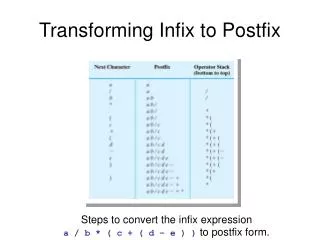
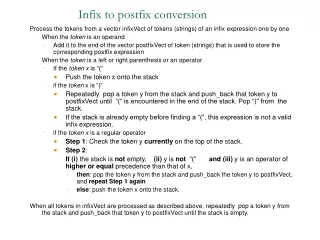
This guide explains the process of converting infix expressions to postfix using a stack-based approach. The process involves reading characters from left to right, handling operands, operators, and parentheses according to specific rules. When encountering operands, they are directly output to the postfix expression. Parentheses dictate the handling of operators to ensure correct precedence. By following these steps, you can efficiently convert complex expressions into a format suitable for stack-based evaluation.

Infix to postfix conversion
E N D
Presentation Transcript
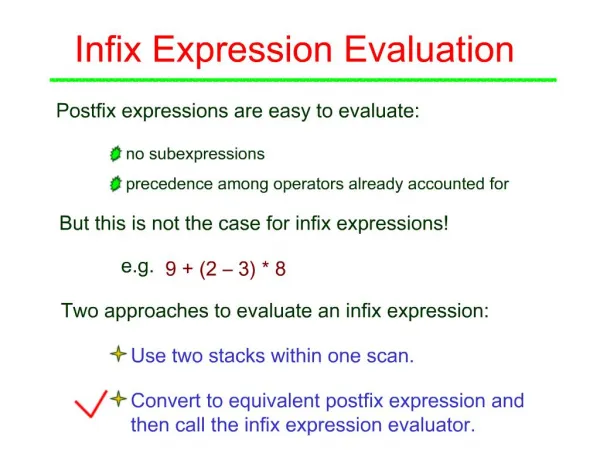
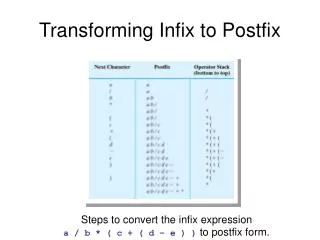
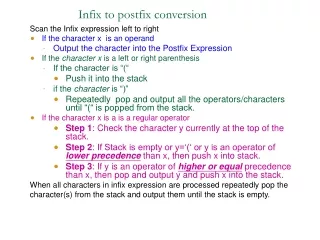
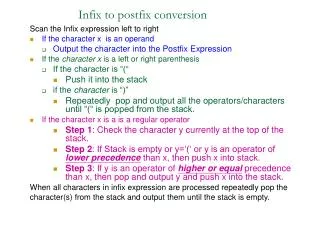
Infix to postfix conversion Scan the Infix expression left to right • If the character x is an operand • Output the character into the Postfix Expression • If the character x is a left or right parenthesis • If the character is “(“ • Push it into the stack • if the character is “)” • Repeatedly pop and output all the operators/characters until “(“ is popped from the stack. • If the character x is a is a regular operator • Step 1: Check the character y currently at the top of the stack. • Step 2: If Stack is empty or y=‘(‘ or y is an operator of lower precedence than x, then push x into stack. • Step 3: If y is an operator of higher or equal precedence than x, then pop and output y and push x into the stack. When all characters in infix expression are processed repeatedly pop the character(s) from the stack and output them until the stack is empty.
Infix to postfix conversion Stack Infix Expression ( a + b - c ) * d – ( e + f ) Postfix Expression
Infix to postfix conversion Stack Infix Expression a + b - c ) * d – ( e + f ) Postfix Expression (
Infix to postfix conversion Stack Infix Expression + b - c ) * d – ( e + f ) Postfix Expression a (
Infix to postfix conversion Stack Infix Expression b - c ) * d – ( e + f ) Postfix Expression a + (
Infix to postfix conversion Stack Infix Expression - c ) * d – ( e + f ) Postfix Expression a b + (
Infix to postfix conversion Stack Infix Expression c ) * d – ( e + f ) Postfix Expression a b + - (
Infix to postfix conversion Stack Infix Expression ) * d – ( e + f ) Postfix Expression a b + c - (
Infix to postfix conversion Stack Infix Expression * d – ( e + f ) Postfix Expression a b + c -
Infix to postfix conversion Stack Infix Expression d – ( e + f ) Postfix Expression a b + c - *
Infix to postfix conversion Stack Infix Expression – ( e + f ) Postfix Expression a b + c - d *
Infix to postfix conversion Stack Infix Expression ( e + f ) Postfix Expression a b + c – d * -
Infix to postfix conversion Stack Infix Expression e + f ) Postfix Expression a b + c – d * ( -
Infix to postfix conversion Stack Infix Expression + f ) Postfix Expression a b + c – d * e ( -
Infix to postfix conversion Stack Infix Expression f ) Postfix Expression a b + c – d * e + ( -
Infix to postfix conversion Stack Infix Expression ) Postfix Expression a b + c – d * e f + ( -
Infix to postfix conversion Stack Infix Expression Postfix Expression a b + c – d * e f + -
Infix to postfix conversion Stack Infix Expression Postfix Expression a b + c – d * e f + -