Postfix Notation and Stacks in Computing
1.02k likes | 1.08k Vues
Learn about infix, postfix, and stack ordering, including opcode precedence and conversion examples. Postfix ideal for hardware implementation with stacks and evaluating expressions.


Postfix Notation and Stacks in Computing
E N D
Presentation Transcript
Ordering of opcodes and operands • Another example of syntax is the ordering of opcode and operand(s). • Postfix: operand(s) then opcode • 4 5 + • Works well with stacks • Prefix: opcode then operand(s) • + 4 5 • Infix: operand opcode operand • 4 + 5
Precedence • Precedence is the order in which operations occur when an expression contains more than one operation. • Operations with higher precedence are performed before operators with lower precedence. • 1 + 2 * 3 - 4 • 1 + 6 - 4 (multiplication has higher precedence) • 7 - 4 (start on the left when operators have the same precedence) • 3
Infix to postfix • To convert 1+2*3-4, put in parentheses even though they’re not strictly necessary for this expression • ((1+(2*3))-4) • Convert the innermost parentheses to postfix: 2*3 becomes 2 3 * • ((1+(2 3 *))-4) • Once a group is in postfix order, it should be thought of as a unit (in particular as a single operand (data)), nothing should come in between any of the parts of the group • Convert the next set of parentheses • ((1 2 3 * +)-4)
Infix to postfix • The last step eliminated the innermost set of parentheses. Continue to convert from infix to postfix from the innermost to outermost parentheses. • (1 2 3 * + 4 -) • Note there is one overall set of parentheses that can be thrown away. Also note that the order of the numbers has not changed.
Another example • 1+ (2+3) * 4 + (5 + 6) * ((7 + 8) * 9) • Add parentheses • 1+ ((2+3) * 4) + ((5 + 6) * ((7 + 8) * 9)) • Add parentheses • (1+ ((2+3) * 4)) + ((5 + 6) * ((7 + 8) * 9)) • Add parentheses • ((1+ ((2+3) * 4)) + ((5 + 6) * ((7 + 8) * 9))) • Convert innermost to postfix • ((1+ ((2 3 +) * 4)) + ((5 6 +) * ((7 8 +) * 9)))
Another Example (Cont.) • ((1+ ((2 3 +) * 4)) + ((5 6 +) * ((7 8 +) * 9))) • ((1+ (2 3 + 4 * )) + ((5 6 +) * (7 8 + 9 * ))) • ((1 2 3 + 4 * +) + (5 6 +7 8 + 9 * *)) • ( 1 2 3 + 4 * + 5 6 +7 8 + 9 * * + )
Postfix good for Hardware • Postfix order is better suited for hardware since one must prepare the inputs (a.k.a. the data, a.k.a. the operands) before operating on them to get an output. • Postfix is particularly well suited for architectures that use a stack to perform computations.
The stack • A stack is a data structure (which may be implemented in hardware or in software) that holds a sequence of data but limits the way in which data is accessed. • A stack obeys the Last-In-First-Out (LIFO) protocol, the last item written (pushed) is the first item to be read (popped).
Stack 2 is pushed onto the stack 2 is popped off of the stack 4 2 3 3 1 1 1 1 1
Stack Pointer: don’t move all the data just change the pointer The stack pointer is pointing to the next available location in the stack. When it’s pointing at the 2, the 2 is no longer on the stack.
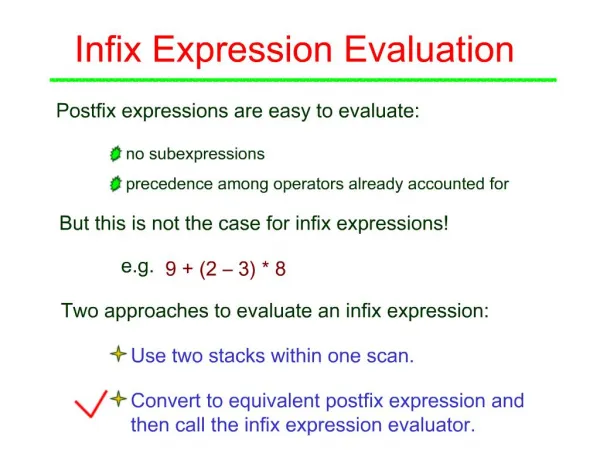
Infix Evaluation • 1+ (2+3) * 4 + (5 + 6) * ((7 + 8) * 9) • 1+(5)*4 + (11)*((15)*9) • 1 + 20 + 11*135 • 1 + 20 + 1485 • 21 + 1485 • 1506
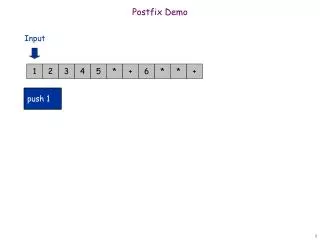
Evaluating a postfix expression using a stack (1) Enter the postfix expression and click Step
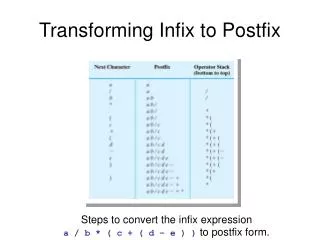
Infix to Postfix (Approach 1) • 9 + (8 + 7) * 6 + 5 * (4 + (3 * 2 + 1)) • Introduce parentheses that do not change the order of operations • 9 + (8 + 7) * 6 + 5 * (4 + ((3 * 2) + 1)) • 9 + ((8 + 7) * 6) + (5 * (4 + ((3 * 2) + 1))) • (9 + ((8 + 7) * 6)) + (5 * (4 + ((3 * 2) + 1))) • ((9 + ((8 + 7) * 6)) + (5 * (4 + ((3 * 2) + 1)))) • Note that there are nine operands, eight operators, eight left parentheses and eight right parentheses.
Infix to Postfix (Approach 1, Cont.) • ((9 + ((8 + 7) * 6)) + (5 * (4 + ((3 * 2) + 1)))) • Convert the innermost parentheses to postfix • ((9 + ((8 7 +) * 6)) + (5 * (4 + ((3 2 *) + 1)))) • ((9 + ((8 7 +) 6 *)) + (5 * (4 + ((3 2 *) 1 +)))) • ((9 ((8 7 +) 6 *) +) + (5 * (4 ((3 2 *) 1 +) +))) • ((9 ((8 7 +) 6 *) +) + (5 (4 ((3 2 *) 1 +) +) *)) • ((9 ((8 7 +) 6 *) +) (5 (4 ((3 2 *) 1 +) +) *) +) • 9 8 7 + 6 * +5 4 3 2 * 1 + + * +
Backwards • 9 8 7 + 6 * +5 4 3 2 * 1 + + * + • 9 (8 + 7) 6 * +5 4 3 2 * 1 + + * + • 9 ((8 + 7) * 6) +5 4 3 2 * 1 + + * + • (9 + ((8 + 7) * 6)) 5 4 3 2 * 1 + + * + • (9 + ((8 + 7) * 6)) 5 4 (3 * 2) 1 + + * + • (9 + ((8 + 7) * 6)) 5 4 ((3 * 2) + 1) + * + • (9 + ((8 + 7) * 6)) 5 (4 + ((3 * 2) + 1)) * + • (9 + ((8 + 7) * 6)) (5 * (4 + ((3 * 2) + 1))) + • (9 + ((8 + 7) * 6)) + (5 * (4 + ((3 * 2) + 1)))
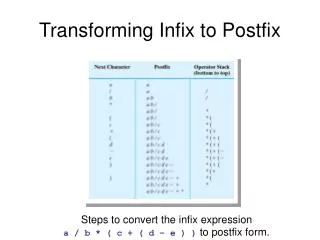
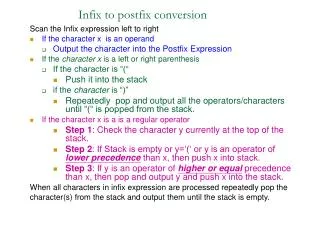
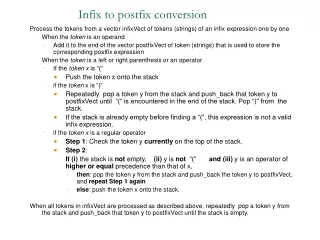
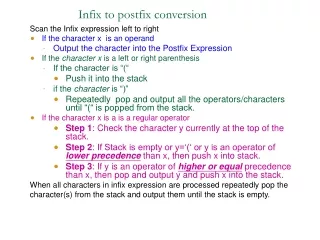
Infix to Postfix • The approach taken for converting infix to postfix does not make for a good algorithm as it requires too many passes. • One passes over the expression introducing parentheses • One pass over the expression converting inner parentheses to postfix • Fortunately there is a more efficient algorithm that requires only one pass through the expression.