SlideServe
Menu
Préférences
© SlideServe · v2026

The Case of Phineas Gage 1848

anne avatar
10 diapositives · 602 Views · Jul 21, 2014

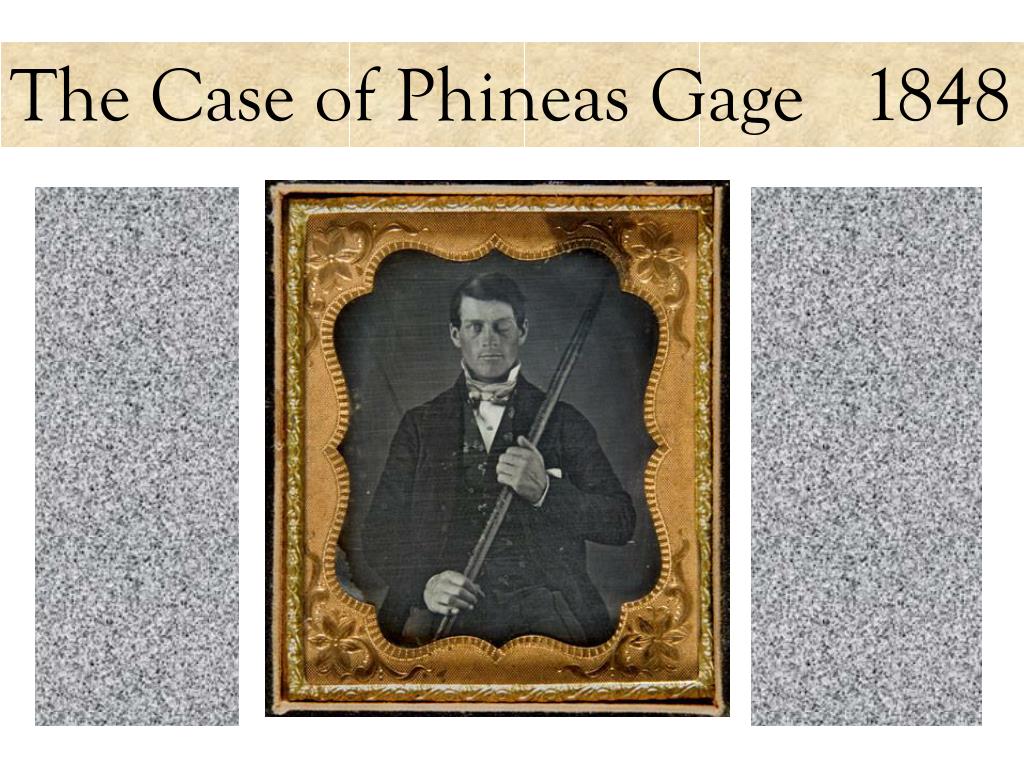
The Case of Phineas Gage 1848. On or near this site in Cavendish, Vermont , workers were using black powder to break up the rock of this railroad embankment . Phineas Gage, age 25, was a foreman at the site. .
The Case of Phineas Gage 1848 - slide 1
01 / 10The Case of Phineas Gage 1848
1 / 17

Télécharger la présentation

The Case of Phineas Gage 1848
Une image / un lien ci-dessous est fourni (tel quel) pour télécharger la présentation

Politique de téléchargement : le contenu du site vous est fourni TEL QUEL pour votre information et votre usage personnel ; il ne peut être vendu, concédé sous licence ni partagé sur d’autres sites sans l’accord de son auteur.Le contenu vous est fourni TEL QUEL, pour votre information et votre usage personnel uniquement. Téléchargez la présentation en cliquant sur ce lien. Lors du téléchargement, si vous ne parvenez pas à télécharger une présentation, l’éditeur a peut-être supprimé le fichier de son serveur.Pendant le téléchargement, si vous ne parvenez pas à obtenir une présentation, le fichier a peut-être été supprimé par l’éditeur.

F I N

Plus de contenu associé

Transcription de la présentation
  1. The Case of Phineas Gage 1848

  2. On or near this site in Cavendish, Vermont, workers were using black powder to break up the rock of this railroad embankment. Phineas Gage, age 25, was a foreman at the site.

  3. The explosion threw a “tamping iron” into the air. This rod was 3 feet long, and 1.5 inches thick. Here, Gage is seen holding the iron…

  4. The iron passed directly through Gage’s brain…emerged out the top, and flew 80 feet further before hitting the ground.

  5. Gage was fully conscious withinminutes of the accident, and was soon sitting up and speaking to the doctor. Here is a newspaper report of the accident…

  6. Within weeks, Gage was walking, conversing, and claiming to feel no pain. He did not return to railroad work. Reports exist that say he appeared at PT Barnum’s American Museum in New York…along with the tamping iron, as a “Curiousity.”

  7. Gage’s recovery was seen as remarkable…but people soon noticed he had changed significantly in terms of Personality. “Some months after the accident, probably in about the middle of 1849, Phineas felt strong enough to resume work.  But because his personality had changed so much, the contractors who had employed him would not give him his place again.   He was now fitful, irreverent, and grossly profane, showing little deference for his fellows.  He was also impatient and obstinate, yet capricious and vacillating, unable to settle on any of the plans he devised for future action.  His friends said he was "No longer Gage”

  8. Gage lived for 12 more years after the accident. He died in 1860, and his headless remains are buried in San Francisco. His skull and the tamping iron are on display at the Warren Anatomical Museum at Harvard Medical School. The Skull of Phineas Gage

  9. ABC reporter Bob Woodruff after a roadside bombing in Iraq