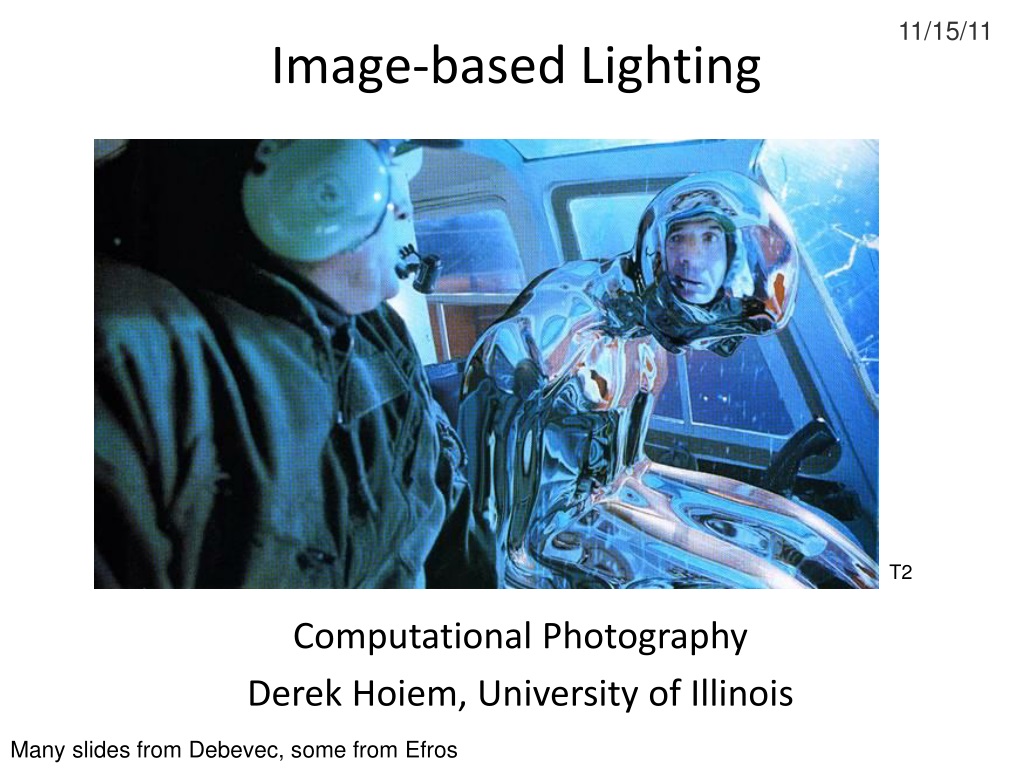
Image-based Lighting. 11/15/11. T2. Computational Photography Derek Hoiem, University of Illinois. Many slides from Debevec, some from Efros. Next two classes. Today Reminder on final project Go over some exam questions Start on ray tracing, environment maps, and relighting 3D objects
Une image / un lien ci-dessous est fourni (tel quel) pour télécharger la présentation
Politique de téléchargement : le contenu du site vous est fourni TEL QUEL pour votre information et votre usage personnel ; il ne peut être vendu, concédé sous licence ni partagé sur d’autres sites sans l’accord de son auteur.Le contenu vous est fourni TEL QUEL, pour votre information et votre usage personnel uniquement.Téléchargez la présentation en cliquant sur ce lien.Lors du téléchargement, si vous ne parvenez pas à télécharger une présentation, l’éditeur a peut-être supprimé le fichier de son serveur.Pendant le téléchargement, si vous ne parvenez pas à obtenir une présentation, le fichier a peut-être été supprimé par l’éditeur.
F I N
Plus de contenu associé
Transcription de la présentation
Image-based Lighting 11/15/11 T2 Computational Photography Derek Hoiem, University of Illinois Many slides from Debevec, some from Efros
Next two classes Today • Reminder on final project • Go over some exam questions • Start on ray tracing, environment maps, and relighting 3D objects Thursday • More HDR, light probes, etc.
Final Projects • To do (11/28 or sooner): Send me an e-mail with ~50 wordsummary of your project idea • Project page write-up due on Dec 8 (11:59pm) • Similar to other projects, but with some more detail on how to do it • Can be in html or pdf • Store at url below or include a link from there http://<username>.projects.cs.illinois.edu/cs498dwh/final/ • Class presentations on Dec 9 (1:30-4:30pm) • ~5 minutes per presentation • Project Grade • 10%: project proposal (full credit if on time, complete) • 70%: completion and ambition of project • 10%: clarity, completeness, extent of results • 10%: class presentation • No free late days • Details here: http://www.cs.illinois.edu/class/fa11/cs498dh/projects/Details%20for%20Final%20Projects.pdf
How to render an object inserted into an image? Traditional graphics way • Manually model BRDFs of all room surfaces • Manually model radiance of lights • Do ray tracing to relight object, shadows, etc.
How to render an object inserted into an image? Image-based lighting • Capture incoming light with a “light probe” • Model local scene • Ray trace, but replace distant scene with info from light probe Debevec SIGGRAPH 1998
Ray casting • Store colors of surfaces, cast out rays, see what colors each ray hits Wolfenstein 3D (1992)
Ray tracing: fast approximation Upon hitting a surface • Cast reflection/refraction ray to determine reflected or refracted surface • Cast shadow ray: go towards light and see if an object is in the way http://en.wikipedia.org/wiki/File:Ray_trace_diagram.svg
Ray tracing • Conceptually simple but hard to do fast • Full solution requires tracing millions of rays for many inter-reflections • Design choices • Ray paths: Light to camera vs. camera to light? • How many samples per pixel (avoid aliasing)? • How to sample diffuse reflections? • How many inter-reflections to allow? • Deal with subsurface scattering, etc?
Environment Maps • The environment map may take various forms: • Cubic mapping • Spherical mapping • other • Describes the shape of the surface on which the map “resides” • Determines how the map is generated and how it is indexed
Cubic Mapping • The map resides on the surfaces of a cube around the object • Typically, align the faces of the cube with the coordinate axes • To generate the map: • For each face of the cube, render the world from the center of the object with the cube face as the image plane • Rendering can be arbitrarily complex (it’s off-line) • To use the map: • Index the R ray into the correct cube face • Compute texture coordinates
Sphere Mapping • Map lives on a sphere • To generate the map: • Render a spherical panorama from the designed center point • Rendering with environment map: • Use the orientation of the R ray to index directly into the sphere
What approximations are made? • The map should contain a view of the world with the point of interest on the object as the Center of Projection • We can’t store a separate map for each point, so one map is used with the COP at the center of the object • Introduces distortions in the reflection, but we usually don’t notice • Distortions are minimized for a small object in a large room • The object will not reflect itself!
Real environment maps • We can use photographs to capture environment maps • The first use of panoramic mosaics • Fisheye lens • Mirrored balls (light probes)
One small snag • How do we deal with light sources? Sun, lights, etc? • They are much, much brighter than the rest of the environment . 1907 . 46 . 15116 . 1 . 18