67th IETF Meeting Agenda Overview - San Diego, CA
70 likes | 182 Vues
This document outlines the agenda for the 67th IETF meeting held in San Diego, CA, spearheaded by Jari Arkko and Mark Townsley. Key topics include updates on source address validation, multi-encapsulation discussions, and new work on SEND. The meeting also addresses documentation needs for legacy EAP methods. Participants will discuss IP mobility threat models, identity and location within IP, and review the ongoing progress of various drafts. This agenda sets the stage for collaborative efforts in the Internet Engineering Task Force.

67th IETF Meeting Agenda Overview - San Diego, CA
E N D
Presentation Transcript
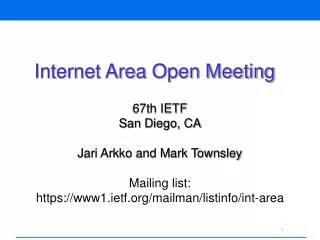
Internet Area Open Meeting 67th IETF San Diego, CA Jari Arkko and Mark Townsley Mailing list: https://www1.ietf.org/mailman/listinfo/int-area
Agenda, Part I Preliminaries (5 min) -- ADs Agenda bashing Blue sheets, scribes and jabber scribes Internet area status update(10 min) -- ADs Call for documenting legacy EAP methods (5 min) -- ADs Multiple Encapsulations (15 min) -- Aboba draft-iab-link-encaps-05.txt
Agenda, Part II Source Address Validation(20 min) -- Bonica www1.toools.ietf.org/bof/trac/wiki/WikiStart New work on SEND?(10 min) -- Kempf IP Mobility Threat Models(15 min) -- Narayanan Identity and Location in IP(30 min) -- Huston
Internet Area Status 67th IETF San Diego, CA Jari Arkko and Mark Townsley
BOF Status • Source Address Validation (SAVA) • Mobile Platform Internet (MPI) • Dual-Stack Moving Internet (DSMI)
“Area Document” Status • draft-fenner-iana-exp-2780-02.txt • AUTH48 • draft-bagnulo-cga-ext-02.txt • RFC 4581 • draft-laganier-ipv6-khi-05.txt • In 2nd IETF Last Call -- please comment! • draft-bagnulo-rfc3484-update-00.txt • No update • draft-bonica-internet-icmp-11.txt • Modified – also ongoing experiments • draft-cheshire-ipv4-acd-04.txt • Considering this – please review
Documenting Legacy EAP Methods • Many current EAP methods poorly documented • Ongoing efforts address new methods • But we would still like to improve documentation for the existing methods • Please submit your deployed method specification as an Individual Submission! • We have clarified the process, agreed with the RFC Editor and the IESG, and found reviewers