CNS Depressants: Drugs, Effects, and Evaluation
Learn about the history, common names, administration methods, and effects of CNS Depressants. Discover how to evaluate individuals under the influence of these drugs and answer study questions.

CNS Depressants: Drugs, Effects, and Evaluation
E N D
Presentation Transcript
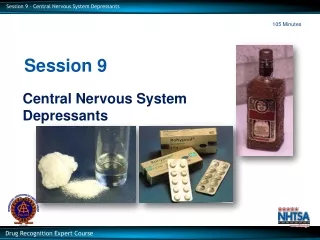
Session 9 105 Minutes Central Nervous System Depressants
Learning Objectives • Explain a brief history of the CNS Depressant category of drugs • Identify common drug names and terms associated with this category • Identify common methods of administration for this category • Describe the symptoms, observable signs and other effects associated with this category
Learning Objectives (Cont.) • Explain the typical time parameters, i.e. on-set and duration of effects associated with this category • List the clues that are likely to emerge when the drug influence evaluation is conducted for a person under the influence of this category of drugs • Correctly answer the “topics for study” questions at the end of this session
Chloral Hydrate (“Mickey Finn”) The first non-alcohol CNS depressant
Major Types of Sub Categories of CNS Depressants • Barbiturates • Non-Barbiturates • Anti-Anxiety Tranquilizers
Major Types of Sub Categories of CNS Depressants • Anti-Depressants • Anti-Psychotic Tranquilizers
Major Types of Sub Categories of CNS Depressants • Combinations
Some Combinations of Depressants • Chlordiazepoxide in combination with Amitriptyline Trade name: “Limbitrol” • Chlordiazepoxide Hydrochloride in combination with Clidinium Bromide Trade name: “Librax” • Perphenazine in combination with Amitriptyline Hydrochloride Trade name: “Triavil” and “Etrafon”
Methods of Ingestion CNS Depressants Orally Injection
Methods of Ingestion CNS Depressants (Cont.) Orally Injection
Possible Effects of CNS Depressants • Reduced inhibitions • Divided attention impairment • Slowed reflexes • Impaired judgment and concentration • Impaired vision • Lack of coordination • Slurred, mumbled or incoherent speech • Emotional instability
Possible Effects of CNS Depressants (Cont.) • Reduced inhibitions • Divided attention impairment • Slowed reflexes • Impaired judgment and concentration • Impaired vision • Lack of coordination • Slurred, mumbled or incoherent speech • Emotional instability
Onset and Duration Classes • Ultrashort Very fast acting, very brief effects • Short Fairly fast acting, effects last several hours • Intermediate Relatively slow acting but prolonged effects • Long Delayed but long-lasting effects
Onset and Duration Classes (Cont.) • Ultrashort Very fast acting, very brief effects • Short Fairly fast acting, effects last several hours • Intermediate Relatively slow acting but prolonged effects • Long Delayed but long-lasting effects
Short Acting CNS Depressants • They produce effects reasonably quickly • Effects last long enough to “enjoy” the effects • Most commonly abused class of CNS Depressants
Intermediate Acting CNS Depressants • Relatively slow acting, but prolonged effects • Generally take effect in about 30 minutes • Effects typically last about 6-8 hours
Long Acting CNS Depressants • Generally take effect about one hour after ingestion • Effects typically last 8-14 hours • Phenobarbital (Luminal), Diazepam (Valium), and Flurazepam (Dalmane) are examples
How would you classify Alcohol in terms of the onset and duration of its effects?
Examples of Short-to-Intermediate CNS Depressants Non-barbiturates • Noctec or Felsule(“Mickey Finn”) • Methaqualone (Quaalude) • Placidyl • Equanil or Miltown • Soma • Gamma Hydroxybutyrate (GHB) • Zolpidem (Ambien)
Examples of Short-to-Intermediate CNS Depressants (Cont.) Anti-anxiety tranquilizers • Valium • Librium • Xanax • Serax • Klonopin • Ativan • Rohypnol
Overdose Signs and Symptoms • Subject will become extremely drowsy and may pass out • The heartbeat (pulse) will be rapid and weak • Respiration will become shallow • Skin may feel cold and clammy
Danger • CNS Depressants combined with Alcohol • More than an additive effect
Evaluation of Subjects Under the Influence of CNS Depressants • HGN - Present • VGN - may be Present (with high doses for that individual) • Lack of Convergence - Present • Impaired performance will be evident on Modified Romberg, Walk and Turn, One Leg Stand and Finger to Nose
Evaluation of Subjects Under the Influence of CNS Depressants (Cont.) Vital Signs • Blood pressure - Down • Pulse - Down (2) • Body temperature - Normal (2) Quaaludes, ETOH and some anti-depressants may elevate Muscle Tone - Flaccid
Evaluation of Subjects Under the Influence of CNS Depressants (Cont.) Dark Room Examinations • Pupil size - Normal (1) • Pupillary reaction to light - Slow (1) Soma, Quaaludes and some anti-depressants usually dilate pupils
Evaluation of Subjects Under the Influence of CNS Depressants (Cont.) General Indicators: • Disoriented • Droopy eyelids (Ptosis) • Drowsiness • Drunk-like behavior • Flaccid muscle tone • Gait Ataxia • Slow, sluggish reactions • Thick, slurred speech • Uncoordinated
CNS Depressant Symptomatology Chart (1) Soma, Quaaludes and some anti-depressants usually dilate pupils (2) Quaaludes, ETOH and some anti-depressants may elevate
Drug Evaluation and Classification Exemplar Demonstrations