Computer Security: Problem
In today's digital age, threats such as outright theft, online scams, and viruses lead to billions in losses. To mitigate damage, understanding computer security is crucial. This guide covers key concepts like strong passwords, encryption methods, and best practices to protect your data. Explore the dynamics of classical and modern encryption, including the importance of securing passwords and avoiding pitfalls like brute force attacks. Delve into the roles of encryption in security vs. privacy and learn practical steps to safeguard your systems effectively.

Computer Security: Problem
E N D
Presentation Transcript
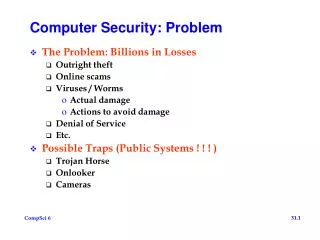
Computer Security: Problem • The Problem: Billions in Losses • Outright theft • Online scams • Viruses / Worms • Actual damage • Actions to avoid damage • Denial of Service • Etc. • Possible Traps (Public Systems ! ! ! ) • Trojan Horse • Onlooker • Cameras
Computer Security: Defenses • Passwords • Using Secure Passwords • Keeping them Secure • Encryption • Simple (Classical Encryption – Pre-Computer) • Strong (Modern – Computer Based) • Good Practices • Like all fields, doing something stupid … • Tradeoffs • Is the cure worse than the disease? • Long Live Common Sense!
Good Passwords and Cracking • Briefcase (style) Combination Locks • Brute force methods: Try allcombinations • Number of wheels • Number of position per wheel • Time per trial • How long does it take? • Contrast to BRUTE brute force method (Always Consider!) • Password on a computer • + More possibilities per “wheel” • + More “wheels” (often up to user) • - Computer based cracking faster! • - Dictionary attacks • Picking a good UNIX password
Classical Encryption • When passwords fail, encryption can be fallback • Also provides extra level of difficulty • Security vs. Privacy • Many levels of encryption sophistication: Go through some of them • Single Alphabetic Substitution • Caesar: L FDPH, L VDZ, L FRQTXHUHG • Magic decoder ring? • Cryptoquote • Cracking single alphabetic substitution • Character frequency -- ETAONIRSH • (Length of text)
Classical Encryption: Single Alphabet I F O J L K F J N D C E L N P N C X N D J L D V F F O J I D M R N J L U J F O V R M I F J M R F C M R S L K F C M S C N C M, D C N Q C D M S F C, K F C K N S P N E S C B S U N J M X, D C E E N E S K D M N E M F M R N G J F G F L S M S F C M R D M D B B A N C D J N K J N D M N E N H O D B. -- D B S C K F B C A 1 H 1 O 4 V 2 B 6 I 3 P 2 W 0 C 16 J 11 Q 1 X 2 D 14 K 7 R 6 Y 0 E 7 L 6 S 10 Z 0 F 15 M 15 T 0 G 2 N 18 U 2
Classical Encryption • Polyalphabetic Substitution • The Vignere Cypher • The Babbit Solution • How many alphabets used? • digraph frequency “th” • Several Single-Alphabet problems • Cypher Reuse ! • Bigger pool of data • Patterns become obvious • One Time Pads • Can be Absolutely Secure • Computers and Random Number Generators ?!
Classical Encryption • The Key Exchange Problem • Threats • Using your “secure” channel • A padlock analogy • Diffie, Hellman, and Merkle solution