Download
1 / 5
50 likes | 196 Vues
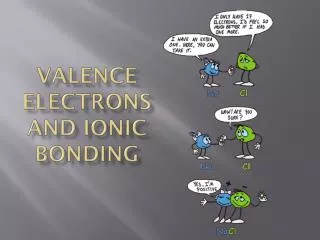
This overview discusses the concepts of valence electrons, Lewis dot structures, and ionic charges using the examples of sodium (Na) and chlorine (Cl). Sodium, a metal with an electron configuration of 1s² 2s² 2p⁶ 3s¹, forms a cation (Na⁺) by losing one electron. Chlorine, a nonmetal with an electron configuration of 1s² 2s² 2p⁶ 3s² 3p⁵, forms an anion (Cl⁻) by gaining one electron. Both elements strive for stability, with stable atoms having a complete outer shell of electrons, typically 8.

E N D
Stable atoms have 8 electrons (or 2 or 0 if they are small)
Metal: sodium • Electron configuration: 1s22s22p63s1 • Sketch of principal energy levels: (Na)2)8)1) • Lewis dot structure: (see the board) • Formation of ion: electron removed: Na1+ • Cation = positively charged ion (pronounced “cat ion” not “kay-shun”)
Nonmetal: chlorine • Electron configuration: 1s22s22p63s23p5 • Sketch of principal energy levels: (Cl)2)8)7) • Lewis dot structure: (see the board) • Formation of ion: electron added: Cl1- • Anion = negatively charged ion
Stable atoms have 8 electrons (or 2 or 0 if they are small)