
Radiosity
E N D
Presentation Transcript
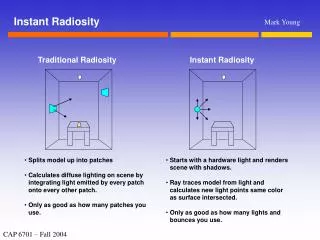
What is Radiosity • Borrowed from radiative heat transfer. • Assuming diffuse reflectance. • View independent solution.
Rendering Equation (Review) • g() removed. • () is related to BRDF.
Radiosity Equation – Single Patch • Discrete form: • Compared to Rendering Equation:
Form Factor Calculation • Analytical forms of form factors are possible for simple shapes only. • Form factor is reduced if a patch sees the other patch partially. • An approximation – Hemicube. • One hemicube for each patch.
Hemicube Patch j Hemicube Patch i
Solving the Linear Equation • Direct method: Gaussian Elimination O(n3) • Iterative method: Gauss-Seidel or Jacobi method O(n2)
Jacobi Iterations • Take a initial guess {xi0} , for i=1..n • Each iteration produces better {xi(k+1)} from {xi(k)}
Gauss-Seidel Variation • New xi’s in iteration k+1 are used whenever they are available. • That is: xi(k+1) uses x1(k+1)… xi-1(k+1) and xi+1(k)… xn(k) Iteration k+1 Iteration k
Progressive Refinement • Allowing the viewing of early incomplete solution • Start from the patch with greatest unshot radiosity. • Update receiving patches. Repeat.
Artifacts • Interpolation necessary to smooth out the patches. • Blocky shadow is still a problem. • Meshing resolution is important to the final quality.
Adaptive Meshing • Subdivide a patch if the radiosity variation is large.
Advanced Techniques • Discontinuity Meshing. • Hierarchical Radiosity. • See Watt’s Section 11.7.2 for details.
For Further Information • Hughes & van Dam’s book 31.10. • Watt’s book 10.3.2 and Chapter 11. (Pharr’s book doesn’t cover radiosity because it mainly uses Monte Carlo path tracing.)