
SlideServe
Menu
Préférences
© SlideServe · v2026

Understanding Cellular Respiration Process

arden-willis avatar
34 diapositives · 424 Views · Nov 08, 2014

Learn about cellular respiration, where protons and electrons combine with oxygen to form water, and the role of NADH and FADH2 in releasing hydrogen for energy production. Explore how respiration proceeds, or stops, at different stages such as glycolysis, and the conversion of pyruvate to lactic acid or ethanol in animals and plants.
Understanding Cellular Respiration Process - slide 1
01 / 34Understanding Cellular Respiration Process
1 / 17

Télécharger la présentation

Understanding Cellular Respiration Process
Une image / un lien ci-dessous est fourni (tel quel) pour télécharger la présentation

Politique de téléchargement : le contenu du site vous est fourni TEL QUEL pour votre information et votre usage personnel ; il ne peut être vendu, concédé sous licence ni partagé sur d’autres sites sans l’accord de son auteur.Le contenu vous est fourni TEL QUEL, pour votre information et votre usage personnel uniquement. Téléchargez la présentation en cliquant sur ce lien. Lors du téléchargement, si vous ne parvenez pas à télécharger une présentation, l’éditeur a peut-être supprimé le fichier de son serveur.Pendant le téléchargement, si vous ne parvenez pas à obtenir une présentation, le fichier a peut-être été supprimé par l’éditeur.

F I N

Plus de contenu associé

Transcription de la présentation
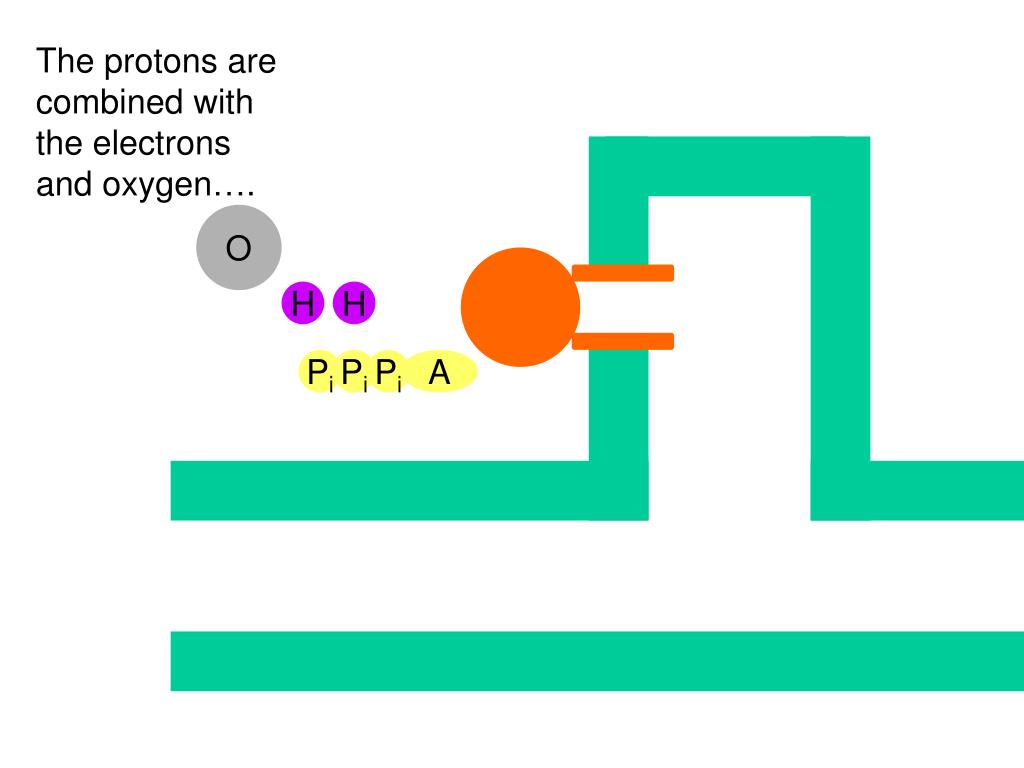
  1. H H Pi Pi Pi A The protons are combined with the electrons and oxygen…. O

  2. H H Pi Pi Pi A ….to form a molecule of water O

  3. H H H H H H H H H H H H Pi Pi Pi A In the absence of oxygen, there is a build up of hydrogen atoms

  4. H+ H+ H H H+ H H H+ H H H H H H H+ H+ H+ H+ H H Pi Pi Pi A The NADH/H+ and FADH2 will not be reoxidised as they will no longer be able to release the Hydrogen they are carrying

  5. H H+ H H H+ H H H+ H H+ H H+ H H H H H+ H H H+ H+ H Pi Pi Pi A NAD The NADH/H+ and FADH2 will not be reoxidised as they will no longer be able to release the Hydrogen they are carrying

  6. H H+ H H H+ H H H+ H H+ H H+ H H H H H+ H H H+ H+ H Pi Pi Pi A NAD This means that respiration cannot proceed beyond the first stage – glycolysis.

  7. This means that respiration cannot proceed beyond the first stage – glycolysis.

  8. This means that respiration cannot proceed beyond the first stage – glycolysis.

  9. This means that respiration cannot proceed beyond the first stage – glycolysis. The pyruvate accepts hydrogen atoms from the NADH/H+ directly in animals

  10. This means that respiration cannot proceed beyond the first stage – glycolysis. The pyruvate accepts hydrogen atoms from the NADH/H+ directly in animals

  11. H H+ This means that respiration cannot proceed beyond the first stage – glycolysis. NAD The pyruvate accepts hydrogen atoms from the NADH/H+ directly in animals

  12. H H+ This means that respiration cannot proceed beyond the first stage – glycolysis. NAD The pyruvate accepts hydrogen atoms from the NADH/H+ directly in animals

  13. H H+ This means that respiration cannot proceed beyond the first stage – glycolysis. NAD The pyruvate accepts hydrogen atoms from the NADH/H+ directly in animals

  14. H H This means that respiration cannot proceed beyond the first stage – glycolysis. NAD The pyruvate accepts hydrogen atoms from the NADH/H+ directly in animals

  15. H H This means that respiration cannot proceed beyond the first stage – glycolysis. NAD The pyruvate accepts hydrogen atoms from the NADH/H+ directly in animals and forms lactic acid.

  16. H H This means that respiration cannot proceed beyond the first stage – glycolysis. NAD A considerable amount of energy is trapped in the lactic acid.

  17. This means that respiration cannot proceed beyond the first stage – glycolysis. In plants the pyruvate is first decarboxylated to release CO2

  18. O C O This means that respiration cannot proceed beyond the first stage – glycolysis. In plants the pyruvate is first decarboxylated to release CO2

  19. O C O This means that respiration cannot proceed beyond the first stage – glycolysis. In plants the pyruvate is first decarboxylated to release CO2

  20. O C O This means that respiration cannot proceed beyond the first stage – glycolysis. In plants the pyruvate is first decarboxylated to release CO2

  21. O C O This means that respiration cannot proceed beyond the first stage – glycolysis. The 2C intermediate accepts the hydrogen atoms from NADH/H+ and forms ethanol

  22. O H H+ C O This means that respiration cannot proceed beyond the first stage – glycolysis. NAD The 2C intermediate accepts the hydrogen atoms from NADH/H+ and forms ethanol

  23. O H H+ C O This means that respiration cannot proceed beyond the first stage – glycolysis. NAD The 2C intermediate accepts the hydrogen atoms from NADH/H+ and forms ethanol

  24. O H H+ C O This means that respiration cannot proceed beyond the first stage – glycolysis. NAD The 2C intermediate accepts the hydrogen atoms from NADH/H+ and forms ethanol

  25. O H H+ C O This means that respiration cannot proceed beyond the first stage – glycolysis. NAD The 2C intermediate accepts the hydrogen atoms from NADH/H+ and forms ethanol

  26. O H H+ C O This means that respiration cannot proceed beyond the first stage – glycolysis. NAD The 2C intermediate accepts the hydrogen atoms from NADH/H+ and forms ethanol

  27. O H H+ C O This means that respiration cannot proceed beyond the first stage – glycolysis. NAD A considerable amount of energy is trapped in the ethanol

  28. In animals the pyruvate is converted to lactic acid: Glucose

  29. In animals the pyruvate is converted to lactic acid: Glucose pyruvate

  30. In animals the pyruvate is converted to lactic acid: Glucose pyruvate lactic acid

  31. In animals the pyruvate is converted to lactic acid: Glucose pyruvate lactic acid In plants the pyruvate is converted to ethanol and carbon dioxide

  32. In animals the pyruvate is converted to lactic acid: Glucose pyruvate lactic acid In plants the pyruvate is converted to ethanol and carbon dioxide Glucose

  33. In animals the pyruvate is converted to lactic acid: Glucose pyruvate lactic acid In plants the pyruvate is converted to ethanol and carbon dioxide Glucose pyruvate

  34. In animals the pyruvate is converted to lactic acid: Glucose pyruvate lactic acid In plants the pyruvate is converted to ethanol and carbon dioxide Glucose pyruvate ethanol + CO2