Download
1 / 4
40 likes | 167 Vues
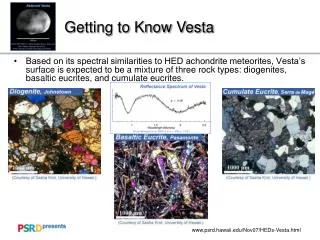
Vesta’s surface is anticipated to be a unique blend of three rock types: diogenites, basaltic eucrites, and cumulate eucrites, based on its spectral similarities to HED achondrite meteorites. The Dawn mission's Gamma Ray and Neutron Detector (GRaND) plays a crucial role in measuring the elemental compositions of Vesta. Usui and McSween’s HED-based mixing model effectively evaluates the proportions of these rock types, utilizing molar ratios of key elements. Their research reveals remarkable correlations between measured and predicted abundances, showcasing the potential of combining cosmochemistry and remote sensing.

E N D
Getting to Know Vesta • Based on its spectral similarities to HED achondrite meteorites, Vesta’s surface is expected to be a mixture of three rock types: diogenites, basaltic eucrites, and cumulate eucrites. www.psrd.hawaii.edu/Nov07/HEDs-Vesta.html
Getting to Know Vesta • The Gamma Ray and Neutron Detector (GRaND), on Dawn, will measure elemental compositions of Vesta’s surface. • Usui and McSween developed a way to evaluate the proportion of different HED rock types represented in the GRaND spectral data. • Their HED-based mixing model uses molar ratios of Mg, Fe, Al, and Si (see plot), which show the compositional differences between the HED rock types. Plot of (Mg+Fe)/Si abbreviated as [M/Si]molversus Al/Si abbreviated as [Al/Si]mol www.psrd.hawaii.edu/Nov07/HEDs-Vesta.html
Getting to Know Vesta • The plot of concentrations of oxides of Si, Fe, Ti, Mg, Al, Ca, Cr, Mn, Na, and K measured in HED meteorites versus their concentrations calculated from the mixing model by Usui and McSween shows excellent agreement. • A logarithmic scale is used to easily show all the elements on one diagram (K is lowest and Si is highest). www.psrd.hawaii.edu/Nov07/HEDs-Vesta.html
Getting to Know Vesta • Usui and McSween’s HED-based mixing model can: • accurately estimate the abundances of major elements measured by GRaND • predict abundances of minor elements (Na, Cr, and Mn) not analyzed by the instrument. • Shows the value of an integrated approach using: • laboratory data on HED meteorites (Cosmochemistry) • remote sensing data from a spacecraft orbiting Vesta (Missions) Neutron Activation Analysis www.psrd.hawaii.edu/Nov07/HEDs-Vesta.html