Patterns in U.S. Immigration: Colonial to New Waves and Their Impact on Society
This overview examines the evolution of immigration to the United States from the Colonial period to the New Immigration wave (1850-1924). It explores varied origins, including English, Irish, German, and Italian immigrants, and the motivations driving their journeys, such as religious freedom, economic opportunity, and escape from tyranny. It highlights the challenges they faced, including discrimination and cultural assimilation, as well as their significant contributions to American society, notably in agriculture, industry, and cultural diversity.

Patterns in U.S. Immigration: Colonial to New Waves and Their Impact on Society
E N D
Presentation Transcript
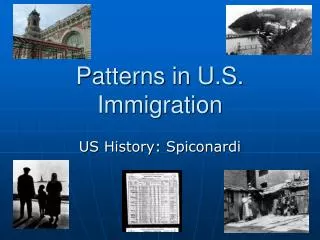
Patterns in U.S. Immigration US History: Spiconardi
Colonial Immigration • The Immigrants • Predominately English • Also Scotch-Irish, some German, Swedish, and Dutch • Africans via the slave trade • Reasons • Political & Religious Freedom • Improvement of economic standing
Colonial Immigration • Difficulties Faced • Conflict over land with Indians • Building of homes/farms in an unfamiliar territory • Contributions • Government = Representative Democracy • Religion = Christianity (Protestantism) • Cultural traditions
Old Immigration 1780s - 1850 • The Immigrants • Northern and Western European • Irish, German, and Scandinavian • Reasons • Irish = Potato famine • German = Political revolution in Germany
“Old” Immigration 1780s-1850 • Difficulties Faced • Irish and German Catholics faced discrimination • US predominately Protestant • Feared Catholics more loyal to pope than USA • Americans feared economic competition posed by immigrants (cheap labor)
“Old” Immigration 1780s-1850 • Contributions • Irish = Helped build railroads, canals, and worked in factories • Germans & Scandinavians = Brought newer farming techniques and kindergarten
“New” Immigration: 1850-1924 • The Immigrants • Italy, Poland, Russia (Jews) • China & Japan
Reasons Farm poverty & job insecurity Available work and land opportunity in America Wars & mandatory military service Political uncertainty & tyranny Democratic political system in United States Religious Oppression Pogroms against Jews Higher standard of living Opportunity for social mobility “New” Immigration: 1850-1924
“New” Immigration: 1850-1924 • Difficulties Faced • Assimilation Process • Loss of native cultural values & traditions • Faced backlash from Nativists • Often violence • Job and housing discrimination • Life in the Ghetto • Tenement housing & unsanitary conditions in the Northeast urban centers.
“New” Immigration: 1850-1924 • Contributions • Italians = masonry • Jews = Young ladies in the garment industry • Poles & Slavs = Coal mines in Pennsylvania • Chinese = Labor on transcontinental railroad in the West