Exploring the Counting Principle with Sandwich Combinations and License Plates
50 likes | 178 Vues
In this engaging lesson, we apply the counting principle to explore various sandwich combinations at a deli. By choosing combinations of meat (turkey or ham), bread (wheat or rye), and vegetable (lettuce or sprouts), we identify that there are a total of 8 different sandwiches. The counting principle formula illustrates that multiplying the number of choices from different categories leads to the total possible outcomes. We also apply this principle to calculate how many possible six-symbol license plates can be made, revealing a staggering 17,576,000 possibilities.


Exploring the Counting Principle with Sandwich Combinations and License Plates
E N D
Presentation Transcript
COUNTING PRINCIPLE SIMULTANEOUS OUTCOMES
LET’S DO LUNCH! • You are choosing items at the deli for a sandwich. Turkey or ham, wheat or rye, lettuce or sprouts. Possible sandwich combinations are Twl, Tws, Trl, Trs, hwl, hws, hrl, hrs = 8 Categories are: meat AND bread AND vegetable. Picking one from each kind and finding the total combinations applies the “counting principle”.
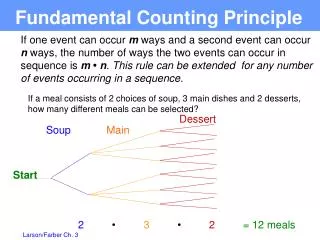
The Formula • Counting Principle Formula: If there are m ways to choose from one kind and n ways to choose from another kind then there are m •n total possible outcomes. EX: 2 kinds of meat ·2 kinds of bread ∙2 kinds of vegetable = 8 total sandwiches Note: The formula applies to any number of categories/events
Why Does It Work? • The “tree” diagram illustrates the principle: As the number of kinds are added, outcomes multiply! LETTUCE WHEAT SPROUTS TURKEY RYE LETTUCE SPROUTS LETTUCE WHEAT SPROUTS HAM LETTUCE RYE SPROUTS
You Try! • How many six-symbol license plates (letters and digits) can be made if the first three are digits and the last three symbols are letters? __·__ ∙__ ·__ ∙__ ·__ (hint follows) Hint: multiply the number of choices of each symbol and note that any symbols may be repeated! (answer follows) ANSWER: 17,576,000 → (10·10∙10·26∙26·26)