
environment
E N D
Presentation Transcript
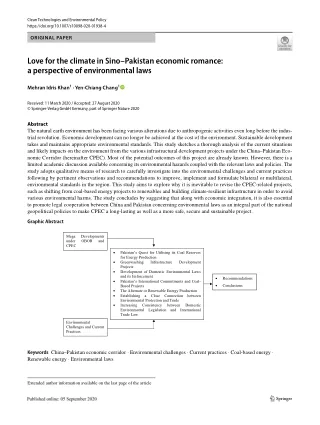
Clean Technologies and Environmental Policy https://doi.org/10.1007/s10098-020-01938-4 ORIGINAL PAPER Love for the climate in Sino–Pakistan economic romance: a perspective of environmental laws Mehran Idris Khan1 · Yen‑Chiang Chang1 Received: 11 March 2020 / Accepted: 27 August 2020 © Springer-Verlag GmbH Germany, part of Springer Nature 2020 Abstract The natural earth environment has been facing various alterations due to anthropogenic activities even long before the indus- trial revolution. Economic development can no longer be achieved at the cost of the environment. Sustainable development takes and maintains appropriate environmental standards. This study sketches a thorough analysis of the current situations and likely impacts on the environment from the various infrastructural development projects under the China–Pakistan Eco- nomic Corridor (hereinafter CPEC). Most of the potential outcomes of this project are already known. However, there is a limited academic discussion available concerning its environmental hazards coupled with the relevant laws and policies. The study adopts qualitative means of research to carefully investigate into the environmental challenges and current practices following by pertinent observations and recommendations to improve, implement and formulate bilateral or multilateral, environmental standards in the region. This study aims to explore why it is inevitable to revise the CPEC-related projects, such as shifting from coal-based energy projects to renewables and building climate-resilient infrastructure in order to avoid various environmental harms. The study concludes by suggesting that along with economic integration, it is also essential to promote legal cooperation between China and Pakistan concerning environmental laws as an integral part of the national geopolitical policies to make CPEC a long-lasting as well as a more safe, secure and sustainable project. Graphic Abstract Mega under CPEC Developments OBOR and • Pakistan’s Quest for Utilising its Coal Reserves for Energy Production Greenwashing Infrastructure Projects Development of Domestic Environmental Laws and its Enforcement Pakistan’s International Commitments and Coal- Based Projects The Alternate or Renewable Energy Production Establishing a Close Connection between Environmental Protection and Trade Increasing Consistency Environmental Legislation and International Trade Law • Development • • • Recommendations Conclusions • • • • between Domestic Environmental Challenges and Current Practices Keywords China–Pakistan economic corridor · Environmental challenges · Current practices · Coal-based energy · Renewable energy · Environmental laws Extended author information available on the last page of the article Vol.:(0123456789) 1 3
M. I. Khan, Y.-C. Chang Introduction 22 power and energy projects with the generating capac- ity of nearly 14,000 MWs, Gwadar East-Bay Expressway, Gwadar Technical and Vocational Institute, Pak–China friendship hospital, construction of breakwaters, devel- opment of various trade zones with industrial parks, Bao Steel Park, Gwadar Smart Port City Master Plan, Gwa- dar University, stainless steel, petrochemicals and other industries in Gwadar and the installation of fibre optics (Bhattacharjee 2017a, b). The debate on different pros and cons of CPEC is not a national or the regional phenomenon, but this mega-multi- billion-dollar project is a source of interest, anxiety and concern in different important capitals of the world (Ahmar 2018). If CPEC is termed as a ‘game-changer’ or a ‘lifetime opportunity’ for Pakistan to transform from an under-devel- oped to a middle-income economy, one also needs to visu- alise and contemplate how it will impact on the country’s financial, environmental and societal patterns. Although the project brings great expectations to the economy of Pakistan, however, the adverse effects on the environment can never be ignored with the construction of new power plants and grids, additional consumption of fossil fuels, roadways and rail- way lines, huge infrastructure, industrial zones and increased flow of heavy traffic on this route. Eventually, these devel- opments will have significant effects on air and water qual- ity, agriculture and wildlife, the habitat of flora and fauna, biodiversity and overall ecology particularly across Pakistan and consequently affecting the whole region at large. The exact scope of this impact is yet to be seen and merits an in-depth study. Therefore, this study will observe whether the stakeholders have undertaken various pertinent impact assessment strategies such as environmental impact assess- ment (hereinafter EIAs), strategic environmental assessment (SEA), initial environmental examination (IEE), change impact assessment (CIA) or social impact assessment (SIA). Also, the required measures regarding international commit- ments about handling the carbon emissions under the appro- priate conventions, treaties and protocols in which Pakistan and China have signatory position and ratified those, will be taken into consideration. The environmental effects share no boundary. Therefore, both China and Pakistan should comprehensively analyse and consider their national strategy, environmental and eco- nomic interests and issues surrounding ecological security to align and establish a strategic approach, template and time- table for negotiations on environmental provisions. China should depart from the current practice where environ- mental provisions are formulated in a case-by-case fashion and differ in each free trade agreement (hereinafter FTA) (Haifeng Deng and Jie Huang 2018). Instead, China should put forward a high-standard ‘Chinese version’ of trade- related environmental provisions and adopt it in China’s future FTA negotiations in order to make the OBOR-related Environmental issues have been affecting human and non-human life since the initial history of humanity and continue at different levels and forms (Li 2018). Environ- mental researchers have cautioned about public discontent or social conflicts due to the expected challenges of envi- ronmental pollution in the future (Pan and Gong 2015). The natural earth environment has been facing various alterations due to anthropogenic activities even long before the industrial revolution (Kiss and Shelton 2007). The det- rimental impact of changes has become a global concern with time. The occurrence of abrupt variations in environ- ment witnessed the large-scale destruction of infrastruc- ture, roads, parks and natural ecosystem across the globe (BBC 2017). The various forms of ecosystem components, for example rivers, lands, streams, sea and even ocean, are equally affected by the rapid pace of pollutants in the air, water or soil (Hao et al. 2018). It was realised that the environmental protection laws need global concern, goals, priorities, policies of social reformers, scientific commu- nities and civil or governmental supports to develop and achieve sustainable environmental goals for the present as well as for generations to come (Danvers 1999). China is heading towards the huge economic develop- ments over the globe with the One Belt One Road (here- inafter OBOR) Initiative, which includes economic activi- ties covering the areas from China to East Asia, Eurasia, South Asia and the African States. The project intends to launch numerous sub-projects, for example roadways, railway lines, energy infrastructure and maritime routes in various States connected thereby. According to a research report titled ‘The Potentials of One Belt One Road’, the States in conjunction with the OBOR cover 63% of the world’s populace and 29% of the gross domestic product (GDP) (Global Capital 2015). The OBOR initiative has revolutionised the world order and presented new trends of diplomacy, bilateral relations, economic, trade and legal reforms. The megaprojects have further divided into several branches. CPEC has been termed as an essential part of the OBOR initiative and regarded as the ‘game- changer’ in this region. The significance of this project is that it connects China to the Middle Eastern States, where it meets 52% of China’s oil demands, and imports need (Rahman and Shurong 2017). In addition to this, the route will also open China to the Indian Ocean that will add and strengthen China’s maritime capacity in this region. The overall impact of these activities will bring numer- ous economic prosperous opportunities for the economy of Pakistan which includes long road infrastructure of approximately 2500 miles, railway lines, construction of Gwadar international airport and Gwadar port, intensive 1 3
Love for the climate in Sino–Pakistan economic romance: a perspective of environmental laws megaprojects more successful. It can help to ensure that Chi- na’s trade-related environmental obligations are consistent with its FTAs. Pakistan’s quest for the coal’s utilisation to meet its energy demand is natural and obvious. However, investing largely in the coal-based energy projects will eventually raise numerous environmental issues, so in spite of having the capacity, why not to shift this focuses to produce the renewable energy in Pakistan? In the post-Paris era, the onus is on all states to pursue decarbonisation towards net zero. However, Pakistan is moving towards the opposite direc- tion by focusing more on the coal-based energies. It is due to the poor economic situation in Pakistan coupled with the energy shortage as well as inefficiency, and the country wants to utilise its natural resources to meet its urgency in the energy sector. Eventually, it puts an increased responsi- bility for the core environmental stakeholders in this joint venture, including the government officials or departments and local or international environmental non-governmental environmental organisations (ENGOs) for taking appropriate practical measures. The study presents the background knowledge about the environmental laws of China and Pakistan and adopts qualitative means of investigating the environmental signifi- cance to examine and explore the damaging effects of the CPEC-related projects; special attention has been paid to infrastructure development and the coal-based energy pro- jects. It tends to highlight the adverse side of the transactions and to find a better way out of the expected environmental challenges. The study addresses the relationship between contextual environmental governance and brings the atten- tion of the key stakeholders under CPEC to consider the environmental assessment strategies, for example EIA, SEA and IEE. The main argument of the study includes refer- ring to the various stakeholders for reviewing the legal ties under CPEC and made necessary amendments considering the environment as an integral part before it may get too late for such interventions to be made. To this end, a systematic and in-depth discussion and analysis of the environmental conditions and relevant laws and policies of these two States is conducted to examine patterns of influence with contrast to the sensitiveness of the established environmental systems under the megaproject of CPEC. Table 1 provides an over- view of the significance and details of development projects under CPEC. Table 2 presents the SEA, relevant legislation and explicit features or situation in both China and Pakistan. Section 2 explains and discusses the various developments under the OBOR and CPEC projects, whereas Sects. 3 and 4 are the core sections of the study, which include the dis- cussion, environmental challenges with a comparison of the current practices and analysis coupled with detailed recom- mendations for better solutions. These components are scru- tinised cohesively in these sections, followed by the results discussed in light of the description of the States perspec- tives as well as the obligations of international environmen- tal laws and commitments. Mega‑developments under OBOR and CPEC One belt one road initiative OBOR is a megaproject to tie China not only with the other Asian States but also Europe, the Middle East and the Afri- can States. The project is likely to play a key role in regional cooperation with new fashion, great interest and loyalties of the member States. The global economic crisis and domestic social issues pushed China to discover new partners or the export markets across the globe to maintain sustainable eco- nomic conditions, especially in the neighbouring State and the region as well. Eventually, the contemporary Chinese political leadership coined a new slogan ‘New Silk Road’ or OBOR initiative to revise the trade and economic order in the region (Cai 2017). The Chinese leaders proposed this initiative to strengthen road connections and promote joint economic cooperation aimed to establish an intensive trans- port corridor connecting Central Asia to the Indian Ocean and the Pacific to the Baltic Sea, eastern, western and south- ern Asia, increasing economic competitiveness, eliminat- ing trade barriers as well as reducing trade and investment expenses strengthen monetary cooperation and people-to- people relations (Szczudlik-tatar 2013). Though, there are some reservations over the geopolitical implications in these China-orientated routes of connectivity (Aris 2016). How- ever, this initiative was taken to draw a gradually explicit bridge between domestic and foreign affairs referred to as OBOR initiative. There are great expectations associated with the OBOR to improve the regional connectivity and economic integration among the member States. CPEC: magnitude of the project The CPEC is a multi-billion-dollar project signed between China and Pakistan, which was officially launched in 2015, and proposed to be entirely operationalised by 2030. It con- nects China to the Middle Eastern States through a long roadway as well as railway networks spanning 3218 kms from Chinese Province Xinjiang to the Gwadar Port in Western Pakistan (Deloitte Pakistan 2016). The route also includes various economic zones with industrial parks, pipe- lines, mega-infrastructural development plan and energy projects. In addition to the time-tested cooperation in the military and diplomatic arena for the last few decades, the project is believed to bring additional strengths between the two neighbouring States to become regional partners in the sphere of economy and trade. Table 1 presents the salient 1 3
M. I. Khan, Y.-C. Chang Table 1 Overview of the various development projects under CPEC Names of the projects Description Proposed routes There are three major corridors or routes of the CPEC project: Eastern, Central and the Western Routes. The ‘Eastern Route’ will create a link between two main business cities of Pakistan: Lahore and Karachi, the ‘Central Route’ will connect Baluchistan and Khyber Pakhtunkhwa Prov- inces, and the ‘Western Route’ is designed to bridge the key project of CPEC: Gwadar Port to the Baluchistan and Khyber Pakhtunkhwa Provinces that will further link to the Xinjiang Province in China at Khunjrab pass (MPDR 2020a) The oil and gas will be liquefied or transported from the Middle Eastern States to China through a network of pipelines that will reduce the current long distance of 12,537 miles down to 2295 miles with a time frame of reaching the consignment from 16 to 3 days only. The Gulf Today 2017 con- sequently, it will make CPEC an energy corridor too, connecting China not only with the Middle East but also Afghanistan, Iran, Central Asia and even possibly India (MPDR 2020b) An existing railway line (ML-1) is scheduled to be upgraded by 2022 with an approximate sum of US$ 8 billion. The up-gradation will increase the current train’s speed up to 140 km/h that will save the additional time of this transit. It will serve as a significant expansion of Pakistan’s railway network connecting with the Kashgar City of China in Xinjiang Province (MPDR 2020c) The road projects of CPEC which are currently underway will connect Chinese province of Xingjian to Western’s Pakistan at Gwadar Port. It will cover approximately 2500 miles long roads network (MPDR 2020d) CPEC is worth eliminating the power shortfall and significantly strengthens Pakistan’s energy capac- ity with a total of 22 energy projects comprising about 14,000 MW according to the present plan with an estimated cost of US$ 27 billion. The projects include coal, solar, wind, hydel, imported fuel and transmission lines as well (MPDR 2020e) The corridor also brings various special economic zones (SEZ) at different locations, which will further ease and promote the essences of the trade in the regions. The unique locations of these economic zones include Moqpondass SEZ at Gilgit-Baltistan, SEZ at Mirpur, Azad Jammu Kashmir, Information, Communication and Technology (ICT) model industrial zone in Islamabad, development of industrial park on Pakistan steel mills land at Port Qassim near Karachi and China special economic zone Dhabeji (MPDR 2020f) Other than the developments mentioned above, CPEC will bring many more that will take Pakistan towards an economically prosperous State. The various projects include construction of Gwadar international airport, Gwadar port, Gwadar East-Bay Expressway, construction of breakwaters, development of various trade zones with industrial parks, Bao steel park, Gwadar University, pilot project of Digital Terrestrial Multimedia Broadcast (DTMB), Gwadar smart port city master plan, stainless steel, petrochemicals and other industries in Gwadar (Bhattacharjee 2017a, b; MPDR 2020b) The pipelines under CPEC Railway network Roads or highways CPEC energy projects Special economic zones under CPEC Other development projects under CPEC Created by this research features for understanding the magnitude of the CPEC-asso- ciated projects and economic activities as briefly explained hereunder: intensified. It will need careful planning and mitigation at this stage before the implementation of these projects by making concerted efforts to maintain and conserve the envi- ronmental concerns. There is enough room that the lakes, rivers, game reserves, mountains and sanctuaries might be polluted by the CPEC-related anthropogenic activities or incredible infrastructure developments, which merits con- siderable and thoughtful efforts in terms of coordinated planning and policy formation for the preservation of these natural resources well in time (Sarwar 2016). In addition to the resources and environment, the impact of round-the-clock traffic, dust particles, suspended solid particles, deforestation and emissions of poisonous gases from other large-scale construction or development projects would consequence to contribute in greenhouse gases (Here- inafter GHGs), loss of biodiversity, air-borne diseases as well as respiratory problems, and deteriorate the soil, which may result as floods in these areas (Mehwish Qayyum and Environmental challenges and current practices CPEC: potential constraints and environmental threats Though having rigorous benefits claimed through the CPEC project, it is more likely to imagine a scenario without facing adverse environmental effects alongside the construction of mega-infrastructure of roads and railway lines as well as the installation of heavy machinery and fuel burning includ- ing coal at various energy production units. The adverse impact on the ecological lives of the local people might be 1 3
Love for the climate in Sino–Pakistan economic romance: a perspective of environmental laws Table 2 SEA systems-relevant legislation and explicit features or situation in both states States SEA system and core legal documents SEA features and situation China Law of PRC on environmental impact assessment 2002; Plan EIA ordinance 2009;revised environmental protection law of the PRC 2014 Different plans have specific requirements for quality control of state representatives and a group of specialists; it is required that half from the group members must possess the specialists Various typologies of plans need numerous kinds of assessment such as comprehensive plans must possess an impact assessment statement, a chapter of environmental impacts and some other specified special plans (Ali et al. 2018b, a) The Environmental Protection Agencies possess relatively weak capacities; Poor quality of reports, least amount of budget for SEA research and weak coordination among various stakeholders during EIA or SEA studies; Not mandatory under the law; The Environmental Protection Agencies lacks financial and technical resources Demands political priority for natural resource and environmental management Pakistan has less expertise or experience in the research or studies of SEA systems (Monteiro et al. 2018) Pakistan Federal and provincial environmental protection agencies in collaboration relevant departments of Pakistan; Section XII of the PEPA, 1997; Provincial environmental protection acts Created by this research Muhammad Bashir 2018). All this is happening in a crucial time when Pakistan is already facing extreme weather pat- terns and seasonal shifts and suffering from the global warm- ing, and climate change issues as nearly 5000 of its glaciers are melting, which have potential impacts on agroecology of the State (Zahoor 2016). With the suspended particles in the air due to construction works and heavy traffic, it would be difficult for the Government of Pakistan to handle the smog issues such as the Punjab Province is already facing smog issues in the winter seasons (Nabi et al. 2018). Beyond this, a report devised by the WWF-Pakistan states that around 20% of roughly one million migratory birds passing through Chitral fall prey to hunting now would lose the habitats and will eventually move or would get extinct due to these mega- infrastructural developmental projects (WWF-Pakistan). It is the right time to cover the unchecked pollution areas in order to avoid worsening impact on the water quality and quantity as well and to ensure sustainable development. which is duly ratified or endorsed by both States (Saeed et al. 2017). EIA proposes and recommends the possible control measures which are imperative to address or to mitigate the possible effects of any development project to protect the environment as well as to protect the identified affected eco- logical segments. EIA was initiated in Pakistan under the Pakistan Envi- ronmental Protection Ordinance (PEPO) 1983, which was later withdrawn and substituted with Pakistan Environmental Protection Act (PEPA) in 1997. It is the legal requirement under section 12 of the PEPA to file a detailed environmental impact statement before the commencement of a project to the concerned environmental protection agency (EPA), fed- eral or the provincial, which is likely to cause effect on the environment (EPD). Section 12 of the Act also comprises several provisions or clauses for imposing a fine in case of non-compliance, lump sum or on a daily basis. However, SEA is not mandatory in Pakistan, but some of the SEA elements have been voluntarily implemented without legisla- tive provisions, for example public participation (Victor and Agamuthu 2014). Environmental impact assessment EIA in Pakistan EIA in China EIA strategy is a legal requirement which is considered under the obligations of national environmental legisla- tion policy of both China and Pakistan as well as of United Nations Declaration on Environment and Development, In China, it is mandatory to conduct an EIA procedure as well as obtaining an EIA approval certificate for all the construction projects (State Council 2017). It is obligatory 1 3
M. I. Khan, Y.-C. Chang requisites under Article 9 of the amended Regulations on the Administration of the Construction Project Environmental Protection that all the construction projects should conduct and obtain EIA approval certificate which may affect the environment. It is required not only before the commence- ment but also for any modification, expansion and renova- tion of the project. The approval can also be disapproved by the concerned authorities on the breach of any binding rule (Hangsheng 2009). The environmental protection depart- ment applies the scrutinising process and then approves or grants EIA certificates if the required criteria are duly met by the construction party (State Council 2017). In addition to the decorum mentioned above, the provinces, municipalities and autonomous regions also impact the scope of authority in approving an EIA certificate (Watkins and Latham 2017). to be mostly inspired by administrative frameworks (Slunge and Tran 2014; Meuleman 2015). The governments in both counties should not only intro- duce new policies to administer SEA system and ensure its strict implementation but also pay attention to the capacity building and disbursing adequate funds to the environmen- tal protection agencies to prevent environmental harms and greenwashing from the development projects. Carbon emissions scheme in Pakistan Pakistan’s climate change policy In 2003, Pakistan submitted an Initial National Communica- tion on Climate Change Report to UNFCCC (Iqbal 2003). This report includes national GHG information for the period of July 1993 to June 1994. However, the government fails to update it on a regular time interval. The govern- ment of Pakistan joined the Kyoto Protocol in 2005, which is administered under the Ministry of Environment & Climate Change (Kyoto Protocol 1997; Sohail et al. 2014). Under this agreement, the Clean Development Mechanism (CDM) has been initiated to mitigate GHGs and for the promotion of a green environment. GHGs information is also developed that is referenced in the concluding report of the Task Force on Climate Change working under the Planning Commission of Pakistan, which indicates to take preventive measures well in time (Ali 2016). Effects of EIA under CPEC This joint venture will have a substantial impact on natu- ral habitats, resettlement, dislocation or migration of the local people and cultural or social issues, which should be addressed before the execution of the project. It demands to fulfil a legal requirement to hold due impact assessments in order to achieve the sustainable development goals (SDG) for which Pakistan is a signatory to the United Nations Con- vention for Climate Change (UNFCCC) (Sohail et al. 2014). According to a statement of the country representative of the International Union for Conservation of Nature (IUCN), the technical capacity of environmental protection agencies is justified to carry out sound EIAs since the environment became a provincial matter in Pakistan. However, the envi- ronmental footprint of this megaproject is unpredictable. It is still not too late to conduct the EIAs for these projects. The government should collaborate and get technical assistance from relevant organisations, for example ICUN, to make these activities more ecologically friendly and sustainable (Ebrahim 2017b). Perspective for low carbon development The primary focus of foreign investment allocated for CPEC has been on energy and transportation projects due to severe scarcity of energy resources in Pakistan. China’s GHGs ratio has also increased in recent years at an alarming rate (Chang et al. 2018). China claims to make sustainable development under OBOR by exploring renewable energy resources to avoid hazardous carbon imprints (Zubedi et al. 2018). Due to the graveness of the prevailing scenario, a signifi- cant number of power plants or coal power projects may be shut down in Pakistan due to high carbon emission (Reyn- olds et al. 2018). Therefore, adequate measures need to be taken to implement green Information, Communication and Technology (ICT) for renewable energy resources. Green ICT has the potential to make a fundamental difference in the lives of local communities by endorsing green energy and environment-friendly technologies (Shruthi 2014). It has also been described as a GHG emission reduction tool in terms of establishing international standards (Fan et al. 2013). It is observed that renewable sources, together with effective ICTs, can assist GHG reduction techniques to invert the adverse impact of climate change (Zubedi et al. 2018). Strategic environmental assessment system The relevant literature review indicates that the SEA has been established mostly or primarily under the fold of EIA for construction or development projects (Noble and Nwanekezie 2017). It has also been termed as ‘EIA-based’ model of the SEA. The EU-SEA Directive (European Com- mission 2018) is a good example of the ‘EIA-based’ model of the SEA (Fundingsland Tetlow and Hanusch 2012), which does not only determine the institutionalisation inside the allied countries, but also acknowledges how the SEA legal framework: strategies, policies, legislation, plans and pro- grammes, have been adopted in other developed countries (Di Ludovico and Fabietti 2018). Besides, the dynamic oper- ational forces of the SEA systems have been recommended 1 3
Love for the climate in Sino–Pakistan economic romance: a perspective of environmental laws parameters, monitoring costs and practicability in order to enhance disciplinary efficiency (ADB 2014). The report should follow a straight reporting period and verified by a third party (Wartmann et al. 2009). The Market Readiness Proposal (MRP) examines the requirements, qualifications, standards and other miscellaneous prerequisites of the veri- fication sector (NDRC 2013). Pathway for sustainable development CPEC is a joint venture where the primary focus is on Gwa- dar Port while the transport sector, infrastructure develop- ment, energy efficiency and industrial cooperation are other significant components. Even though the investment is enor- mous, it is indispensable to ensure that environmental sus- tainability is not endangered. The biggest challenge towards sustainable development is climate change across the globe. Its widespread impact is vivid on our ecosystem as well. On the one hand, it causes an extreme change in climatic conditions resulting in floods, droughts, typhoons and earth- quakes, while on the other hand, it affects the production of food, water availability: quality and quantity, forests, biodi- versity, coastal and marine environment (Khan et al. 2016). Due to the adverse impact of climate change in Pakistan, it ranks 16th regarding the index of vulnerability among 170 States, and 135th internationally concerning global GHG emissions per capita (Verisk 2010). The average annual tem- perature in Pakistan has increased by 0.6° during the last century. The 2012 Global Climate Risk Index of German- watch has ranked Pakistan as eighth worldwide (Harmel- ing 2012). To achieve the SDG, a new infrastructure which is compatible with green ICT needs to be incorporated in the CPEC routes for reducing the environmental impacts of existing infrastructure. The region is, however, at the edge of accelerating carbon release because of its rapid development in recent decades. China’s certified emission reduction scheme In June 2012, the NDRC released ‘Interim Measures on Chi- nese Voluntary Emissions Trading’, which proposes meas- ures to offset carbon emissions through credits produced by certified projects voluntarily (Khan and Chang 2018). It was anticipated that these measures would support the seven obligatory ETS pilots in China by contributing an offset apparatus to the local units (Swartz 2013). Eventually, this development improved the capacity and institutional capa- bility to address ecological issues in China. However, these interim measures will not exceptionally apply to these seven pilots if not duly approved by the NDRC (GPPG 2014). Discussion and analysis Pakistan’s quest for utilising its coal reserves for energy production Carbon emission scheme in China China is going to invest more than US$ 46 billion under CPEC, of which, US$ 34 billion has been assigned for energy projects including coal, wind, hydro and solar. Even- tually, it will serve as a natural and fastest solution to Paki- stan’s energy and power crisis (MPDR 2014). The imported petroleum products constitute almost 90% of fuel consump- tion in Pakistan (Downs et al. 2017; Kugelman 2017). According to policy documents, Pakistan possesses the coal reserves of around 186 billion tons, and the government pro- poses to raise annual production of domestic coal from 4.5 to 60 million tons to shift its dependence on imported fuel to the cheap indigenous energy sources, for example coal (MPDR 2014). It is also worth mentioning here that China is closing its coal-based power plants because of environ- mental degradation, but at the same time, transferring them to Pakistan in complete disregard of international environ- mental standards (Hadi et al. 2018). China is the largest coal producer in the world, adds almost half of global consumption, and eventually, regarded as the largest source of carbon emissions (US EIA 2014). Coal is the leading cause of damaging air quality and overall environmental hazards. Therefore, coal-based power pro- jects under CPEC could also have a destructive environ- mental impact in the long run (Saleem 2017). The Global Emission trading scheme The Government of China has initiated a pilot project regard- ing carbon emissions trading initially in seven provinces (Bodansky et al. 2015). In 2014, the National Development and Reform Commission (NDRC) in China had released Interim Regulations on Administration of Carbon Emission Trading (Zhang et al. 2017). The ‘Chinese Certified Emis- sions Reductions’ (CCER) and the ‘emission quotas’ were the fundamental objectives of carbon emissions trading in these pilot areas (Duan et al. 2014). Besides these pilot pro- jects, the national united carbon emissions trading market place was also developed by NDRC (Feng 2013). Monitoring, reporting and verification Monitoring in a national system is conducted by the covered entities from the industrial as well as non-industrial sec- tors through direct ways followed by finalised reports for monitoring, reporting and the verification system (MRV) for carbon emissions trading (Swartz 2013). The main com- ponents of MVR include monitoring methods, appropriate 1 3
M. I. Khan, Y.-C. Chang Climate Risk Index of 2017 ranks Pakistan among the ten most affected countries (Kreft et al. 2017). energy (Ur Rehman et al. 2019), instead of assisting it in developing renewable energy, whereas both the countries have obligations to minimise the coal usage in the 2015 Paris Agreement. Besides, both countries should consider that all the joint projects under CPEC should adhere to the guide- lines of the regional or international environmental laws or treaties such as the Paris Agreement on Climate Change, Sustainable Development Goals, Aichi Biodiversity Targets, Sendai Framework for Disaster Risk Reduction and so on. Greenwashing infrastructure development projects Greenwashing is considered an ecological whitening strat- egy used by the enterprises, commercial companies and even by the governments to demonstrate the environment- friendly image of the relevant projects to the general pub- lic (Achour 2017). It includes spending a large amount on advertising and public relations strategies concerning the development projects, which portrays their environmentally benign (White 2003). In this way, despite the use of ideo- logical campaigns, efforts and coercive measures to co-opt environmental concerns, ordinary people continue to face environmental degradation in their lives. The affected residents reserve the right for legal actions if they witness any greenwashing practice by either party and draw the attention of the relevant policymakers to set the misleading environmental claims straight (Achour 2017). However, many of the environmental reservations have been seen in Pakistan, but there is a lack of information and awareness concerning these solutions. Therefore, the various shareholders from both countries should consider and take appropriate measures concerning criminological imagina- tion to contribute in these struggles by rethinking how new regional integration can diagnose, deter and prevent ongoing environmental harms to the local people. It will further help to make the CPEC a clean and environment-friendly project (White 2003). Likely environmental impacts of CPEC‑related projects Environmental issues are also of great concern as China’s coal-fired power plants, tree loss and other related projects can have a lasting negative impact on the Pakistani environ- ment. These effects can have severe repercussions on local flora and fauna. However, the Pakistani government is trying to counter this threat through preventive measures such as the One Billion Tree Project in KPK Province. In addition, there has been unrest in the local Gwadar community regard- ing the hospital and college developed as part of the initia- tive that will mainly offer its services to Chinese person- als (Hadi et al. 2018). It is also expected that the Pakistani economy could be adversely affected compared to China due to the removal of tariffs under Pakistan and China. The main fear associated with the CPEC results for Pakistan is that it could lose more of its wealth, effective GDP and trade balance while China will prove to be the real winner of the situation (Hussain and Ali Shah 2017). However, the vision of the CPEC project as a whole will enable the Paki- stani government to develop and implement viable systems to ensure long-term sustainable economic growth (Ahmed and Mustafa 2017). According to an IUCN report, around 54,000 trees were felled in various sub-projects for the construction of the CPEC infrastructure in KPK (Ebrahim 2017b). It is a threat to climate change and the agricultural sector. The current rise in temperature and the shortened winter weather are signs of the problem. It is assumed that the productivity of the agricultural sector will decrease. It appears that the EIA was not carried out properly before the CPEC began. A lack of transparency, vague investment conditions and high credit conditions from China and especially the bureaucracy culture can discuss this controversially (Ebrahim 2017a). The CPEC has around 19 energy-related projects which are a mix of coal, idle, solar and wind; there are only three hydropower projects with a total output of around 2700 MW (MPDR 2020e). While there are also some projects com- pering renewable energy, most of them have no significant potential, except for the Quaid-e-Azam solar park with a capacity of 1000 MW. In contrast, there are ten coal power projects with an estimated capacity of 8880 MW (Ali 2018a, Development of domestic environmental laws and its enforcement As the environment changes, the contemporary climate change requires the States to take appropriate policy meas- ures to achieve the goals of sustainable development suc- cessfully. To this end, China has achieved much in the way of pertinent legislation including the thorough revision of the Environmental Protection Act, 2015, and introducing the Environmental Protection Tax Act implemented since 2018 (Zahar 2018). In contrast, Pakistan is still facing problems in addressing its environmental challenges and ranked among environmentally vulnerable countries in the world (Anasta- siou et al. 2018). The current situation, therefore, merits that Pakistan should prioritise not only the development but also strict enforcement of domestic and international environ- mental laws, and China could assist in achieving this goal to smoothen the regional environment. It is unfortunate that the current practice is perhaps moving towards the wrong direction by ignoring these much-needed capacity develop- ments; for example, China is reducing the exploitation of its coal reserves and helping Pakistan to generate coal-based 1 3
Love for the climate in Sino–Pakistan economic romance: a perspective of environmental laws b). Therefore, there can be concerns about the carbon diox- ide (CO2) emissions associated with coal-based thermal energy projects that could seriously damage the environ- ment. Above all, the timing of these environmental issues is crucial when Pakistan is already facing extreme weather patterns and seasonal shifts, suffering from the global warm- ing, and climate change issues as nearly 5000 of its glaciers are melting, which have potential impacts on agroecology of the State (Zahoor 2016). generation from renewable energy sources (UNEP 2017). Keeping in view the above scenario, it is fair enough to com- ment that instead of focusing on the renewables, Pakistan is possibly going in the opposite direction by largely promoting coal-based energy projects which have serious environmen- tal consequences. It is noteworthy that Pakistan has around 167.7 GW of renewable energy potential, which is enough to meet its total energy demand (Rafique and Rehman 2017). Despite the massive potential of renewable resources, Paki- stan adds less than 1% from the renewables in the energy mix (Sheikh 2010). Pakistan’s international commitments and coal‑based projects Establishing a close connection between environmental protection and trade According to report released by the Asian Development Bank (ADB) regarding the evaluation of power sector of Pakistan represents that every 10GW generation capacity under the CPEC (ADB 2018) will intensify GHG emissions substantially that might have a serious impact on the climate change mitigation. In addition, disposal problems and ash handling will also aggravate adverse effects on the environ- ment. The report further depicts that an immense increase in fossil-fuel or coal-based power generations will add to environmental degradation and climate change. However, the bank itself is currently financing 600 MW coal plant in Jamshoro with an agreement of US$ 900 million project signed in March 2017 (Ahmed 2018). A research (Naureen et al. 2017) concerning the carbon emissions of existing coal-based power plants under the CPEC project has revealed some surprising results. The study reveals that out of 5580 MW of coal-based power plants generation, the total carbon emission released out of these power projects is 75,979,636.4 tons. It is also pertinent to mention that China and Pakistan are signatories to the 2015 Paris Agreement to bring down the use of coal to mini- mise the impacts of global warming. Besides these facts, Pakistan is contributing more to coal-based energy produc- tion to meet its energy crisis, whereas the most recent data demonstrate a reduction in coal usage in China for the third consecutive year in the fulfilment of its international com- mitments towards climate change coupled with extensive coal usage (Saeed 2017; Ali et al. 2018a,b). It puts shared responsibility on both States to implement the provisions of the 2015 Paris Agreement in the real sense. There are some trade agreements between the other coun- tries of the world where trade is happening with due con- sideration of the environmental significance, such as the EU-Canada Comprehensive Economic and Trade Agree- ment (CETA) (European Commission 2017). China and Pakistan should also render and make positive contributions to sustainable trade liberalisation as the USA, Canada and Mexico have made in the North American Agreement on Environmental Cooperation (NAAEC). NAAEC bounds the parties to make a contrast between their policies, laws and regulations, and environmental protection (Allen 2012). On 30 November 2018, a new United States–Mexico–Canada Agreement (USMCA) was signed that is also regarded as ‘What the USMCA–The New NAFTA (North American Free Trade Agreement) which Means for The Environment’ (Miller 2018), to bring down potential trade and environ- mental conflicts, enhance regional environmental collabora- tion and encourage as well as endorse the effective enforce- ment of environmental laws (GOC 2018). Another example is MARPOL 73/78. However, compared with these FTAs, the CPEC should impose a greater number of compulsory obligations on China and Pakistan, not only for taking measures to enforce MARPOL 73/78 but also to make these measures publicly available (Haifeng Deng and Jie Huang 2018). Besides, in the arena of international law, however, there is no specialised agreement in WTO on ‘trade and environmental’ issues. However, it indirectly influences the trade parties to ensure environmental protection in its Article XIV (a), (b), and (c) of the General Agreement on Trade in Services (GATS) and Article XX of General Agreement on Tariffs and Trade (GATT) (Storey and Sver- ige 2006). These provisions should have been incorporated into the terms and conditions under the operations of CPEC energy projects. It may also be feasible for the stakehold- ers for determining how the dispute resolution panels will apply WTO case law about these provisions (Ciuriak and Ciuriak 2016). The alternate or renewable energy production A report titled Global Trends in Renewable Energy Invest- ment 2017, by the UN Environment Program (UNEP), represents US$ 241.6 billion investments in renewables in 2016 (excluding large hydro) (UNEP 2017). The report also reveals that in 2016, around 138.5 GW energy from renewable sources was included in global power capacity, which shows the global trends towards promoting the power 1 3
M. I. Khan, Y.-C. Chang Trade between neighbouring States should not be held at the cost of the environment. The illustrations as mentioned above may be considered to learn lessons for formulation and then implementation of various bilateral agreements between China and Pakistan concerning the climate change mitigation as well as safeguarding the whole environmental situation in the region. environmentally conscious in its implementation of the OBOR Initiative (MOFCOM 2018). China should seek mutual recognition of environmental protection measures and environmental standards with countries alongside OBOR and CPEC. Sustained efforts by various stakehold- ers from both China and Pakistan in CPEC are the prereq- uisite to make a considerable contribution for achieving the environmental commitments, sustainable development goals, and ultimately building a better world. Pakistan should consider coal-based energy production as a short- term solution and shift over the renewable energy sources to make this venture long-lasting and environmentally more safe, secure and sustainable. Besides, the bilateral exchange of environmental lawyer’s programme from both China and Pakistan should be promoted to comprehend legal regime concerning the environment. Regional empowerment coupled with various economic concerns is a good Chinese strategy, which will help to implement its vision of peaceful rise in a great deal: OBOR and CPEC perhaps reshaping the world with a new eco- nomic leader. However, the core concerns highlighted in this study are the environmental issues attached to the mega- developments under these projects, which are obligatory to be addressed before it may hurt the various stakeholders. The States, alongside the OBOR and CPEC, are versatile in terms of economic stages and environmental standards. Therefore, China should encourage them to mutually rec- ognise each other’s environmental protection measures and environmental standards. To this end, China can adopt mutual recognition of environmental protection measures and environmental standards by actively signing bilateral and multilateral agreements on environmental protection and thereby reduce environment-related trade friction. The mega-developments under CPEC will eventually cause huge environmental impacts to GHGs, climate change and global warming, which are necessary to encounter at this stage before it may get too late. Pakistan should consider coal only as a short-term solution to address its energy crisis but necessarily take the procurement measures, including the implication of modern technology and stern policies so that adverse environmental implications are minimised. There is a need to take collaborative as well as compara- tive environmental measures by both States to make CPEC more successful and environment-friendly particularly for this region and the whole world at large; the observations and recommendations made under this research may be help- ful to achieve these sustainable development goals. Increasing consistency between domestic environmental legislation and international trade law China and Pakistan should seek to harmonise their domestic environmental legislation with international trade laws. It is of crucial importance to establish a domestic environ- mental law system that corresponds to international trade rules (Meltzer 2014). However, there is a lack of consist- ency between domestic environmental legislation and international trade rules; for example, the Chinese Foreign Trade Law only briefly addresses environmental protection. In contrast, only a few provisions relating to trade appear in China’s environmental laws, including the China Environ- mental Protection Law and the Drug Administration Law (Mu et al. 2014). Both States should hasten the introduction of legislation on environmental protection concerning the legislative gaps in areas of environmental protection such as medical waste management, blood test waste disposal and the elimination of ozone-depleting substances (Khan 2017). The next steps should include expanding the coverage of related environmental legislation and enhancing the practi- cal operability of those laws by amending ambiguous legal principles. They should then look at aligning the technical standards in local or domestic environmental laws with the environmental standards contained in international trade instruments. Recommendations and conclusion Pakistan and China need homogeneous commercial codes and legal cooperation mechanisms to make a more reli- able infrastructure development of CPEC (Ali 2018a,b). Under the prevailing scenario and given a literature survey of existing studies, the government of Pakistan needs to strictly precede and adhere to a distinct growth plan by incorporating green ICT for all projects under the head of CPEC (Shruthi 2014; Zubedi et al. 2018). China is actively promoting large infrastructure projects to coun- tries alongside the OBOR Initiative (Li 2015). However, China has concluded few FTAs with these States, and it is unrealistic for China to conclude FTAs with all OBOR States in a short period (Huang 2016). Some of these OBOR States and NGOs have strongly urged China to be Funding Funding was provided by The National Social Science Funda- mental Project, China, ‘Research on China’s Maritime Rights Protec- tion under the Perspective of Maritime Community with the Shared Future’ (Grant No. 19VHQ009); Economic and Social Development Research, Base General Project, Liaoning Province, China, “Research 1 3
Love for the climate in Sino–Pakistan economic romance: a perspective of environmental laws Cai P (2017) Understanding China’s Belt and Road Initiative. In: Think-Asia. https ://think -asia.org/handl e/11540 /6810. Accessed 29 Feb 2020 Chang Y-C, Wang C, Khan MI, Wang N (2018) Legal practices and challenges in addressing climate change and its impact on the oceans—A Chinese perspective. Mar Policy. https ://doi. org/10.1016/j.marpo l.2018.11.018 Ciuriak N, Ciuriak D (2016) Climate change and the trading sys- tem: implications of the Trans-Pacific partnership. Int Trade J 30:345–361. https ://doi.org/10.1080/08853 908.2016.11982 82 Deloitte Pakistan (2016) How-will-CPEC-Boost-Pakistan. In: Deloitte Pakistan. https ://www2.deloi tte.com/pk/en/pages / ccg/artic les/how-will-cpec- boost-pakistan-economy.html. Accessed 29 Feb 2020 Danvers (1999) Global Environmental change: research pathways for the next decade (1999). The National Academies Press, Washington, DC Deng H, Huang J (2018) What should China Learn from the CPTPP environmental provisions? Hofstra Law Rev 7:243–258. https ://doi.org/10.3366/ajicl .2011.0005 Di Ludovico D, Fabietti V (2018) Strategic environmental assess- ment, key issues of its effectiveness. The results of the speedy project. Environ Impact Assess Rev 68:19–28. https ://doi. org/10.1016/j.eiar.2017.10.007 Downs E, Herberg M, Kugelman M et al (2017) Asia’s energy secu- rity and China’s belt and road initiative. Natl Bur Asian Res 68:1–41 Duan M, Pang T, Zhang X (2014) Review of carbon emissions trad- ing pilots in China. Energy Environ 25:527–549. https ://doi. org/10.1260/0958-305X.25.3-4.527 Durani MQ, Khan MB (2018) The environmental impact of the China– Pakistan economic corridor (CPEC): a case study. Abasyn J Soc Sci 11:294–310. https ://doi.org/10.1002/2015W R0174 46 Ebrahim, ZT (2017a) Is CPEC Good, Bad or a Disaster for Pakistan’s Economy and Environment? The Wire.In. https ://thewi re.in/exter nal-affai rs/is-cpec-good-bad-or-a-disas ter-for-pakis tan-econo my- envir onmen t. Accessed 16 Aug 2020 European Commission (2017) EU-Canada: Comprehensive Economic and Trade Agreement. In: Eur. Comm. https ://ec.europ a.eu/trade /polic y/in-focus /ceta/. Accessed 23 Nov 2019 Ebrahim ZT (2017b) CPEC and the environment: good, bad or ugly? Express Trib. https ://tribu ne.com.pk/story /14478 59/cpec-envir onmen t-good-bad-ugly/. Accessed 14 Aug 2020 Global Capital (2015) The Potential of One Belt, One Road. In: Glob. Cap. https ://www.globa lcapi tal.com/artic le/vf5bs fykt1 tj/the- poten tial-of-one-belt-one-road. Accessed 9 Dec 2019 EPD History. In: Environmwnt Protection Department Govovernment of Punjab, Pakistan. https ://epd.punja b.gov.pk/histo ry. Accessed 29 Feb 2020 European Commission (2018) Strategic Environmental Assessment- SEA. In: Eur. Comm. https ://ec.europ a.eu/envir onmen t/eia/sea- legal conte xt.htm. Accessed 23 Nov 2019 Fan Z, Kulkarni P, Gormus S et al (2013) Smart grid communications: overview of research challenges, solutions, and standardization activities. IEEE Commun Surv Tutor 15:21–38 Feng F (2013) Status of China’s regional trading programs: progress and challenge. Inst of Ener, Env and Eco, Tsinghua Uni.https :// unfcc c.int/files /focus /mitig ation /appli catio n/pdf/statu s_of_china s_regio nal_tradi ng_progr ams.pdf. Accessed 9 Dec 2019 Fundingsland Tetlow M, Hanusch M (2012) Strategic environmen- tal assessment: the state of the art. Impact Assess Proj Apprais 30:15–24. https ://doi.org/10.1080/14615 517.2012.66640 0 GOC (2018) A new Canada-United States-Mexico Agreement. In: Gov. Canada. https ://www.inter natio nal.gc.ca/trade -comme rce/trade -agree ments -accor ds-comme rciau x/agr-acc/cusma -aceum /index .aspx?lang=eng. Accessed 2 Dec 2019 on the Legal Issues regarding Northeast Asian Energy Market Integra- tion”, No. 20211sljdybkt-005. References Achour S (2017) Greenwashing and Environmental Protection. In: BBN Times. https ://www.bbnti mes.com/en/socie ty/green washi ng-envir onmen tal-prote ction . Accessed 9 Jan 2020 ADB (2014) Assessment of Shanghai Emissions Trading Scheme’s impacts on targeted sectors and the city economy. In: SinoCarbon Innov. Invest. CO., Ltd. https ://carbo nium.fr/wp-conte nt/uploa ds/2015/07/Shang hai-ETS-asses ssmen t-study .pdf. Accessed 10 Jan 2020 ADB (2018) Sector Assistance Program Evaluation for the Pakistan Power Sector. In: Asian Dev. Bank. https ://www.adb.org/sites /defau lt/files /evalu ation -docum ent/39721 6/files /eap-pak-spe- energ y.pdf. Accessed 29 Feb 2020 Ahmar DM (2018) The other side of CPEC. Dly. Times. https ://daily times .com.pk/23847 4/the-other -side-of-cpec/. Accessed 29 Feb 2020 Ahmed A (2018) CPEC coal-based power plants to damage environ- ment: ADB. Dawn. https ://www.dawn.com/news/13871 05. Accessed 16 Aug 2020 Ahmed R, Mustafa U (2017) Impact of CPEC projects on agriculture sector of Pakistan: infrastructure and agricultural output link- ages. Pak Dev Rev 56(4):511–527 Ali M (2016) Does Pakistan need a carbon Tax? J Contemp Manag Sci 2. https ://jcms.aiou.edu.pk/?p=418. Accessed 15 Aug 2020 Ali M (2018a) Legal cooperation in perspective of belt and road initiative and China Pakistan economic corridor. Int J Res 5:1434–1453 Ali M (2018b) Pakistan’s quest for coal-based energy under the China– Pakistan economic corridor ( CPEC ): implications for the envi- ronment. Env Sci Pol Res 25:31935–31937 Ali F, Khan IA, Asghar W, Liao Z, Beghum S, Douven W, Khan KA (2018a) Legal status of the strategic environmental assessment (SEA), practice of application and challenges in Pakistan. Int J Waste Res 8:2 Ali S, Xu H, Al-amin AQ, Ahmad N (2018b) Energy sources choice and environmental sustainability disputes: an evolutional graph model approach. Qual Quant. https ://doi.org/10.1007/s1113 5-018-0775-9 Allen LJ (2012) The North American agreement on environmental cooperation: has it fulfilled its promises and potential? An empir- ical study of policy. Color J Int Environ Law Policy 23:121–199 Anastasiou T, Ní Ghráinne B, dos Santos SA et al (2018) Environmen- tal displacement in 2018—Current protection challenges. School of Advanced Study University of London Senate, London Aris S (2016) One belt, one road: China’s vision of “connectivity”. CSS Anal Zur Sicherheitspolitik 195:1–4. https ://doi.org/10.3929/ ethz-a-01071 7719 BBC (2017) What is climate change? In: BBC; Sci. Environ. https :// www.bbc.com/news/scien ce-envir onmen t-24021 772. Accessed 29 Feb 2020 Bhattacharjee D (2017) China Pakistan economic corridor ( CPEC ): naval postgraduate. Indian Counc World Aff 1–15 Bhattacharjee D (2017) China Pakistan Economic Corridor ( CPEC ): Naval Postgraduate. Indian Council of World Affairs, 1–15. Bodansky DM, Hoedl SA, Metcalf GE, Stavins RN (2015) Facilitating linkage of climate policies through the Paris outcome. Clim Pol- icy 16:956–972. https ://doi.org/10.1080/14693 062.2015.10691 75 1 3
M. I. Khan, Y.-C. Chang MPDR (2014) Pakistan 2025: one nation one vision. In: Minist. Plan- ning, Dev. Reform, Islam. Pakistan. https ://fics.seecs .edu.pk/ Visio n/Visio n-2025/Pakis tan-Visio n-2025.pdf. Accessed 29 Feb 2020 MPDR (2020a) China-Pakistan Economic Corridor (CPEC). Ministry of Planning, Development & Reform, Islamabad, Pakistan. https ://cpec.gov.pk/. Accessed 15 Aug 2020 MPDR (2020b) China-Pakistan Economic Corridor (CPEC): The Pipe- lines. Ministry of Planning, Development & Reform, Islamabad, Pakistan. https ://cpec.gov.pk/other s. Accessed 15 Aug 2020 MPDR (2020c) CPEC Rail Based Mass Transit Projects. Ministry of Planning, Development & Reform, Islamabad, Pakistan. https :// cpec.gov.pk/mass-trans it-proje cts. Accessed 15 Aug 2020 MPDR (2020d) CPEC Infrastructure Projects. Ministry of Planning, Development & Reform, Islamabad, Pakistan. https ://cpec.gov. pk/infra struc ture. Accessed 15 Aug 2020 MPDR (2020e) CPEC-Energy Priority Projects. Ministry of Planning, Development & Reform, Islamabad, Pakistan. https ://cpec.gov. pk/energ y. Accessed 15 Aug 2020 MPDR (2020f) CPEC Special Economic Zones (SEZs). Ministry of Planning, Development & Reform, Islamabad, Pakistan. https ://cpec.gov.pk/speci al-econo mic-zones -proje cts. Accessed 15 Aug 2020 Mu Z, Bu S, Xue B (2014) Environmental legislation in China: achievements. Chall Trends Sustain 6:8967–8979. https ://doi. org/10.3390/su612 8967 Nabi G, Ullah S, Khan S et al (2018) China–Pakistan economic cor- ridor (CPEC): melting glaciers—a potential threat to ecosystem and biodiversity. Environ Sci Pollut Res 25:3209–3210. https :// doi.org/10.1007/s1135 6-017-1151-3 Naureen F, Salman A, Makarevic N (2017) Environmental cost of China–Pakistan economic corridor. Russ Fed Sochi J Econ 11:99–106 NDRC (2013) Notice on the Issuance of the First Batch of GHG Accounting Methods and Reporting Guidelines for Enterprises in 10 Sectors (Trial). In: Gen. Off. Natl. Dev. Reform Comm. https ://www.gov.cn/zwgk/2013-11/04/conte nt_25207 43.htm. Accessed 29 Feb 2020 Noble B, Nwanekezie K (2017) Conceptualizing strategic environ- mental assessment: principles, approaches and research direc- tions. Environ Impact Assess Rev 62:165–173. https ://doi. org/10.1016/j.eiar.2016.03.005 Pan H, Gong J (2015) China risks social conflict if war on pollution lags: government researchers. Environmenal China. https ://china pace.org/upfil es/20151 1/14489 34533 .pdf. Accessed 6 Dec 2019 Rafique MM, Rehman S (2017) National energy scenario of Pakistan— Current status, future alternatives, and institutional infrastruc- ture: an overview. Renew Sustain Energy Rev 69:156–167. https ://doi.org/10.1016/j.rser.2016.11.057 Rahman SU, Shurong Z (2017) Analysis of Chinese economic and national security interests in China–Pakistan economic corridor (CPEC) under the framework of One Belt One Road (OBOR) ini- tiative. Arts Soc Sci J. https ://doi.org/10.4172/2151-6200.10002 84 Reynolds C, Stout T, Wang X, Weinthal E (2018) Environmental and economic impacts of the belt and road initiative on Pakistan’s energy sector. Duke University. https ://dukes pace.lib.duke.edu/ dspac e/handl e/10161 /16605 . Accessed 22 Jan 2020 State Council (2017) Decision of the State Council on Amending the Regulation on the Administration of Construction Project Envi- ronmental Protection (2017). China Saeed F (2017) In China and Pakistan’s coal romance—where is the love for the climate? In: Clim. Anal. https ://clima teana lytic s.org/ blog/2017/in-china -and-pakis tans-coal-roman ce-where -is-the- love-for-the-clima te/. Accessed 29 Feb 2020 GPPG (2014) Trial measures of guangdong province on carbon emis- sions management. Guangdong Provincial People’s Government, China Hadi NU, Batool S, Mustafa A (2018) CPEC: an opportunity for a prosperous pakistan or merely a mirage of growth and develop- ment. Dialogue 8(3):295–311 Hangsheng X (2009) Climate change, China’s view. China Dly. Accessed 29 Feb 2020 Hao Y, Deng Y, Lu ZN, Chen H (2018) Is environmental regulation effective in China? Evidence from city-level panel data. J Clean Prod 188:966–976. https ://doi.org/10.1016/j.jclep ro.2018.04.003 Harmeling S (2012) Who Suffers Most from Extreme Weather Events? Weather-Related Loss Events in 2010 and 1991 to 2010. Ger- manwatch e.V, Berlin. https ://germa nwatc h.org/sites /germa nwatc h.org/files /publi catio n/7175.pdf. Accessed 14 Aug 2020 Huang JJ (2016) Silk road economic belt: can old BITs fulfil China’s new initiative? J World Trade 50:733–754 Hussain C, Ali Shah S (2017) Quantitative assessment of Pakistan and China free trade agreement. Pak J Commer Soc Sci (PJCSS) 11(1):293–308 Iqbal T (2003) Pakistan’s Initial National Communication on Climate Change. Islamabad Kyoto Protocol (1997) Kyoto Protocol—Targets for the first commit- ment period. In: United Nations Clim. Chang. https ://unfcc c.int/ proce ss/the-kyoto -proto col. Accessed 29 Feb 2020 Khan MI (2017) Medical waste in Pakistan and environment law. Pak J Pharm Res 3:14–17. https ://doi.org/10.22200 /pjpr.20171 14-17 Khan MI, Chang YC (2018) Environmental challenges and current practices in China-A thorough analysis. Sustainability 10:1–20. https ://doi.org/10.3390/su100 72547 Khan MA, Khan JA, Ali Z et al (2016) The challenge of climate change and policy response in Pakistan. Environ Earth Sci 75:1–16. https ://doi.org/10.1007/s1266 5-015-5127-7 Kiss A, Shelton D (2007) Guide to international environmental law. Martinus Nijhoff Publishers, Leiden Kreft S, Eckstein D, Melchior I (2017) Global Climate Risk Index 2017: Who Suffers Most From Extreme Weather Events? Weather-related Loss Events in 2015 and 1996 to 2015. In: Ger. Watch. https ://germa nwatc h.org/sites /germa nwatc h.org/files / publi catio n/16411 .pdf. Accessed 23 Jan 2020 Kugelman M (2017) The China-Pakistan economic corridor: what it is, how it is perceived, and implications for energy geopolitics. Asia’s Energy Secur China’s Belt Road Initiat 68:15–28 Li B (2015) The “One Belt and One Rad” Is a strategy to optimize regional pattern focus. Twenty-First Century Econ Rep 10:4. http://www.cnki.com.cn/Artic le/CJFDT otal-HPHP2 01501 004. htm. Accessed 29 Feb 2020 Meltzer JP (2014) The trans-pacific partnership agreement, the envi- ronment and climate change. Trade Lib Int Co-operation A Leg Anal Trans-Pacific Partnersh Agreem, pp 207–230 Meuleman L (2015) Owl meets beehive: how impact assessment and governance relate. Impact Assess Proj Apprais 33:4–15. https :// doi.org/10.1080/14615 517.2014.95643 6 Miller E (2018) What the USMCA—The New NAFTA—Means For The Environment. In: Idea Stream. https ://www.ideas tream .org/ news/what-the-usmca -–-the-new-nafta -–-means -for-the-envir onmen t. Accessed 2 Dec 2019 MOFCOM (2018) China-Georgia FTA Comes into Force Today. In: Minist. Commer. People’s Repub. China. https ://engli sh.mofco m.gov.cn/artic le/newsr eleas e/signi fican tnews /20180 1/20180 10269 5104.shtml . Accessed 29 Feb 2020 Monteiro BM, Partidário RM (2017) Meuleman L (2018) A compara- tive analysis on how different governance contexts may influence strategic environmental assessment. Env Imp Ass Rev 72:79–87. https ://doi.org/10.1016/j.eiar.2018.05.010 1 3
Love for the climate in Sino–Pakistan economic romance: a perspective of environmental laws ://www.eia.gov/today inene rgy/detai l.php?id=16271 . Accessed 29 Feb 2020 Verisk (2010) Risk calculators and dashboards: Climate Change Vulnerability Index 2009–2010. In: Verisk Maplecroft. https ://maple croft .com/about /news/clima te_chang e_risk_list_highl ights _vulne rable _natio ns_and_safe_haven s_05.html. Accessed 29 Feb 2020 Victor D, Agamuthu P (2014) Policy trends of strategic environmental assessment in Asia. Environ Sci Policy 41:63–76. https ://doi. org/10.1016/j.envsc i.2014.03.005 Wartmann S, Groenenberg H, Brockett S (2009) Monitoring and reporting of GHG emissions from CCS operations under the EU ETS. Energy Procedia 1:4459–4466. https ://doi.org/10.1016/j. egypr o.2009.02.262 Watkins and Latham (2017) Environmental Protection is Enshrined as Official Ideology in China Amid Major Reforms. Environ L Resour Pract. https ://m.lw.com/thoug htLea dersh ip/envir onmen tal-prote ction -offic ial-ideol ogy-china -major -refor ms. Accessed 29 Feb 2020 White R (2003) Environmental Issues and the criminological imagina- tion. Theor Criminol 7:483–506. https ://doi.org/10.1177/13624 80603 00740 05 WWF-Pakistan WWF-Pakistan: Migratory Birds. In: WWF-Pakistan. https ://wwfpa k.org/sc_migra toryb irds.php. Accessed 29 Feb 2020 Zahar A (2018) Implementation of the polluter pays principle in China. Rev Eur Comp Int Environ Law 27:293–305. https ://doi. org/10.1111/reel.12242 Zahoor A (2016) Climate change melting 5000 glaciers rapidly, drastic impact expected. Dly Times Zhang H, Li M (2018) China and transboundary water politics in Asia. Taylor & Francis Group, New York Zhang M, Liu Y, Su Y (2017) Comparison of carbon emission trading schemes in the European union and China. Climate-MDPI 5:70. https ://doi.org/10.3390/cli50 30070 Zubedi A, Jianqiu Z, Arain QA, Memon I (2018) Sustaining low-car- bon emission development : an energy efficient transportation plan for CPEC. J Inf Process Syst 14:24 Saeed S, Khwaja MA, Urooj M (2017) Preliminary environmental impact assessment (EIA) of the China–Pakistan Economic Corri- dor (CPEC) route road construction activities in selected districts of Haripur, Abbottabad and Mansehra of Khyber Pakhtunkhwa (KPK). Sustain Dev Policy Inst (SDPI), Islam Saleem F (2017) Coal power. News Int. Accessed 29 Feb 2020 Sarwar ZK (2016) Environmental Impact of CPEC on Gilgit Baltistan. Pamir Times. Accessed 29 Feb 2020 Sheikh MA (2010) Energy and renewable energy scenario of Paki- stan. Renew Sustain Energy Rev 14:354–363. https ://doi. org/10.1016/j.rser.2009.07.037 Shruthi D (2014) Information and communication technologies for sustainable renewable energy sources promoting green environ- mental growth. In: The International conference on issues and challenges in intelligent computing techniques. Ghaziabad, India, pp 820–824 Slunge D, Tran TTH (2014) Challenges to institutionalizing strategic environmental assessment: the case of Vietnam. Environ Impact Assess Rev 48:53–61. https ://doi.org/10.1016/j.eiar.2014.05.005 Sohail MT, Delin H, Talib MA et al (2014) An analysis of environ- mental law in Pakistan-policy and conditions of implementation. Res J Appl Sci Eng Technol 8:644–653. https ://doi.org/10.19026 /rjase t.8.1017 Storey M, Sverige (2006) Capacity building on WTO and environmen- tal protection. The Swedish Environmental Protection Agency, Bromma Swartz J (2013) A User Guide to Emissions Trading in China. Int Emiss Trading Assoc 1–49. https ://www.ieta.org/.../ieta_emiss ionst radin g_china _users guide _sept2 013_draft _a4_sf.pdf. Accessed 13 Aug 2020 Szczudlik-tatar J (2013) China’s new silk road diplomacy-policy paper. Polish Inst Int Aff 34:1–8 The Gulf Today (2017) CPEC to Reduce Transportation Costs to Europe, Middle East. The Gul Tod. https ://gulft oday.ae/porta l/ba231 f3b-2697-4f7f-aafc-75b93 b7e2e 28.aspx. Accessed 15 Aug 2020 Ur Rehman SA, Cai Y, Mirjat NH et al (2019) Energy-environment- economy nexus in Pakistan: lessons from a PAK-TIMES model. Energy Policy 126:200–211. https ://doi.org/10.1016/j.enpol .2018.10.031 UNEP (2017) Global trends in renewable energy investment. Frank- furt Sch Nations Environ Program Cent. https ://europ a.eu/capac ity4d ev/file/71900 /downl oad?token =57xpT J4W. Accessed 21 Dec 2019 US EIA (2014) China produces and consumes almost as much coal as the rest of the world combined. In: U.S. Energy Inf. Adm. https Publisher’s Note Springer Nature remains neutral with regard to jurisdictional claims in published maps and institutional affiliations. Affiliations Mehran Idris Khan1 · Yen‑Chiang Chang1 1 * Yen-Chiang Chang School of Law, Dalian Maritime University, Dalian 116026, Liaoning Province, China ycchang@dlmu.edu.cn Mehran Idris Khan lfomd@hotmail.com 1 3