Mercury in the Environment
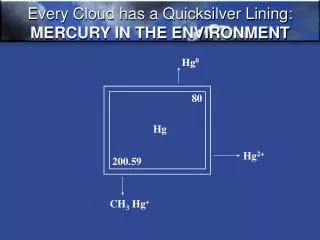
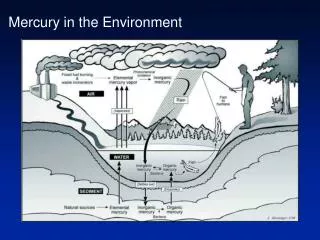
Mercury in the Environment. What is Mercury (Hg). Hg is a silvery, liquid metal at room temperature "heavy metals." Like water, Hg can evaporate and become airborne. Because it is an element, mercury does not break down into less toxic substances.

Mercury in the Environment
E N D
Presentation Transcript
What is Mercury (Hg) • Hg is a silvery, liquid metal at room temperature • "heavy metals." • Like water, Hg can evaporate and become airborne. • Because it is an element, mercury does not break down into less toxic substances. • Once mercury escapes to the environment, it circulates in and out of the atmosphere until it ends up in the bottoms of lakes and oceans.
Where Does Mercury Come From? • Mercury is a naturally occurring element. • Mercury ore - cinnabar - is mined • History of SJ
Mercury enters the environment from: • Natural sources such as volcanoes and the weathering of rocks; • Our intentional uses of mercury; • Our unintentional releases of mercury from burning fossil fuels and smelting metals. • CFL • E-waste
Bioaccumulation = an increase in the concentration of a chemical in an organism over time, compared to the chemical's concentration in the environment. • Occurs naturally • And necessary for certain minerals and macromolecules • Problematic when bioaccumulate toxins
Bioaccumulation of Hg • Hg enteres food chain via anaerobic bacteria (SRBs) • Why does Tuna have such high [Hg]?
Basic Chemistry of Hg Hg(II) (s) Hgo (g) Air deposition volatilization Water reduction Hg(II) Hgo (aq) Hgo (l) oxidation dissolution Natural concentrations: 5 to 100 pM (1 – 20 ng /L) ng/L = ppt; µg/L = ppb; mg/L = ppm
Oxidation-Reduction Reactions reduction Hg(II) Hgo (aq) • Done by bacteria oxidation Hgo (aq) Hg(II) • Limited in freshwater (since not many molecules to bond with)
Hg(II) (s) Hgo (g) Air Water reduction Hg(II) Hgo (aq) oxidation Versions of Hg (II): Hg2+, HgCl2o, Hg(OH)2o, Hg(SH)2o, HgS(SH)-, CH3Hg(SH)o Natural concentrations: 5 to 100 pM (1 – 20 ng /L)
Sulfide and Methyl Mercury SO42- HgS(HS)- Hg(HS)2 Hg(Sn)HS- reduction MeHg SRB Hgo (aq) Hg(II) oxidation H2S, HS- (these by-products perpetuate methylation, since they cycle back into the rxn) SRB = Sulfide reducing Bacteria
Guadalupe River Watershed River system low [methylated] Hg since low [SRB] Bay has highest [methylated Hg] since high [SRB]
San Francisco Bay, ‘Stinky Mud’ Salt H2O has 1000x more sulfate than fresh H2O
Sulfide Complexes of Hg Hg(SH)2o HgS(SH)- Hg(Sn)SH- Hg2+ + HS-
Methyl Mercury (MeHg) SRB Hg(HS)2 HgS(HS)- MeHg More toxic Less toxic MeHg = CH3HgS- CH3HgCl CH3HgOH
Interaction with Solids Hg(II) (s) Hgo (g) Air deposition volatilization Water reduction Hg(II) Hgo (aq) Hgo (l) oxidation Dissolution/precipitation HgS (mined mercury) Sediment (solid)